What Ibogaine Is
A plant alkaloid, isolated in Paris in 1901, sold in France for decades and banned in America since 1970. What it is and how it got here.
Ibogaine is a single molecule, one of around thirty alkaloids in the root bark of Tabernanthe iboga, a Central African shrub. It was isolated in Paris in 1901 and sold in France as a stimulant for decades. No regulator anywhere has approved it, and it prolongs the QT interval of the heartbeat, which is what kills people.
Most pages that answer this question answer a different one, and describe what ibogaine is for. This one is about what it is, and how a Central African root became a molecule with a patent history and a place in American federal statute.
The molecule
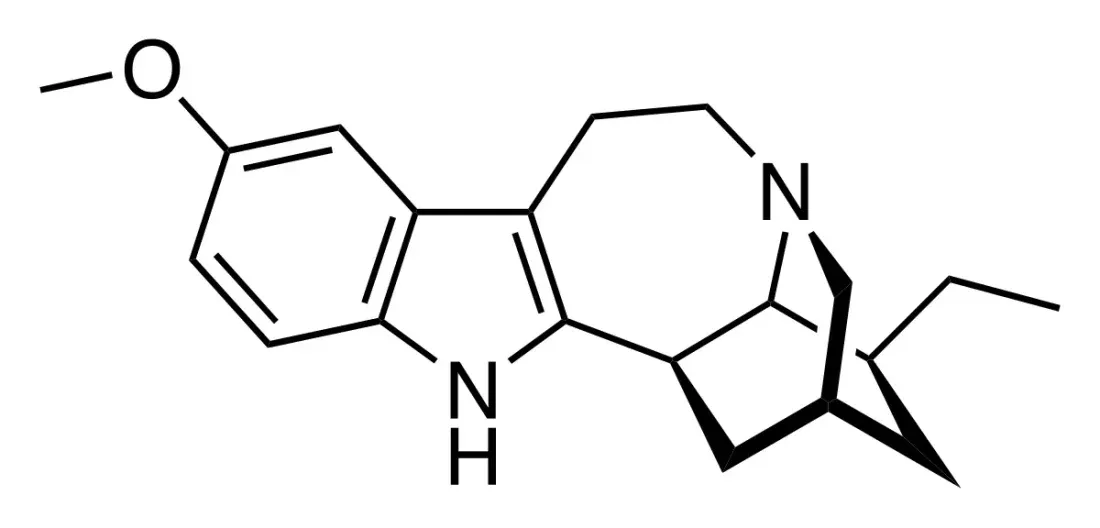
Ibogaine is C₂₀H₂₆N₂O, molecular weight 310.4, CAS registry number 83-74-9. It is an indole alkaloid, in the same broad chemical family as serotonin, LSD and strychnine, though relatedness in that family predicts very little.
It occurs naturally in the root bark of Tabernanthe iboga, where it is the most abundant of around thirty alkaloids. The plant has a page of its own, and the distinction between the two matters enough that so does the difference.
Two things about the molecule decide almost everything else on this site.
It is converted in the body to something longer-lived. A single liver enzyme turns ibogaine into noribogaine, which is active in its own right, blocks the cardiac channel slightly harder, and is still present days after the experience has ended.
It blocks the hERG potassium channel. That is the mechanism behind the QT prolongation and the deaths, and it is the best-established fact about this compound. Ibogaine and the heart sets out what follows from it.

Two teams, two names, one year
The word ibogaine was coined in Paris in 1901, in a note to the Académie des sciences by Dybowski and Landrin, who described a new alkaloid in the iboga root and the excitant properties they attributed to it.
Weeks later, in the same volume, Haller and Heckel described the active principle of the same root and called it ibogine, assigning the plant to a different genus. A third note followed from Lambert and Heckel, and the volume’s index records Dybowski and Landrin asking the Académie to open a sealed envelope establishing their precedence.
So the tidy sentence that ibogaine was isolated in 1901 conceals a dispute about what to call it, which plant it came from, and who got there first. The chemistry in the earliest paper was wrong.
None of this is the discovery of iboga. The plant had been in use in Central Africa for a long time before a French chemist reduced it to a powder, and the Bwiti religion is the context that use belongs to.
What happened in 1901 is that one compound was separated from the others and given a European name. That is a real event with a real date, and it is not the beginning of the story.
The French tablet
For much of the twentieth century, ibogaine’s main appearance in Europe was commercial rather than scientific.
A product called Lambarène, made from an iboga extract, was sold in France from the late 1930s. It was marketed not as a psychoactive but as a stimulant against fatigue, taken a few tablets a day. Accounts place its withdrawal from the market in the 1960s.
Almost everything else about it is uncertain, and the uncertainty is worth stating rather than papering over. Two peer-reviewed sources give two different figures for how much ibogaine a tablet contained, five milligrams and eight, and both trace back to the same secondary account from 1993. The advertisement that would settle it sits in an advertising annexe that has not been digitised. And the French medicines agency is reported to have said these products carried only a commercialisation permit rather than a marketing authorisation, which is why no adverse-event file survives.
We repeat none of those numbers as settled. What is documented is that a compound now in Schedule I was sold across the counter in a European country for roughly thirty years, against tiredness.
The claim that changed everything
In 1962 a nineteen-year-old in New York named Howard Lotsof took ibogaine recreationally, was dependent on heroin at the time, and reported afterwards that his withdrawal symptoms and his craving had gone. He extended the observation to a handful of friends.
That anecdote is the origin of everything this site covers. It entered the formal record twenty years later, not as a paper but as a patent.
| Patent | For | Granted |
|---|---|---|
| US 4,499,096 | Narcotic addiction | 1985 |
| US 4,587,243 | Cocaine and amphetamine | 1986 |
| US 4,857,523 | Alcohol | 1989 |
| US 5,026,697 | Nicotine and tobacco | 1991 |
| US 5,152,994 | Poly-drug dependency | 1992 |
| US 5,591,738 | Chemical dependency, beta-carbolines | 1997 |
The 1985 patent asserts that treatments were effective in 71 per cent of cases, and the 1986 one claims 100 per cent for cocaine. These are assertions in a commercial filing, not trial results, and no trial stood behind them.
Its entire list of references cited is a single line: an entry in the Merck Index.
That is how the modern ibogaine claim entered the documentary record, and it is worth knowing when you meet a percentage on a clinic website. The evidence that exists now is thin, but it is not this.
Lotsof’s patents passed out of his hands in 1998 through a writ of execution against his company, and ended up in other hands. The last of them expired years ago.
How America controlled it
The usual telling is that the FDA banned ibogaine in 1967. That is wrong twice over, and the real sequence is more interesting.
1967, and it was not a ban. The Food and Drug Administration listed ibogaine as a depressant or stimulant drug under the Food, Drug, and Cosmetic Act, on the ground of its hallucinogenic effect, alongside bufotenine and DET. That brought registration and distribution controls. The order took effect on 22 November 1967.
1970, and it was Congress. Prohibition came with the Controlled Substances Act, and it did not come from an agency. Ibogaine is named in the text of the statute itself, at entry (8) of Schedule I, four places after DMT and immediately before LSD. Congress adopted the list wholesale rather than assessing ibogaine on its own merits.
The order of those events matters. Ibogaine was not prohibited because it was found dangerous. Nobody had examined the anti-addictive claim and nobody understood the cardiac mechanism. It was found dangerous later, and that later finding is now used to justify the earlier decision.
Nowhere in the UN conventions
One fact explains why national positions on ibogaine differ so wildly, and it is usually left out.
Ibogaine appears in neither the 1961 Single Convention on Narcotic Drugs nor the 1971 Convention on Psychotropic Substances. It is absent from both the Yellow List and the Green List that record what is under international control.
So there is no treaty obligation on any country to control it, and no treaty framework telling them how. Each has decided alone, and they have decided differently: prohibited in some, a prescription-only medicine in a few, unscheduled in others, and caught by general psychoactive-substances laws elsewhere. Where ibogaine is legal maps twenty-six of them.
Who takes it, and for what
The best count anyone has made is now old. A 2008 survey estimated that around 3,400 people had taken ibogaine by February 2006, a fourfold increase over five years, of whom 68 per cent had taken it for a substance-related disorder and 53 per cent specifically for opioid withdrawal.
Larger figures circulate. The most-quoted, that more than ten thousand people have sought treatment, comes from a narrative review rather than a count, and should never be reported as one.
The same survey described four distinct worlds around the drug: a medical model, lay providers and treatment guides, an activist and self-help network, and a religious or spiritual setting. Those four still describe the field, and a claim made in one of them frequently gets quoted as though it came from another.
What it is not
Three things this molecule is routinely called, and is not.
Not an approved medicine, anywhere. It has no marketing authorisation in any jurisdiction. Where treatment happens legally, it happens through prescription routes for unapproved products, or in countries where nothing prohibits it.
Not a proven treatment. No randomised controlled trial has published drug-use outcomes. Two finished in 2024 and neither has reported.
Not understood. Several mechanisms are proposed for the anti-addictive effect and none has been confirmed in a person. The one mechanism that is worked out explains the harm.
That last asymmetry is the honest summary of this compound. We know precisely how it can stop a heart, and we do not know how it is supposed to help.
Common questions
Sources
5 sources · How we source