18-MC: The Analogue Built to Drop the Cardiac Risk
A synthetic iboga alkaloid designed to keep the anti-addictive effect and lose the heart risk and the visions. What it has and has not shown.

18-MC is a synthetic relative of ibogaine, designed to keep the anti-addictive effect while dropping the cardiac danger and the visions. On the cardiac question the laboratory evidence is striking: it blocks the channel implicated in ibogaine deaths more than fourteen times less potently. Whether it works in people has never been established.
Ibogaine has an obvious problem. Whatever it does that people want, it also blocks a cardiac ion channel at concentrations they actually reach, and that is what kills them.
The obvious response is to build something that keeps the first part and loses the second. That is what 18-MC is, and the interesting thing is how far it got.
What it is
18-methoxycoronaridine, built from coronaridine, another alkaloid of the iboga family. It is fully synthetic, so no plant is uprooted to make it, and it was designed rather than found.
Two properties were the design target. Drop the cardiac liability. Drop the hallucinogenic experience, which makes treatment expensive, long and unpleasant, and which restricts it to a supervised setting.
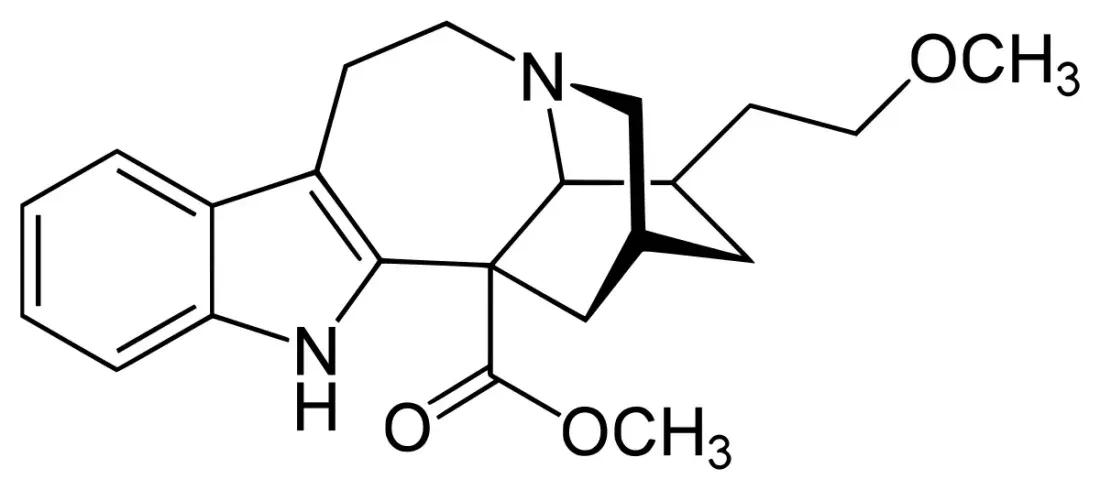

On the heart, it delivers
This is the strongest result in the 18-MC literature and it is not close.
Ibogaine, noribogaine and 18-MC were tested against the same hERG potassium channel in the same experiments.
| Compound | Concentration blocking half the channels |
|---|---|
| Voacangine | 2.25 µM |
| Noribogaine | 2.86 µM |
| Ibogaine, plant-extracted | 3.53 µM |
| Ibogaine, semi-synthetic | 4.09 µM |
| 18-MC | above 50 µM |
Human blood concentrations after ordinary ibogaine doses peak around five micromolar. So ibogaine sits squarely in its own blocking range and 18-MC sits an order of magnitude outside it.
18-MC binds the channel with an affinity in the same range as the others. What it does not do is block it.
Binding and blocking coming apart like that is exactly what a designed molecule is trying to achieve, and it is evidence that the cardiac liability is separable from the rest of the pharmacology rather than intrinsic to the scaffold. That is the finding that makes the whole analogue programme worth pursuing.
On the mechanism, it complicates things
The most repeated explanation for ibogaine’s lasting effect involves a growth factor, GDNF, raised in rodent midbrain. If that is the mechanism, an analogue should reproduce it.
18-MC does not. In a study comparing the three compounds, noribogaine raised GDNF and reduced alcohol self-administration when infused into the relevant brain region, as ibogaine does. 18-MC did neither.
That cuts two ways and both are worth stating. Either the GDNF route is not essential, and 18-MC works through something else — most likely the nicotinic receptor pathway that the medicinal-chemistry programme around it is built on. Or the GDNF route matters and 18-MC will not reproduce ibogaine’s effect in people.
Nobody has run the experiment that would separate those. How ibogaine works sets out why the mechanism question is still open.
What it has not shown
No published trial establishes that 18-MC treats anything in a human being.
The animal literature is real and reasonably extensive. The human literature is the gap, and it now has an ending.
A phase 1 study of 108 people completed in December 2021. No results have been posted. In the third quarter of 2022 the company developing it stated, in its annual report, that following regulator feedback about what a phase 2 would require, any further clinical development would be subject to finding non-dilutive capital and third-party collaborations. Spending on the programme fell eighty per cent in a year. Elsewhere the same company describes it as paused, then as suspended.
Since 2023 it has not mentioned 18-MC, or ibogaine, in an annual report at all. The company has since renamed itself and its pipeline is two unrelated compounds.
So no efficacy result in people has been published for any indication, and the organisation best placed to produce one has stopped. Who is developing ibogaine sets out the wider commercial picture.
It is easy to read the hERG table above as good news and stop there. The table says one thing only: 18-MC is far less likely to prolong the QT interval than ibogaine is.
It says nothing about whether it helps anyone. On that question ibogaine has uncontrolled case series and two unreported randomised trials, which is thin. 18-MC has less.
The wider programme
18-MC is the best-known member of a family. Several academic groups are pursuing compounds built around the iboga scaffold, with the same goal of keeping the therapeutic effect while dropping the cardiac risk, the hallucinogenic experience, or both.
One of them, described in Nature in 2021, reduced alcohol- and heroin-seeking in rodents without the hallucinogenic signature. Its authors’ own framing of why the programme exists is worth quoting plainly: ibogaine’s toxicity, hallucinogenic potential and tendency to induce cardiac arrhythmias have hindered its clinical development. The paper’s senior author is president and chief scientific officer of the company that licensed the technology, which the paper discloses.
Why this page matters to someone considering ibogaine
Not because 18-MC is an option. It is not available and nothing establishes that it works.
It matters because of what the programme’s existence says. The people who know this pharmacology best looked at ibogaine, concluded the cardiac risk was the thing to engineer away, and spent decades trying. That is a considered judgement about where the danger lies, made by the field itself, and it agrees with what the fatality record shows.
If any compound from this family becomes a medicine, there is a reasonable chance it will not be ibogaine.
Common questions
Sources
4 sources · How we source
- hERG Blockade by Iboga Alkaloids
- Noribogaine, but not 18-MC, exhibits similar actions as ibogaine on GDNF expression and ethanol self-administration
- What We Have Gained from Ibogaine: alpha3beta4 Nicotinic Acetylcholine Receptor Inhibitors as Treatments for Substance Use Disorders
- A Non-Hallucinogenic Psychedelic Analog with Therapeutic Potential