CYP2D6: Why Response Varies Between People
One enzyme does almost all the clearance, its activity varies enormously between people, and almost nobody measures it before dosing by weight.
One liver enzyme performs more than ninety-five per cent of ibogaine’s clearance, and its activity varies enormously between people on genetic grounds. Clearance across that range differs more than tenfold at an identical dose per kilogram. Weight is not what determines how much drug reaches you. Genotype is, and almost nobody measures it.
If one fact explains why two people given the same dose have completely different nights, it is this one. It is also the best argument that dosing by body weight is precision applied to the wrong quantity.
One enzyme does nearly all of it
Work in human liver preparations established that CYP2D6 catalyses the conversion of ibogaine into its active metabolite, and that the high-affinity component of that reaction accounts for more than ninety-five per cent of total intrinsic clearance.
Preparations from a donor lacking functional enzyme showed only the low-affinity component. So this is not one route among several. It is the route.
Noribogaine covers the metabolite that results, which is active in its own right and persists for days.
How much people differ
The measurement that matters was made in fourteen patients, all given the same 10 mg per kilogram, all genotyped.
Clearance was estimated at 0.82 litres per hour at an activity score of zero, and increased by 30.7 litres per hour for each point of score.
The authors describe the span as more than tenfold across the range of activity scores, and conclude that genotype-based dosing should be performed to ensure equal exposure.
Their fitted equation, applied across the full activity range, implies a ratio considerably larger than tenfold.
We report their figure, which is the citable one, and note that the larger number is our arithmetic from their published parameters rather than a claim they make. Their words are “more than a 10-fold difference”, which is literally true and understates what their own model produces.
Even within that single fixed dose, the observed spread was substantial: the metabolite’s exposure varied roughly twofold between the first and third quartiles of the same fourteen patients.
Why milligrams per kilogram does not fix it
Dosing by body weight controls for one source of variation and this is not it.
Body mass in adults varies perhaps twofold. Clearance through this enzyme varies by an order of magnitude or more. A dose calculated to two decimal places from someone’s weight is answering a question that is not the one that matters.
That is worth holding when a provider describes a careful weight-based calculation. The care is real and it is directed at the smaller variable.
What inhibits it, and by how much
This has been measured directly in humans.
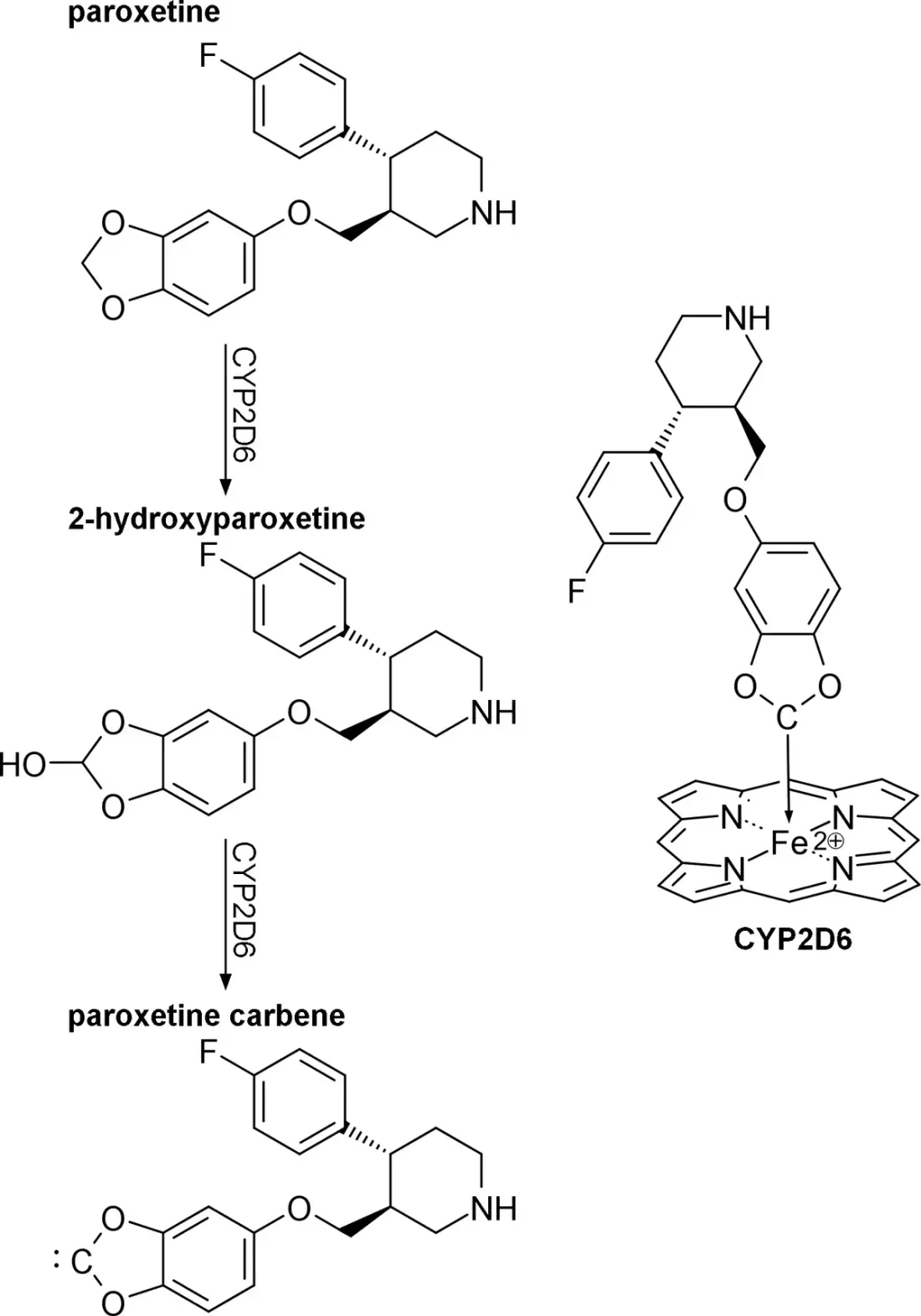
In 21 healthy volunteers pretreated for six days with paroxetine or placebo, genotype correlated strongly with exposure, and exposure to ibogaine plus its metabolite was about twice as high after paroxetine.
The authors’ conclusion is the practical one: it may be prudent to genotype patients awaiting ibogaine treatment, and to at least halve the intended dose in poor metabolisers.
Two caveats keep that honest. The dose studied was 20 mg, a small fraction of a treatment dose. And there was no cardiac endpoint, so it establishes that exposure doubles rather than what doubled exposure does to a heart.
Several drugs inhibit the enzyme according to their own approved labels: fluoxetine, described as potent; paroxetine, whose inhibition is irreversible and outlasts the last dose; bupropion, through long-lived metabolites; duloxetine; and sertraline. Ibogaine drug interactions sets out the full picture, including which drugs are not this problem.

Why it connects to the heart
The same fourteen-patient study made the link explicit.
QT prolongation was best described by a model driven by ibogaine concentration. The metabolite did not correlate with it. And neither correlated with the severity of withdrawal symptoms.
So the enzyme controls the parent compound’s concentration, and the parent compound’s concentration drives the cardiac effect. That is the chain, measured end to end in humans, and it is the strongest reason genotype is not an academic detail.
A 2026 review in Addiction recommends that treatment be conducted exclusively under controlled medical supervision, with CYP2D6 genotyping and rigorous cardiovascular monitoring. Read the body of the same paper and the wording softens to calling genotyping commendable. We report both, because the gap between an abstract and its own body text is worth noticing.
What this means before a treatment
Genotyping is a cheek swab. It is the single measurement that most changes how much drug a given dose delivers, its result would change the dose according to the people who studied it, and one registered trial requires a favourable genotype for entry.
Almost no clinic does it. When one describes careful individualised dosing, this is the question that tests whether that is true. Pre-treatment screening covers the rest of what is and is not measured.
Common questions
Sources
4 sources · How we source
- Cytochrome P4502D6 catalyzes the O-demethylation of the psychoactive alkaloid ibogaine to 12-hydroxyibogamine
- Influence of CYP2D6 activity on the pharmacokinetics and pharmacodynamics of a single 20 mg dose of ibogaine in healthy volunteers
- The pharmacokinetics and pharmacodynamics of ibogaine in opioid use disorder patients
- Rare but relevant: Ibogaine and cardiovascular complications