Noribogaine: The Metabolite That Outlasts the Drug
Ibogaine is converted to noribogaine by an enzyme whose activity varies widely. The metabolite lasts far longer, and blocks the cardiac channel harder.

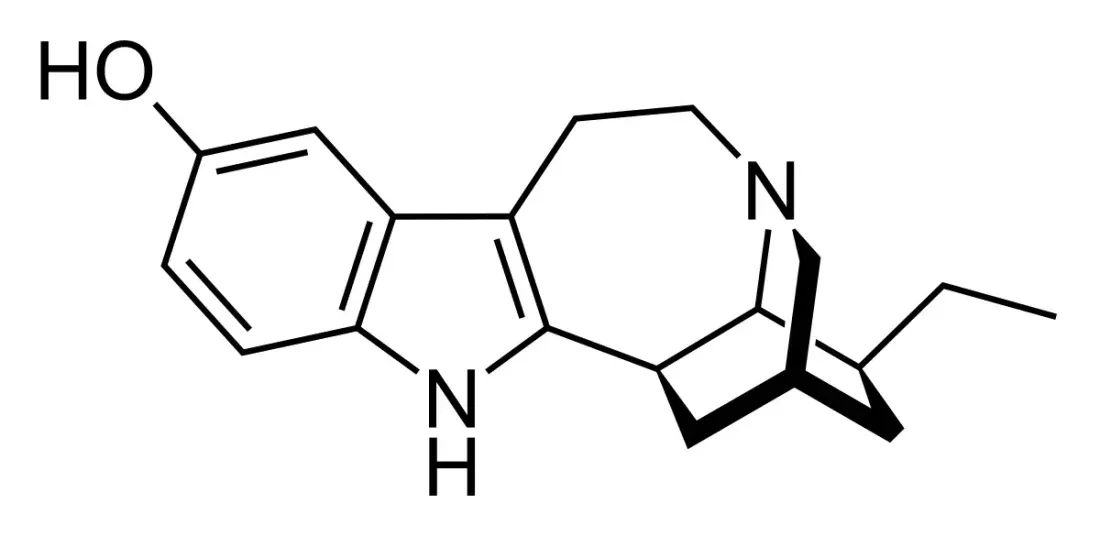
Noribogaine is what the body turns ibogaine into, through the liver enzyme CYP2D6. It is active in its own right and it lasts far longer, with a half-life of roughly one to two days against a few hours for the parent drug. It blocks the cardiac channel implicated in ibogaine deaths slightly more potently than ibogaine does.
Anyone reading about ibogaine for long enough meets a second name. It matters more than it looks, because most of the time a person spends with this drug in their body, the drug is no longer ibogaine.
What the conversion is, and who does it
Ibogaine loses a methyl group in the liver and becomes noribogaine. The enzyme responsible was identified in human liver tissue in 1998, and the finding was unusually clean: a single enzyme, CYP2D6, accounted for more than 95 per cent of the clearance.
The same study included tissue from a donor who was a poor metaboliser. That sample had only the slow, low-affinity route. The genetic variation was visible in the chemistry before anyone had given the drug to a patient.
The plant does the same reaction backwards
Calling noribogaine a metabolite is correct about people and incomplete about the molecule, because the compound exists before anyone swallows anything.
In 2018 a group at the John Innes Centre sequenced the iboga transcriptome and identified the last two steps of ibogaine biosynthesis in the plant. They named the enzymes ibogamine 10-hydroxylase and noribogaine 10-O-methyltransferase, and confirmed both by expressing them in yeast and in E. coli. The pathway they describe runs:
ibogamine → noribogaine → ibogaine
The plant builds ibogamine first, hydroxylates it at position 10 to give noribogaine, then methylates that oxygen to finish ibogaine. Noribogaine is the last intermediate before the end product.
Now put that beside the liver. CYP2D6 takes ibogaine and removes the same methyl group from the same oxygen. The final step of the plant’s synthesis and the first step of human metabolism are the same bond, run in opposite directions. The plant spends its last enzymatic act making ibogaine out of noribogaine, and the body’s first act is to undo it.
One limit on how far to take this. Being an intermediate on a pathway is not the same as accumulating in the tissue, and no published analysis of root bark reports free noribogaine as a measurable constituent. The compound in the plant is transient. What you would buy is still ibogaine, and what circulates in you for the next three days is still a metabolite. The pathway explains why the two molecules are one methyl group apart, which is not an accident of pharmacology but the plant’s own last step.
The other alkaloids of iboga covers ibogamine, which this pathway makes the parent of everything else here.
CYP2D6 is among the most variable enzymes in human genetics. People are grouped as poor, intermediate, extensive or ultra-rapid metabolisers, and the groups differ several-fold in how fast they clear the drugs that depend on it. When a single variable enzyme performs nearly all of the conversion, the dose written on the chart and the dose the body experiences come apart.

How much apart
Two human studies put numbers on it.
In twenty-one healthy volunteers, half were pre-treated for six days with a drug that blocks CYP2D6 before receiving 20 mg of ibogaine. Enzyme activity correlated strongly with exposure to ibogaine, and blocking it roughly doubled exposure to the active compounds. The authors’ recommendation was explicit: genotype people before treatment, and at least halve the intended dose in poor metabolisers.
That study used a chemical stand-in for the genotype and a dose one twenty-fifth of a treatment dose. The second study did neither.
Fourteen patients with opioid use disorder were given a real 10 mg/kg treatment dose in a Dutch hospital and genotyped. Clearance of ibogaine rose by about 30 litres per hour for each point of CYP2D6 activity score, from a baseline near zero at score zero. That is not a modest gradient. It is the difference between clearing the drug and barely clearing it at all.
The half-life is the whole point
| Ibogaine | Noribogaine | |
|---|---|---|
| Time to peak | under an hour in the hospital series | 6 to 10 hours |
| Half-life | a few hours, longer when the enzyme is blocked | roughly 24 to 49 hours |
Those noribogaine half-lives come from two studies in which it was given directly, to healthy volunteers and to opioid-dependent patients.
The parent drug is gone within a day. The metabolite is still there two or three days later. Its peak concentration is lower than ibogaine’s, roughly a third, but because it persists so much longer the total exposure over time is comparable.
This is why the acute experience ending is not the same as the drug leaving, and it is the pharmacological basis for the observation that people are discharged from clinics while still carrying an active compound.
Noribogaine and the heart
The cardiac question is where the metabolite stops being a footnote.
Ibogaine and noribogaine were tested against the hERG potassium channel, the channel whose blockade prolongs the QT interval and causes torsade de pointes, in the same set of experiments.
| Compound | Concentration blocking half the channels |
|---|---|
| Noribogaine | 2.86 µM |
| Ibogaine, extracted from the plant | 3.53 µM |
| Ibogaine, made semi-synthetically | 4.09 µM |
| 18-MC | above 50 µM |
Two things follow.
The metabolite is the slightly more potent blocker. Not dramatically, but the direction is the opposite of what people assume when they hear the word “metabolite”. The authors of that study connect noribogaine’s long half-life to clinical observations of QT prolongation persisting for days after ingestion, and that connection is the most economical explanation available.
Plant-extracted and semi-synthetic ibogaine performed the same. The difference between those two numbers is smaller than the spread within either. Anyone claiming that naturally sourced ibogaine is cardiologically different is not describing this measurement. Where ibogaine actually comes from covers the sourcing question on its own terms.
Given on its own, it did not work
Noribogaine has been given directly to people, which spares us having to reason from the parent drug.
Twenty-seven opioid-dependent patients received 60, 120 or 180 mg of noribogaine, or placebo, in a randomised double-blind ascending-dose safety study. The result has two halves and both matter.
The QT signal was dose-dependent and linear with concentration, at about 0.17 milliseconds per nanogram per millilitre, giving mean prolongations of roughly 16, 28 and 42 milliseconds across the three dose levels.
On withdrawal, the paper reports a trend toward lower scores that did not reach statistical significance.
This is the only randomised, double-blind, placebo-controlled study of any iboga alkaloid in opioid-dependent people. It was designed as a safety study and it is small, at twenty-seven participants across four groups. It cannot rule out an effect.
What it does not do is provide the positive controlled result that is routinely implied to exist. It found a clear dose-dependent cardiac signal and no significant relief of withdrawal. What the trials found sets out the rest of that record.
The awkward finding for the metabolite hypothesis
A common argument runs that noribogaine carries the lasting benefit, since it is the compound still present when people report feeling different days later.
One measurement makes that harder. Ibogaine’s highest-affinity target in the whole screened set is the sigma-2 receptor, which it binds at about 201 nanomolar. Noribogaine binds the same site at about 5,226 nanomolar, a loss of roughly twenty-six-fold.
Whatever the metabolite is doing, it is not doing that.
And the one human study to test concentration against outcome found the relationships pointing the wrong way for a simple story. Ibogaine concentrations correlated with QT prolongation and, strongly, with the loss of coordination. Noribogaine concentrations correlated with neither, which is why the authors conclude both effects are driven mainly by the parent compound. And neither compound correlated with the severity of opioid withdrawal.
The compound that tracked the harms was the parent. Nothing tracked the benefit.
What this means in practice
Three consequences follow from the pharmacology, and none of them is controversial in the literature.
- Milligrams per kilogram is not a dose. Two people of the same weight given the same amount can differ several-fold in exposure, and the variable that decides it is rarely measured. Both research groups above recommend genotyping.
- The monitoring window is longer than the experience. The compound associated with persistent QT prolongation peaks late and clears slowly. Ibogaine and the heart covers what that means for how long someone should be watched.
- Interacting drugs matter more than usual. Anything that inhibits CYP2D6 pushes a person toward the poor-metaboliser end, and a great many common psychiatric medicines do exactly that.
This site publishes no dosing guidance and never will. The point of this page is narrower: the number on a clinic’s protocol describes the tablet, not the person.
Common questions
Sources
6 sources · How we source
- Cytochrome P450 and O-methyltransferase catalyze the final steps in the biosynthesis of the anti-addictive alkaloid ibogaine from Tabernanthe iboga
- Cytochrome P4502D6 catalyzes the O-demethylation of the psychoactive alkaloid ibogaine to 12-hydroxyibogamine
- The pharmacokinetics and pharmacodynamics of ibogaine in opioid use disorder patients
- hERG Blockade by Iboga Alkaloids
- Ascending Single-Dose, Double-Blind, Placebo-Controlled Safety Study of Noribogaine in Opioid-Dependent Patients
- Influence of CYP2D6 activity on the pharmacokinetics and pharmacodynamics of a single 20 mg dose of ibogaine in healthy volunteers