Ibogaine comes from three places, not one. Iboga root bark contains it directly. The commercially available semi-synthetic material is made from voacangine in the bark of Voacanga africana, a different African tree. And it has been synthesised from scratch since 1966. Nobody has published what share each route represents.
The conservation argument about iboga usually assumes that demand for ibogaine translates directly into pressure on Gabonese roots. That assumption is at least partly wrong, and the correction has been available since the 1950s.
The Voacanga route
Voacanga africana is a tree of West and Central Africa whose bark contains voacangine, an alkaloid one chemical step away from ibogaine. Hydrolysing the methyl ester and decarboxylating what remains gives ibogaine.
The chemistry is not new. A patent granted in November 1957 sets out the process, and states the reason for preferring it in terms that could have been written by a conservationist today: gathering bark is much easier than gathering roots, and unlike root harvest it does not destroy the plant.
Peer-reviewed work describes Voacanga africana root and stem bark as the primary sources of commercially available semisynthetic ibogaine. That qualifier matters, and we keep it.
The reason is arithmetic rather than preference. A 2021 process paper working through half a kilogram of Voacanga africana root bark isolated voacangine at about 0.8 per cent of dry weight, and found the bark’s major alkaloids to be dimers containing the voacangine unit at around 3.7 per cent, which cleaving releases at about forty per cent molar yield and nearly doubles the total recovered. The same paper describes direct isolation from Tabernanthe iboga as low yielding.
So the industry did not choose the tree that is not iboga for ethical reasons. It chose the one that gives more alkaloid per kilogram of bark, from a plant that survives the harvest.
No peer-reviewed study, government report or survey quantifies what share of world ibogaine supply is voacangine-derived. Anyone telling you most ibogaine is semi-synthetic, or that most is extracted from iboga, is going beyond the evidence in one direction or the other.
There is a trap here worth naming. Voacanga africana seeds are exported by the hundreds of tonnes from West Africa, and that trade is regularly cited as evidence of an industrial ibogaine supply. It is not. The seeds are harvested for tabersonine, which is converted into vincamine and its derivatives for cerebrovascular medicines. Voacangine is in the bark, not the seeds.
PROTA notes separately that Voacanga africana is rapidly becoming endangered, though the driver it identifies is the seed trade rather than bark harvest: fruits stripped and trees felled to reach them. The tree is under pressure, and the pressure is not coming from ibogaine.

What Voacanga africana actually is
The tree does not exist to supply ibogaine, and understanding what it is on its own terms explains most of the confusion around it.
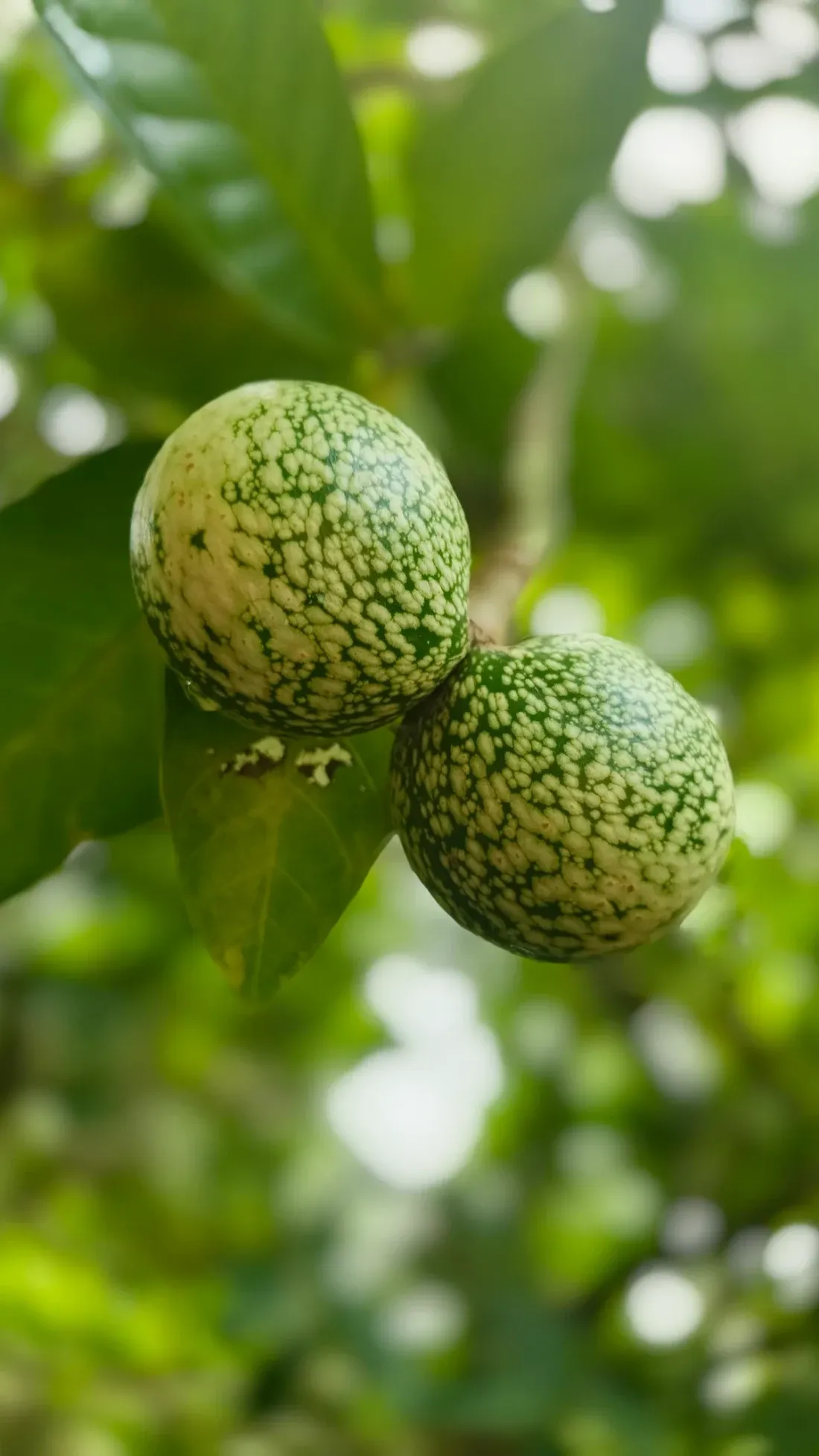
Voacanga africana is an evergreen shrub or small tree of tropical Africa, reaching about ten metres and occasionally more, in the Apocynaceae, the dogbane family. That family matters more than it sounds: it also contains Tabernanthe iboga, the genus Tabernaemontana, the Madagascar periwinkle, and Rauvolfia. Close botanical relatives with sharply different alkaloids is the recurring theme of this subject, and the powder sold as iboga that turned out to be Rauvolfia is what that resemblance costs when nobody checks.
Alkaloid content is not even across the plant, which is the single most misunderstood thing about it. Voacangine, the precursor that matters here, sits in the bark. The seeds carry tabersonine, a different alkaloid entirely, which is converted industrially into vincamine and its derivatives, used in cerebrovascular medicines.
The scale of that seed trade is easy to mistake for an ibogaine industry. About 1,600 tons of Voacanga seeds left Ghana and Côte d’Ivoire in 2009 alone, most of it destined for pharmaceutical manufacture that has nothing to do with ibogaine, with a remainder sold online as a traditional psychedelic. A tonnage figure about seeds tells you little about ibogaine supply, because the compound in question is in a different part of the tree.
The ceremonial psychedelic that was invented in 2007
Search for this plant and you will be told, in a dozen places, that it is “used in Ghana as a poison, stimulant, aphrodisiac, and ceremonial psychedelic”. That sentence has a traceable origin, and it is not Ghana.
An environmental historian followed it back. The claim entered Wikipedia in 2007, added by a businessman in Accra editing under the username MrGoodGuy, who attached to it a link to a website selling the seeds and kept restoring the link after a moderator removed it. The link eventually went. The sentence did not.
More than half of the ethnobotanical retailers now selling Voacanga seeds online either reproduce or paraphrase his wording. Drug-information sites took it up over the following years, and experience reports and forum posts about the tree rose sharply from 2007 through the 2010s, on a sample of forty-eight such reports.
The same historian went to the Akyem Traditional Area in Ghana in January 2017, where several companies said they sourced their seeds, and asked. Buyers come from Accra between June and August. Most people he spoke to knew only that foreign companies wanted the seeds for medicines. Many thought the tree had no local use at all; a few named hernias and parasites; a local priest described a sacred use connected with childbirth. One of the contracted seed buyers, who had bought two houses with the proceeds, was incredulous when the idea of a ceremonial psychedelic was put to him.
Two reasons, and neither is trivia.
The first is that the invented reputation sells seeds, and the people buying them are frequently people who have read about ibogaine and are looking for a legal route to something similar. Voacanga bark contains iboga-type alkaloids. What that does to a heart has not been characterised, and the cardiac mechanism that has killed people is a property of this alkaloid class, not of one species.
The second is method. A claim repeated by retailers, encyclopedias and drug-information sites for nearly twenty years turns out to rest on one edit by someone with something to sell. That is the same shape as most of what circulates about iboga itself, which is why this site reads sources back to their origin rather than counting how many places repeat them.
The literature repeats it too
The looseness is not confined to retailers. A 1997 paper in Brain Research Bulletin, still indexed and cited, opens by calling ibogaine “a natural alkaloid of Voacanga africana”.
Read strictly that is wrong, or at least unestablished: the alkaloid Voacanga reliably supplies is voacangine, and ibogaine is what voacangine becomes after a chemist works on it. The distinction is the whole subject of this page, and it disappears in a peer-reviewed sentence written by pharmacologists.
The sentence has since laundered itself. A 2023 paper in ACS Omega repeats that ibogaine has been isolated from Voacanga species, and the reference it gives for that statement is the 1997 paper. A loose phrase in one abstract becomes a cited fact in another, twenty-six years apart, with no new analysis in between.
We flag it not to correct a 1997 paper but because it shows how a shorthand becomes a fact. If the primary literature blurs the two plants, a retailer’s product page has no chance of keeping them apart.
Synthesis
Ibogaine has been made from scratch since 1966, when a total synthesis of the iboga alkaloids was published. What was missing was never the chemistry but the economics: yields were too low for the route to compete with a plant.
That is changing. A modular synthesis published in Nature Chemistry in 2025 reports a gram-scale route in seven steps from pyridine.
If that scales, the supply question stops being botanical. It also removes the last practical argument for wild harvest, and simultaneously removes the last economic reason for anyone to pay Gabon anything. Both things follow from the same fact, which is why benefit-sharing has to be settled before the chemistry settles it by default.
The Amazonian claim
A story circulates that ibogaine occurs in Amazonian Tabernaemontana species, usually T. undulata or T. sananho, and more recently that an undisclosed Brazilian species is a new source.
What the literature actually reports in those species is iboga-type alkaloids, principally coronaridine, voacangine and ibogamine. We could find no peer-reviewed analysis reporting ibogaine itself in either species.
The claim has nonetheless reached a peer-reviewed table, listing Tabernaemontana undulata as a natural source of ibogaine in a paper whose authors analysed no Tabernaemontana material at all. And the 2026 report of a secret Amazonian source names no species, cites no study, and describes a different compound.
Mexican and Central American Tabernaemontana species do contain measurable ibogaine, and have been proposed as alternatives to Voacanga. That is a real research direction. It is not a commercial supply, and it is not the Amazon.
Common questions
Sources
6 sources · How we source
- Derivatives of the ibogaine alkaloids, US Patent 2,813,873
- The Invention of Voacanga africana as a Ceremonial Psychedelic
- Voacanga africana Stapf, PROTA monograph
- Quantitative Evaluation of a Mexican and a Ghanaian Tabernaemontana Species as Alternatives to Voacanga africana for the Production of Antiaddictive Ibogan Type Alkaloids
- Efficient Access to the Iboga Skeleton, Optimized Procedure to Obtain Voacangine from Voacanga africana Root Bark
- Efficient and modular synthesis of ibogaine and related alkaloids
More in The plant

Ibogamine and the Other Alkaloids of Iboga
What is ibogamine, how does it differ from ibogaine, and what have analyses found in iboga bark and extracts? A sourced look at the evidence and its limits.
Growing Iboga from Seed
Germination is slow, irregular, and fails once the seed coat dries. What the botanical record says, and where iboga is already farmed.