Pre-Treatment Screening: The Tests That Matter
A resting ECG missed forty per cent of male carriers of the gene it exists to detect. Here is what screening can do, and what it cannot.

Screening before ibogaine is worth doing and it is not a clearance. In the study that characterised long QT syndrome, a resting ECG produced false negatives in forty per cent of male gene carriers. The American Heart Association states that monitoring the QT interval alone may be inadequate to predict the arrhythmia it is used to predict.
Most pages on this subject list tests. The list is the easy part. What matters is knowing what a normal result does and does not buy you.
What the published protocols actually did
Three academic protocols exist, and they disagree with each other.
The most detailed is a Dutch hospital study. Its exclusion criteria were a history of clinically significant cardiac disease including long QT syndrome, syncope or ECG abnormalities, with a QTc threshold of 450 milliseconds for men and 470 for women; serum potassium outside 3.5 to 5.0 millimoles per litre; severe liver or kidney dysfunction; and pregnancy. Participants could not take any QT-prolonging or CYP2D6-affecting medication, with methadone the single exception. Potassium, calcium and magnesium were all confirmed in range immediately before dosing.
| Dutch hospital study | Caribbean series | Veteran study | |
|---|---|---|---|
| QTc formula | Fridericia, measured by hand | not stated | not stated |
| QTc cut-off | 450 ms men, 470 ms women | long QT excluded; heart rate under 50 excluded | not stated |
| Electrolytes | K, Ca and Mg confirmed in range | labs “within normal limits” | “routine blood work” |
| CYP2D6 genotype | not required | measured, but not an eligibility gate | not measured |
| Echocardiography | none | none | none |
| Monitoring after dosing | at least 24 h | telemetry to 24 h | 12 to 16 h |
That last row is the one to carry away, and what emergency preparedness means follows it through.
The measurement is harder than it looks
Two things about the ECG itself are rarely mentioned and both change the answer.
Which formula. The heart rate correction matters. The American Heart Association’s own statement notes that the Bazett correction tends to produce overlong QTc values at faster heart rates, particularly above 85 beats per minute. Someone in opioid withdrawal is frequently above 85. The Dutch study used Fridericia, which is a different number from the same tracing.
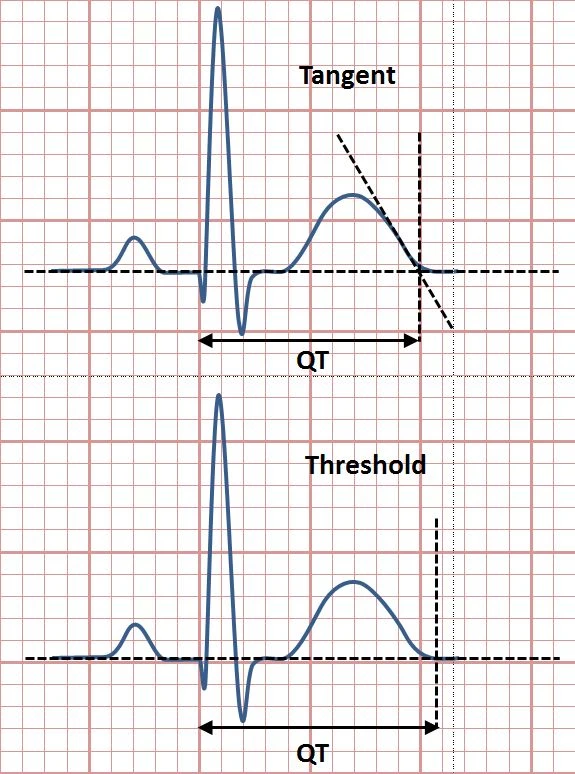
Which lead, and by whom. The recommended practice is to measure in a lead with a clear T-wave end, to use the same lead over time, and to document which one. Where the T-wave end is ambiguous, the tangent method is drawn from the steepest downslope.
In the Dutch study, two trained researchers measured every QT independently.
Their correlation was 0.64, and the average absolute difference between their measurements was 34 milliseconds.
That is in a university hospital, by people whose job it was. Thirty-four milliseconds is a third of the distance between a normal QTc and the threshold at which cardiologists act. A number read off a machine at a clinic, by somebody who cannot tell you which formula produced it, carries more uncertainty than that.

What screening cannot catch
This is the section that matters most, and it rests on four independent lines of evidence.
The test misses carriers. In the study that characterised the condition, carriers of the long QT gene and non-carriers overlapped in 126 of 199 subjects. Thresholds strict enough to be completely predictive produced false negative diagnoses in 40 per cent of males and 20 per cent of females.
The condition is not rare. A prospective study of 43,080 newborns found long QT syndrome in at least one in 2,534 apparently healthy live births, and the authors advanced the hypothesis that the true figure is closer to one in 2,000.
The authorities say the test does not do the job. The American Heart Association and American College of Cardiology state directly that monitoring the QT intervals alone may be inadequate to accurately predict torsades de pointes, and that establishing the end of a distorted QT interval is prone to inter-rater differences.
Common variants reduce the margin without showing up. One polymorphism is carried by 10 to 15 per cent of black Africans and confers susceptibility to drug-induced arrhythmia; another is present in 3 to 5 per cent of African Americans. Neither produces a baseline abnormality. Nothing on a screening panel detects them.
And a genetic test is not a clearance either. The newborn study includes one genotype-negative infant diagnosed with long QT syndrome on clinical grounds.
A man received a 200 mg test dose, a fraction of a treatment dose. One hour later he developed polymorphic ventricular tachycardia and cardiac arrest, was defibrillated, and arrested three more times over the following days.
His sodium, magnesium, potassium and calcium were all normal. He had no structural heart disease.
Nothing on any screening panel would have flagged him.
Electrolytes, and the numbers that matter
The screening threshold and the treatment threshold are different, and both are worth knowing.
For eligibility, the Dutch protocol required potassium between 3.5 and 5.0 millimoles per litre, with calcium and magnesium confirmed in range.
For a patient already at risk, the cardiology guidance is to maintain normal potassium and magnesium aggressively, and notes that repletion to supratherapeutic levels of 4.5 to 5 may be considered, while flagging that the evidence for that practice is thin.
Why it matters here specifically: in every ibogaine fatality where potassium was measured it was low, in one case as low as 2 millimoles per litre, and magnesium was low in half of them. Against a background rate of hypokalaemia around 20 per cent in hospital patients, an observed incidence of 100 per cent in this series is striking.
Vomiting is a near-universal effect of ibogaine, and vomiting removes potassium. The side effects covers that loop.
The measurement almost nobody takes
Ibogaine is cleared almost entirely by one enzyme, and clearance across the range of that enzyme’s activity spans roughly thirty-seven fold. Two people of the same weight given the same milligrams per kilogram are not receiving the same exposure.
A 2026 review recommends that treatment be conducted with CYP2D6 genotyping and rigorous cardiovascular monitoring. Read the body of the same paper and the wording softens to calling genotyping “commendable”. We report both, because the gap between an abstract and its own body text is the kind of thing this site exists to notice.
Ibogaine drug interactions sets out which medicines inhibit that enzyme.
Two honest blanks
Echocardiography. No published ibogaine protocol used it. A search of the literature for the two together returns nothing. If a provider offers one they are going beyond every study ever published, which may be sensible; if they present it as standard practice, it is not.
Pregnancy. There are no human data at all. Two of the three protocols exclude pregnancy without citing any evidence, which is a reasonable default and not a finding. The only developmental data come from zebrafish, where ibogaine produced early bradycardia at low concentrations and pericardial oedema at higher ones. That is a fish, and we report it as one.
What to do with this
Screening is worth doing. It removes the people with findings, and findings are common in this population.
What it cannot do is tell you that you are safe, and the difference between those two sentences is where people die. Ibogaine and the heart sets out the mechanism, and who should never take ibogaine covers the conditions that screening is meant to find.
Common questions
Sources
5 sources · How we source
- Safety of ibogaine administration in detoxification of opioid-dependent individuals
- Prevention of torsade de pointes in hospital settings: a scientific statement from the American Heart Association and the American College of Cardiology Foundation
- The spectrum of symptoms and QT intervals in carriers of the gene for the long-QT syndrome
- Prevalence of the congenital long-QT syndrome
- Multiple Episodes of Cardiac Arrest Induced by Treatment With Ibogaine: A Case Report