Ibogaine vs Ayahuasca
One contains a monoamine oxidase inhibitor and one blocks a cardiac channel. That single difference decides almost everything else about them.
Ayahuasca contains a monoamine oxidase inhibitor, so its serious danger is serotonin toxicity when it meets an antidepressant. Ibogaine does not, and its serious danger is the heart. For addiction the ayahuasca evidence is thinner than the ibogaine evidence: no randomised trial exists, none is registered, and the whole clinical literature is twelve people at one retreat.
People arrive at this comparison having been told the two are versions of the same thing, a plant medicine from a traditional culture that resets something. Pharmacologically they have almost nothing in common, and the differences run in both directions.
The one difference that generates the others
Ayahuasca is not a drug. It is two plants combined for a specific chemical reason.
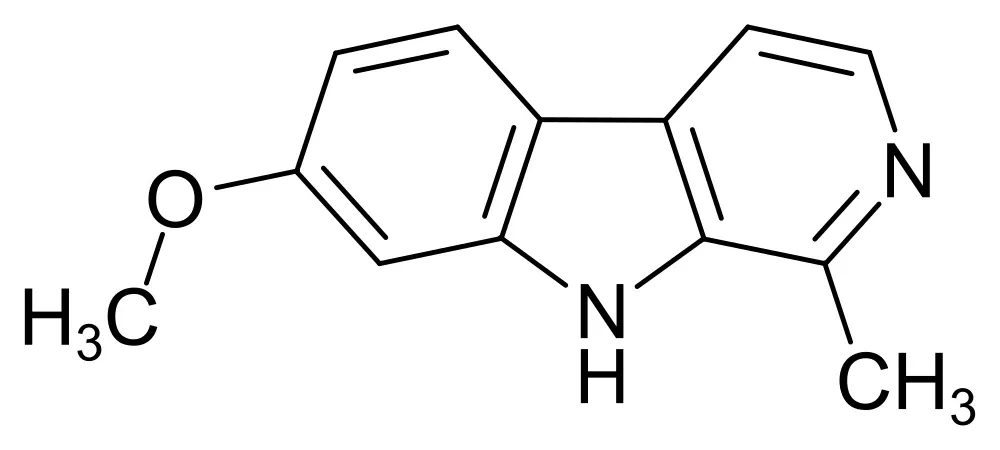
DMT, the psychoactive component, is destroyed in the gut before it reaches the blood. It is orally inactive even at a thousand milligrams. The second plant supplies β-carboline alkaloids, chiefly harmine and harmaline, which are reversible inhibitors of monoamine oxidase A. Inhibit that enzyme and the DMT survives.
Everything that makes ayahuasca work also makes it interact. Monoamine oxidase is the enzyme that clears serotonin. Ibogaine has no such component.
| Ibogaine | Ayahuasca | |
|---|---|---|
| What it is | One alkaloid | A brew of two plants, four main alkaloids |
| Contains an MAOI | No | Yes, and that is why it works orally |
| Duration | About 19 hours | Resolved by about 4 hours |
| Main interaction route | CYP2D6, and QT-prolonging drugs | Serotonergic drugs, through MAO-A |
| Documented mechanism of death | hERG blockade, QT prolongation, arrhythmia | Serotonin toxicity, and vomiting injury |
| Typical use pattern | Once | Repeatedly. 45% report more than 30 lifetime sessions |

Serotonin toxicity: the risk ibogaine does not have
The clearest statement of the rule comes from a 2022 review of serotonin toxicity in psychedelics: true serotonin toxicity typically requires either an overdose or a combination in which something that raises synaptic serotonin meets a monoamine oxidase inhibitor. Serotonergic drugs without an MAOI, combined with psychedelics without an MAOI, are low risk.
Ayahuasca is the one substance in this comparison that brings the MAOI.
If you take an SSRI, an SNRI, tramadol, triptans, lithium or another serotonergic drug, ayahuasca is the substance in this comparison that interacts with them, and it does so through a mechanism with a documented lethal endpoint.
A 2025 review of DMT fatalities found three previously reported deaths plus two new United Kingdom cases. Neither of the new cases was in a ceremony. Both were polydrug, and both included other serotonergic drugs, one cocaine and amphetamine, the other venlafaxine and mirtazapine. The authors attribute death to excessive serotonergic activity.
Nobody should read that as a rate. Five documented deaths is a very small number. What it establishes is the mechanism, and the mechanism is the one the pharmacology predicts.
Ibogaine’s interaction problem is real but it runs elsewhere: through the CYP2D6 enzyme that converts it, and through anything else that lengthens the QT interval. A common antidepressant, paroxetine, roughly doubles ibogaine exposure. Noribogaine covers that pathway.
On the heart, the comparison is genuinely lopsided
This site does not soften ibogaine’s cardiac record and it will not invent a matching one for ayahuasca.
Under controlled conditions, ayahuasca’s measured cardiovascular effect is modest. In a double-blind study of eighteen volunteers, diastolic blood pressure rose 9 mmHg at the higher dose and systolic pressure and heart rate rose non-significantly.
Against that, ibogaine blocks the hERG potassium channel at concentrations people actually reach, and in a hospital series half of fourteen patients exceeded a QTc of 500 milliseconds.
We searched for it and found nothing. There is no published study of ayahuasca and the QT interval, no thorough QT study, and no hERG data for harmine or harmaline.
That is an absence of a reported signal, not a demonstrated absence of risk. Nobody has looked. It remains a lopsided comparison, because ibogaine’s cardiac liability has been measured, replicated and counted in bodies, and ayahuasca’s has not been measured at all.
Where ayahuasca’s own harms are
They are not cardiac. They are gastrointestinal, neurological and psychiatric, and the largest dataset is uncomfortable reading.
The Global Ayahuasca Survey asked more than ten thousand people across fifty countries. Seventy per cent reported a physical adverse effect. Vomiting or nausea 62%, headache 18%, abdominal pain 13%, breathing difficulty 7%, chest pain 5%, fainting 4%, seizures 1.3%. 2.3% required subsequent medical attention. Mental-health adverse effects were reported by 55%, and 12% said they had needed professional support.
Most respondents framed these as part of a positive process. That is their judgement to make and the survey records it. It does not change the numbers.
Two findings from it are directly useful. Physical adverse effects were more likely in people with a previous substance use disorder diagnosis, and more likely when taken in a non-supervised context. Mental-health adverse effects were less likely in religious settings.
The death question, where two good sources disagree
The Global Survey states that it has been impossible to relate a single death directly to ayahuasca use.
An analysis of 538 ayahuasca exposures reported to United States poison centres between 2005 and 2015 found that 63% had a major or moderate clinical effect, 28 required intubation, there were four cardiac arrests, seven respiratory arrests, twelve seizures, and three fatalities.
Both are real and they are measuring different things. A survey of people still engaged with the practice systematically excludes anyone harmed badly enough to leave. Poison-centre data is a maximally selected numerator with no denominator, and a death recorded in a call is not an adjudicated cause of death.
We publish both rather than choosing the one that suits an argument. And one death has been formally determined: an Australian health regulator found in 2025 that a retreat participant died of a perforated oesophagus caused by vomiting, from DMT toxicity, with a toxic post-mortem blood level.
For addiction, ayahuasca is the weaker case
This is the finding most likely to surprise someone who came here assuming ayahuasca is the better-studied option.
There is no randomised trial of ayahuasca for any substance use disorder. There is none registered. The trial registry returns fourteen ayahuasca studies, no phase 3, and no randomised trial with a substance use disorder as its indication. A 2025 systematic review of psychedelics for opioid use disorder found few studies with serotonergic psychedelics, with most work investigating ibogaine or ketamine.
The entire clinical literature is one cohort.
Twelve people in a rural First Nations community in British Columbia took part in a retreat combining four days of group counselling with two ceremonies. Self-reported alcohol, tobacco and cocaine use declined; cannabis and opiate use did not. Eleven of them were interviewed again for a qualitative follow-up.
Twelve people, no control group, no randomisation, no biochemical verification, and an intervention in which the ceremonies were two components of a week-long programme. It establishes that participants reported improvement. It establishes nothing about the brew.
Ibogaine’s addiction evidence is also weak, and this site says so at length in why there is no success rate. But it is not this weak: ibogaine has registered randomised trials, two of which have completed.
For depression, ayahuasca has one trial
Here the direction reverses, and ayahuasca has something ibogaine does not.
One randomised placebo-controlled trial of treatment-resistant depression randomised 35 people and analysed 29. Scores were lower at day one, day two and day seven, with a between-group effect size of 1.49 at day seven. Response at day seven was 64% against 27%.
Three things about it belong beside the headline.
Remission did not reach significance (36% against 7%, p = 0.054). The placebo was an active-tasting brew of water, yeast, citric acid, zinc sulfate and caramel colouring, which was a serious attempt at the problem, and it did not solve it: five of ten participants correctly identified the placebo. And 57% of the ayahuasca group vomited, against nobody in the placebo group, which is not a blind anyone can hold.
A Bayesian network meta-analysis in the BMJ pooling 19 studies found that this is the only ayahuasca trial in the entire network, and its estimate against a placebo response drawn from antidepressant trials has a lower credible bound of 0.02, which barely excludes zero.
The trial excluded anyone with a personal or family history of schizophrenia or bipolar disorder, and anyone with substance abuse.
So the one randomised trial that exists deliberately removed the population that most people comparing these two substances belong to. It is evidence about treatment-resistant depression in people without an addiction, and it should not be carried across.
The legal picture is more interesting than either side claims
Start with the fact almost nobody mentions. The International Narcotics Control Board states that no plants are controlled under the 1971 or 1988 conventions, and that preparations made from them are not under international control either. It then gives two examples in the same passage: ayahuasca, and iboga.
At the level of international law the two plants are in identical positions. Every divergence is national, and it is a religious-freedom divergence rather than a pharmacological one.
The United States. DMT and ibogaine are both Schedule I. Two churches have won the right to use ayahuasca sacramentally: the UDV in the Supreme Court in 2006, and a Santo Daime congregation in an Oregon district court in 2009. Read the decisions and they are narrower than their reputation. The Supreme Court affirmed a preliminary injunction, and reasoned partly from the small size of the group, about 130 American members. The Oregon church had about 80 members in the state. The administrative route is slow enough that one church that petitioned the DEA in February 2019 had still received no determination when a federal appeals court noted the fact in 2024.
Europe went the other way. In 2014 the European Court of Human Rights considered a Santo Daime church’s claim under the freedom-of-religion article, held that the ban served the protection of health, and declared the application inadmissible unanimously. The Dutch Supreme Court followed in 2019. This is almost never mentioned alongside the American cases.
Brazil, and this is the one people get backwards. The 2010 CONAD resolution protects religious use. It also states that whoever sells ayahuasca performs an act of commerce and not of faith, that tourism should be avoided, and that any practice using ayahuasca for strictly therapeutic ends must be forbidden until efficacy is proven by academic research.
Brazil is routinely cited as evidence that ayahuasca is an accepted treatment. Its own governing instrument says the opposite in as many words.
Ibogaine has no equivalent case law in either direction. Where ibogaine is legal maps its position country by country.
What actually separates them
Not tradition, and not danger in the abstract. Four things.
Duration. Four hours against nineteen. That is the difference between an evening and a full day and night of physical incapacity.
Repetition. Ayahuasca is a practice people return to; 45% of survey respondents reported more than thirty lifetime sessions and church members cluster far higher. Ibogaine is given once. Any comparison that treats a single ayahuasca ceremony as the equivalent unit is comparing the trial protocol to the real-world practice.
Where the danger sits. Ayahuasca’s is an interaction risk you can largely control by knowing what else is in your body. Ibogaine’s is intrinsic to the molecule, invisible, and can arrive hours after the experience ends.
What has been asked. For depression, ayahuasca has been asked once and ibogaine not at all. For addiction, ibogaine has been asked and has not answered; ayahuasca has not been asked.
Neither of these is a treatment. One of them is a religion with a court record, and the other is a molecule with a fatality series. Ibogaine and the heart is where the comparison stops being academic.
Common questions
Sources
8 sources · How we source
- Ayahuasca as a Decoction Applied to Human: Analytical Methods, Pharmacology and Potential Toxic Effects
- Rapid antidepressant effects of the psychedelic ayahuasca in treatment-resistant depression: a randomized placebo-controlled trial
- Adverse effects of ayahuasca: Results from the Global Ayahuasca Survey
- Ayahuasca Exposure: Descriptive Analysis of Calls to US Poison Control Centers from 2005 to 2015
- Serotonin toxicity of serotonergic psychedelics
- Gonzales v. O Centro Espírita Beneficente União do Vegetal, 546 U.S. 418 (2006)
- Resolução CONAD nº 1, de 25 de janeiro de 2010
- INCB Annual Report 2010