Ibogaine vs Bufo
Fifteen minutes against nineteen hours. And the only comparison on this site where the other substance has a published randomised trial and ibogaine does not.

5-MeO-DMT is over in about half an hour. Ibogaine lasts about nineteen hours. And this is the one comparison on this site where the other substance has a published randomised placebo-controlled trial and ibogaine has nothing that has reported an efficacy result.
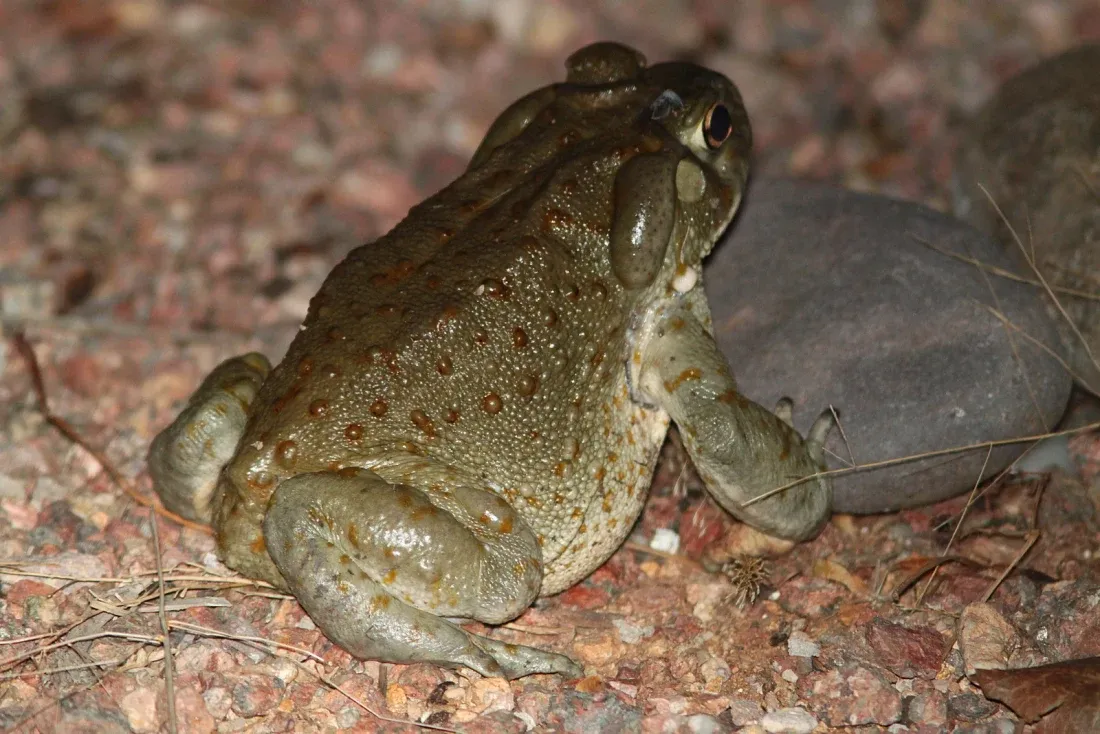
Bufo, as it is usually called, is 5-MeO-DMT, from the secretion of the Sonoran desert toad or made synthetically. It has moved from a ceremonial curiosity to a pharmaceutical development programme faster than almost any comparable compound, and the gap between what the programme has shown and what the ceremony offers is the interesting part.
Two drugs at opposite ends of every axis
| Ibogaine | 5-MeO-DMT | |
|---|---|---|
| Route | Swallowed | Smoked, inhaled or intranasal |
| Onset | 30 to 60 minutes | 2 to 5 minutes |
| Duration | About 19 hours | Over by about 30 minutes |
| Receptor emphasis | Multiple, none confirmed as the mechanism | About 300-fold selective for 5-HT1A over 5-HT2A |
| Physical incapacity | Severe ataxia in essentially everyone | None reported |
| Published randomised trial | None reporting efficacy | One, in treatment-resistant depression |
| QT interval studied | Extensively | Never |
That receptor point is worth a sentence, because it is the opposite emphasis to the classic psychedelics. Psilocin and DMT act mainly at 5-HT2A. 5-MeO-DMT binds 5-HT1A roughly three hundred times more tightly than 5-HT2A, which is why its subjective character is described so differently.
The trial that exists
In 2026, JAMA Psychiatry published a randomised placebo-controlled trial of inhaled synthetic 5-MeO-DMT in treatment-resistant depression. Eighty-one people were randomised, forty to drug and forty-one to placebo, over a single dosing day with escalating doses.
The difference on the depression scale was 15.5 points, an effect size of 2.0. Remission at day eight was 23 of 40 against 0 of 41. There were no serious adverse events and no clinically significant changes to the electrocardiograms.
This is a real randomised trial and it is more than ibogaine has for any indication. Three things sit beside it.
The blinded period was seven days. Everything beyond that is open-label extension, so the trial establishes a one-week effect and nothing about durability.
The placebo remission rate was zero. Not low, zero, out of forty-one people. Placebo arms in treatment-resistant depression do not normally produce nobody. When a trial’s placebo arm performs that far below expectation, the usual explanation is that participants knew which group they were in, and the authors themselves flag functional unblinding.
The sponsor was in the room. The paper states that employees of the company were involved in the study design, the collection and analysis of data, and the review of the manuscript. The conflict-of-interest declaration runs to roughly a page, nearly every author discloses payments, shares or advisory fees, two hold pending patents, and one author’s spouse is a senior executive at a company that does business with the sponsor.
The bigger trial is not published at all
The figure most often quoted for 5-MeO-DMT is a trial of 196 people. It has never been peer reviewed. The registry shows it completed with no results posted, and the medical literature contains nothing.
The numbers in circulation come from a company annual report filed with the securities regulator. Three things follow from reading it. The comparator was an active low dose, not a placebo. The higher dose did not beat the lower one. And the open-label extension records one serious drug-related adverse event.
None of that means the trial failed. It means nobody outside the company has examined it, which is the same objection this site makes to ibogaine’s two unreported randomised trials.
What is known about harm
The best safety dataset is a phase 1 study in 44 healthy participants. No serious adverse events. But 48% exceeded the reference range for systolic blood pressure, reaching 181 mmHg; 55% exceeded it for diastolic, reaching 113; and 23% had a heart rate above 100, reaching 166. All resolved within about ninety minutes.
No 5-MeO-DMT trial reports the QT interval as an endpoint, and no dedicated cardiac repolarisation study exists, across roughly two hundred people dosed in trials.
We apply the same wording here as on the ayahuasca page. That is an absence of a reported signal, not a demonstrated absence of risk. It remains a lopsided comparison, because ibogaine’s cardiac liability has been measured, replicated and counted in deaths.
On deaths the honest answer has three parts, and sources disagree. Only one peer-reviewed fatality carries quantified levels: a man who died in 2005 after taking 5-MeO-DMT in a preparation that also contained monoamine oxidase inhibiting alkaloids, with the manner of death recorded as undetermined. The drug agency’s 2010 scheduling rule refers to a death associated with abuse of the compound. And the main academic review states there are no deaths in national surveillance databases. We report all three rather than writing “no deaths”.
Reactivations, which people call flashbacks, are common and distinctive to this compound. In a survey of ninety users, 69% reported them and 97% described them as positive or neutral. That is a self-selected sample of people still engaged with the practice, so it establishes that reactivations are frequent and says little about how often they are distressing.
Toad and synthetic are not the same substance
This distinction is routinely collapsed and it has a cardiac dimension.
Every clinical trial above used synthetic 5-MeO-DMT. The secretion of Incilius alvarius also contains bufagenins and bufotoxins, which are bufadienolide cardiac glycosides, along with other indole alkylamines. Those are absent from the synthetic compound.
The clearest demonstration is veterinary. A study of 208 dogs poisoned by the same toad found cardiac signs in 74.5%, though 99% survived. Dogs are not people and mouthing a toad is not a ceremony, but it establishes that the secretion carries cardioactive material the trials never tested.
Two things we could not verify and will not assert: the conservation status of the toad, which is widely described as endangered without a source we could retrieve, and any count of deaths in toad ceremonies.
_(8-2-10)_YARD,_WEST_OF_PATAGONIA,_SCC,_AZ_-02_(4858976630).jpg)
A regulatory detail worth knowing
The drug agency placed the clinical programme’s application on hold from late 2023, requesting further inhalation toxicology because of respiratory tract findings in a completed rat study, along with device verification. The hold was lifted in December 2025.
That matters here for one reason. The inhaled route is precisely what toad ceremonies use, and it was the route a regulator paused over lung findings.
The legal position, and an oddity
5-MeO-DMT has been Schedule I in the United States since January 2011, under a rule published in December 2010. So on paper it and ibogaine sit together.
Then look at Colorado. The Natural Medicine Health Act defines the substances it covers as dimethyltryptamine, ibogaine, mescaline, psilocybin or psilocyn. The string “5-methoxy” appears zero times in the statute.
So the one American framework that has opened a legal route for ibogaine does not cover bufo at all. Where ibogaine is legal maps the rest.
What the comparison comes to
If someone is choosing between these two for depression, the evidence points at 5-MeO-DMT, and this site will say so plainly even though it is a site about ibogaine. One published randomised placebo-controlled trial, however qualified, beats none.
If the question is safety, the comparison is between a measured risk and an unmeasured one. Ibogaine’s cardiac danger is established in detail and has killed people. 5-MeO-DMT’s cardiovascular effects are large, brief, and have never been examined for the specific mechanism that makes ibogaine lethal.
And if the material is toad rather than laboratory, none of the trial evidence transfers, because it is not the same substance.
Common questions
Sources
6 sources · How we source
- A narrative synthesis of research with 5-MeO-DMT
- GH001 vs Placebo in Patients With Treatment-Resistant Depression: A Randomized Clinical Trial
- A phase 1 study of BPL-003 in healthy participants
- A fatal intoxication following the ingestion of 5-methoxy-N,N-dimethyltryptamine in an ayahuasca preparation
- Schedules of Controlled Substances: Placement of 5-Methoxy-N,N-Dimethyltryptamine into Schedule I
- Colorado Natural Medicine Health Act, Initiative 58 final text