Is Ibogaine Like DMT?
A 2026 meta-analysis on DMT for substance misuse contains no study of DMT. Seven of eight are ayahuasca; the eighth is a different molecule with ibogaine.

Barely alike. DMT smoked or injected peaks in about two minutes and is over in under thirty; ibogaine lasts about nineteen hours. Swallowed alone, DMT does nothing at all. And the confusion between DMT, ayahuasca and 5-MeO-DMT is not a lay error: we found three documented instances of specialists making it in print.
This comparison is mostly an exercise in separating things that share a name, and the separation turns out to be the interesting part.
Three molecules, and why they are not interchangeable
| N,N-DMT | 5-MeO-DMT | Ibogaine | |
|---|---|---|---|
| Receptor emphasis | 5-HT2A, plus serotonin transport | 5-HT1A above 5-HT2A | Multiple, none confirmed as the mechanism |
| Route | Smoked or injected | Smoked or inhaled | Swallowed |
| Onset | About 2 minutes | 2 to 5 minutes | 30 to 60 minutes |
| Duration | Under 30 minutes | About 30 minutes | About 19 hours |
| Orally active alone | No | — | Yes |
| UN 1971 Convention | Schedule I | Not scheduled | Not scheduled |
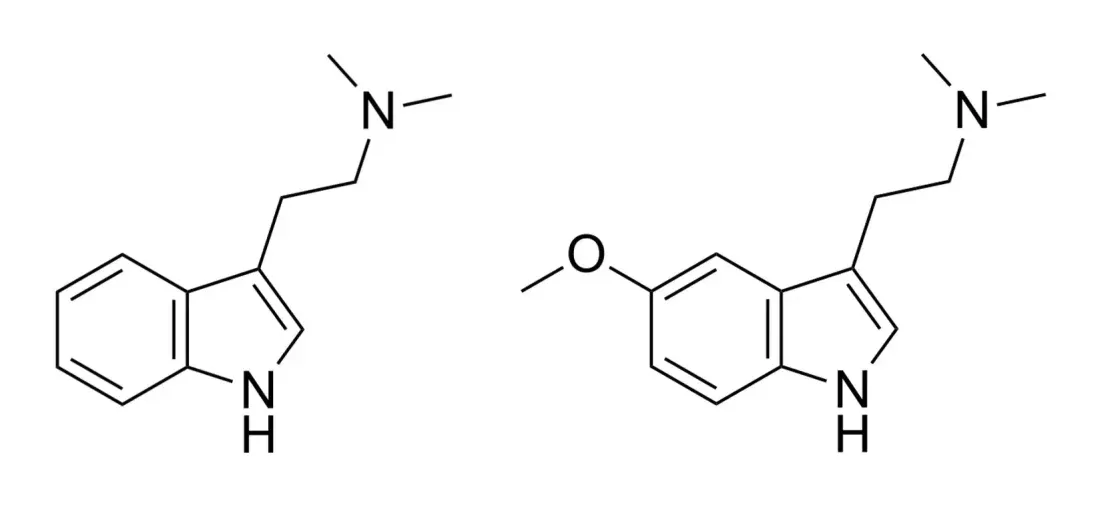
The receptor line is the pharmacological reason they are separate drugs. Across a survey of twenty-one tryptamines, all are 5-HT2A agonists but only a few are 5-HT1A agonists, and 5-MeO-DMT’s affinity is highest at 5-HT1A. That is the opposite emphasis to DMT.

The experiment that settles oral inactivity
Six people received the same dose of DMT by two routes in the same study.
Swallowed, no psychotropic effects were experienced and no DMT was recovered in urine; a monoamine oxidase product accounted for 97 per cent of what came back. Smoked, it was fully psychoactive.
That single result explains ayahuasca’s entire existence: the brew pairs DMT with plants supplying a monoamine oxidase inhibitor so the DMT survives the gut. It is also why ayahuasca has an interaction problem that neither DMT alone nor ibogaine has. Ibogaine and ayahuasca covers that.
So the same molecule produces three different experiences depending on route and on whether an inhibitor is present: nothing at all when swallowed alone, a two-minute peak when smoked, and a rise over an hour and a half in ayahuasca.
The conflation, documented three times in the literature
This is the strongest thing on the page, and it is not our observation about laypeople.
A 2026 meta-analysis titled for DMT and substance misuse reports an overall effect size of 0.94. Read its methods and the eight included studies examine ayahuasca or 5-MeO-DMT, through pre-post and longitudinal observational designs. Seven are oral ayahuasca. The eighth delivered inhaled 5-MeO-DMT together with ibogaine.
Zero of the eight studied N,N-DMT on its own. All received high-risk and low-quality designations, heterogeneity was 96.9 per cent, and the authors state that the wider literature contains no randomised controlled trials examining substance use outcomes and that reported effects should be read as preliminary rather than as established efficacy.
A 2022 review in a pharmacology journal was formally corrected after asserting that 5-MeO-DMT is present in ayahuasca. The correction’s own words are that the source of that information appears to have been incorrect and misleading, and that disagreement even about this basic question shows the subject needs far more research. The rebuttal that prompted it makes the point in its title: 5-MeO-DMT has not been found in traditional ayahuasca preparations, and combining it with monoamine oxidase inhibitors is dangerous.
And a 2005 forensic case is cited to this day as an ayahuasca or DMT death. Its own toxicology gives N,N-DMT at 0.02 mg/L against 5-MeO-DMT at 1.88, a difference of roughly ninety-four fold. It was a 5-MeO-DMT death in an analogue preparation.
A corrected review, a meta-analysis with the wrong drug in its title, and a coroner’s case miscited for twenty years. Three independent instances, all by specialists, all in the exact domain this page covers.
If the peer-reviewed literature cannot keep these three molecules apart, a clinic website will not, and neither will a search result. That is the practical value of the table above.
What DMT has been shown to do
More than ibogaine, in one narrow place, and less than its coverage suggests.
Depression. A phase 2a randomised placebo-controlled trial in 34 people found a significant difference on the depression scale at two weeks, with a larger effect at one week. Read further and the picture is more careful: at two weeks the response and remission confidence intervals both cross zero, a second dose added nothing, and the sustained three-month claim rests on an open-label stage. The authors did not assess blinding integrity or expectancy, which they acknowledge matters given DMT’s distinct subjective effects.
Its conflict statement runs to a paragraph, with multiple authors employed by or holding shares in companies developing the drug.
Addiction. Nothing. We queried the trial registry directly: zero registered N,N-DMT trials in opioid use disorder, and one genuine DMT addiction trial anywhere, a phase 1 safety study in alcohol use disorder that began in 2025 and does not complete until 2027.
Ibogaine’s addiction evidence is weak and this site says so at length. It is not this weak: ibogaine at least has registered trials in the indication.
Safety, and an absence stated carefully
In a randomised placebo-controlled study of 27 healthy participants, infusions raised blood pressure and heart rate only mildly and non-significantly, and vital signs normalised within fifteen minutes of stopping. Bolus doses produced sharper rises, to a mean 159 systolic and 119 beats per minute, and more anxiety.
A six-hour infusion study with serial twelve-lead ECGs reported no serious adverse events and no significant abnormalities on electrocardiography.
But no thorough QT study of DMT exists, and no published hERG data for it. So the honest formulation, the same one this site uses for ayahuasca: no QT signal has been reported in controlled human studies including one with serial ECGs over six hours, and that is an absence of a reported signal rather than a demonstrated absence of risk.
Against that, ibogaine’s cardiac liability has been measured, replicated and counted in deaths. Ibogaine and the heart sets it out.
On fatalities the whole literature is five cases: three previously reported, two of them in ayahuasca ceremonies, plus two United Kingdom cases that were polydrug and included other serotonergic drugs.
The legal asymmetry nobody expects
This one reverses the usual assumption.
DMT is listed in Schedule I of the 1971 United Nations Convention, the most restrictive international category, which binds every signatory state. We verified it in the current international control list, where it appears as entry PD 004.
Ibogaine appears in that list zero times. So does 5-MeO-DMT.
In the United States all three are Schedule I with three separate drug codes, which is itself a useful reminder that they are three separate substances. But internationally they are not in the same category at all: one is under treaty control everywhere, and two are under none. Where ibogaine is legal explains why national positions on ibogaine differ so widely as a result.
What the comparison comes to
If someone tells you ibogaine is like DMT, they are wrong about duration by a factor of about forty, wrong about route, wrong about receptor pharmacology, and wrong about legal status in opposite directions.
And if they cite evidence that DMT helps addiction, ask which molecule the studies used. In the most recent meta-analysis on exactly that question, the answer was none of them.
Common questions
Sources
5 sources · How we source
- Efficacy of N,N-dimethyltryptamine (DMT) psychedelic therapy for substance misuse: A systematic review and meta-analysis
- A short-acting psychedelic intervention for major depressive disorder: a phase IIa randomized placebo-controlled trial
- Acute effects of intravenous DMT in a randomized placebo-controlled study in healthy participants
- 5-MeO-DMT has not been found in traditional ayahuasca preparations and the combination of 5-MeO-DMT with MAOIs is dangerous
- INCB Green List, List of Psychotropic Substances under International Control, 36th edition