Ibogaine vs Kambo
Kambo is not a psychedelic. It has been measured with psychedelic instruments and it does not register. What it is instead is a frog peptide on a burn.

These two are not variants of one another. Ibogaine is an alkaloid that produces a nineteen-hour altered state and blocks a cardiac channel. Kambo is a frog secretion rubbed into fresh burns, it is not a psychedelic, and researchers established that by measuring it with the standard psychedelic instruments and finding nothing.
Kambo turns up alongside ibogaine at the same retreats and in the same conversations, which is the only real reason to compare them.
It is not a psychedelic, and this was tested
The claim usually goes unexamined because kambo sits in a category people fill by association: traditional, Amazonian, ceremonial, intense.
Researchers took twenty-two people who had had kambo and administered the standard battery for measuring altered states: the Altered States of Consciousness rating scale, the phenomenology of consciousness inventory, the mystical experience questionnaire. Their conclusion in their own words is that the effects came with no psychedelic-type distortions of perception or thinking. The same group then surveyed 386 users, two thirds of whom had also taken ayahuasca, and recorded only mild psychoactive effects.
A comprehensive pharmacology review of the frog contains, across its entire text, zero mentions of serotonin, of 5-HT, and of the word psychedelic.
So the comparison a reader expects, between two ways of altering consciousness, does not exist. One is a psychoactive alkaloid and the other is not meaningfully psychoactive at all.
What it actually is
Phyllomedusa bicolor, the giant leaf frog. The secretion is up to seven per cent of its weight in active peptides, and it is administered by burning small holes in the skin and rubbing the material into them.
| Peptide | What it acts on |
|---|---|
| Phyllocaerulein | Cholecystokinin receptors |
| Phyllomedusin | Tachykinin receptors, and antidiuresis |
| Phyllokinin | Bradykinin receptors, potent drop in blood pressure |
| Sauvagine | Corticotropin-releasing factor receptors |
| Dermorphins and deltorphins | Opioid receptors |
| Dermaseptins | Membrane lysis |
The effects, described in the first pharmacological study in 1993, are violent peripheral gastrointestinal and cardiovascular ones, and they generally subside in about an hour. Traditional users among the Katukina can receive more than a hundred applications at once; non-native users average eight to eleven.
Two of those peptides do have real drug-development histories. That is evidence about purified compounds at controlled doses, not about raw secretion on a burn, and marketing routinely conflates the two.
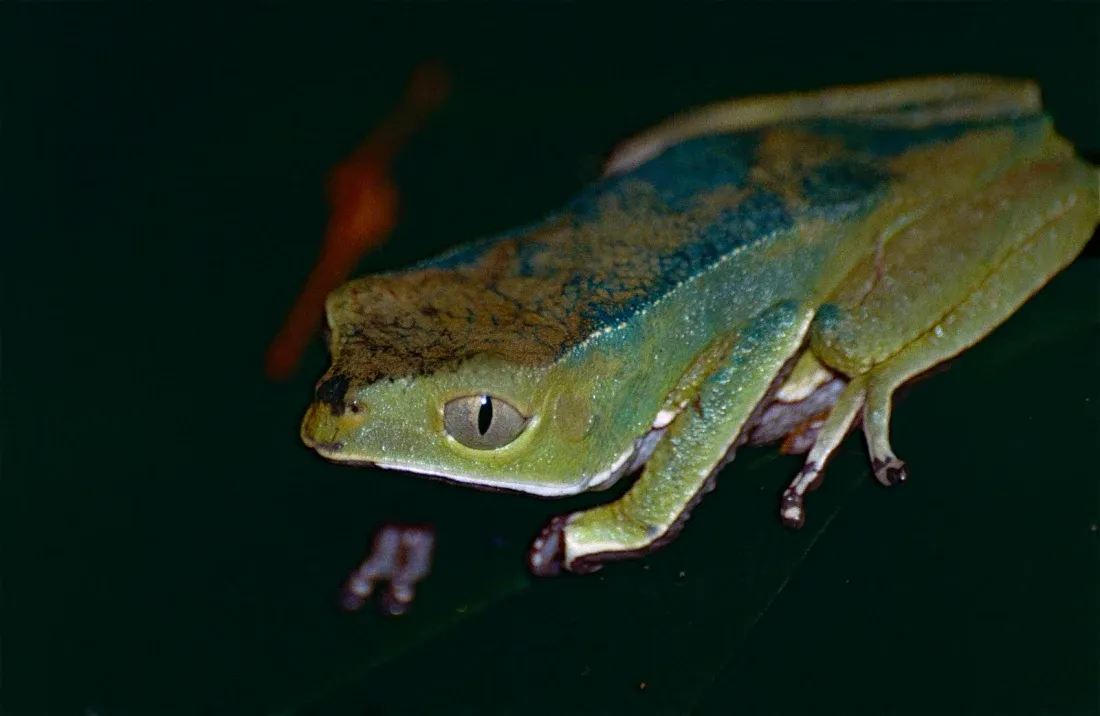
_(10461062633).jpg)
Nothing has been tested
The evidence position is simpler than ibogaine’s, because there is none.
A search of the medical literature for kambo trials returns eight results, all of them false positives where Kambo is an author’s surname. The trial registry contains one kambo record, an observational retreat survey, and zero studies of the frog genus.
The pharmacology review puts it without hedging: the beneficial effects have not been scientifically tested in randomised controlled trials, so the curative effect may just be a placebo effect. A coroner reviewing the evidence reached the same place: there is no peer-reviewed research supporting the health benefits, and no clinical research supporting the purported therapeutic benefits of the ceremony.
Ibogaine’s evidence is thin and this site says so throughout. Kambo’s is absent.
How it kills, when it kills
Not the way people assume. The documented lethal pathway is water.
Three things compound. The peptides drive antidiuresis. Practitioners instruct participants to drink a large volume of water beforehand. And the violent vomiting strips sodium. The result is acute hyponatraemia.
Published cases show the shape clearly. A woman in Slovenia drank six litres and reached a blood sodium of 116, with a seizure and lasting memory loss. A woman in Chile drank at least six litres, reached 120, had generalised seizures, and her muscle-breakdown marker rose from 8,479 to 107,216. And in 2025 a woman in the United States progressed from headache and vomiting to cerebral oedema and brain death, attributed to excessive water intake, peptide-induced vomiting with sodium loss, and suspected inappropriate antidiuretic hormone secretion.
The violent vomiting also carries its own mechanical risk. Oesophageal rupture has been reported twice, once progressing to tension pneumothorax and septic shock, once in an otherwise healthy man.
Nothing has been studied about combining them, so what follows is mechanism rather than evidence, and we mark it as such.
Ibogaine’s danger runs through the QT interval, and the single most reliable way to make that worse is to lose potassium and magnesium. Kambo’s defining effect is violent vomiting and fluid loss.
If the two appear on the same retreat schedule, that is the question to ask. Ibogaine and the heart sets out why.
The death that gets misattributed
This one is worth stating carefully, because the error is everywhere.
One kambo death carries a formal coronial determination. The State Coroner of New South Wales found in February 2024 that the cause of Natasha Lechner’s death was sudden cardiac arrhythmia following the administration of Kambo frog toxin. She was 39, had completed a practitioner training the previous month, and autopsy found 61 round lesions. She drank 1.5 litres of water, then received five applications, and collapsed within minutes. The person administering had no phone and did not know the Australian emergency number.
The Coroner’s most quotable finding is that the information given to participants does not properly advise them of the true risk, and that death can occur even where there is no pre-existing condition, or at least none identifiable beforehand.
A man who died at a retreat at Kyogle in October 2021 is very widely described as a kambo fatality. The primary document says otherwise.
The New South Wales Health Care Complaints Commission decision of 25 September 2025 records that the cause of death was determined to be a perforated oesophagus due to excessive vomiting caused by N,N-dimethyltryptamine toxicity. He had a toxic blood level of DMT from ayahuasca. He had also received kambo that morning, nine applications where others received three or five, and was visibly unwell all day before the evening ceremony. The Commission’s expert evidence states it is uncertain whether the two could have reacted together.
It is an officially determined ayahuasca death. We separate it because a site that counts fatalities has to count them correctly, and because the expert evidence adds a warning that applies to every case here: the man’s blood was not tested for kambo until ten days after death, the peptides degrade over time, and a negative test therefore does not mean it was absent.
Two further deaths sit in the peer-reviewed literature: a 42-year-old man in Italy who died about thirty minutes after application, with a kambo peptide detected in his blood and no competing cause beyond an enlarged heart, in a paper whose own title is a question; and the brain-death case above. A fourth appears in a peer-reviewed letter but traces back only to a 2008 newspaper report.
The honest count is therefore: one with a coronial determination, two in the literature, one media-sourced, and a structural undercount because the peptides degrade and no standard assay exists.
The law, and what it tells you
Australia is the one jurisdiction with a complete, documented decision, and its reasoning is more interesting than its outcome.
Kambo entered Schedule 10 of the Poisons Standard on 1 October 2021, the category for substances of such danger to health as to warrant prohibition of supply and use. The entry is two words, cross-referenced to the frog.
The proposal had been for Schedule 9. The delegate went further, and the reason is precise: the public health risks substantially outweigh any public health benefits, and the potential health risk does not include a potential for dependency or abuse that would warrant inclusion in Schedule 9.
Read that twice. Kambo was placed in the stricter category because it is not addictive. It fell outside the schedule built for drugs of dependence, so the regulator used the one built for things simply too dangerous to allow.
The delegate also recorded that 20 of 23 written submissions opposed the change, that opponents included the practitioners’ association, and that practitioners are not recognised by the national health practitioner regulator while the benefits they advertise are supported by neither scientific studies nor toxicity data.
Elsewhere the picture is emptier than anyone assumes.
| Jurisdiction | Status |
|---|---|
| Australia | Prohibited, Schedule 10, since October 2021 |
| New Zealand | Not prohibited. Regulator warning published in 2023 |
| United States | Not scheduled. No mention in the federal drug schedules |
| United Kingdom | Nothing. No publication, no coroner’s report, never raised in Parliament |
What the comparison comes to
Ibogaine has a mechanism, a fatality series, registered trials and a real scientific literature, all of which this site spends most of its pages qualifying.
Kambo has none of those things. It has no trial, no proposed mechanism of benefit, a lethal pathway that runs through drinking water, and one national regulator that concluded it was too dangerous to permit in any context.
The one thing they share is the setting. If someone is offering both, the useful question is not which works better. It is why a schedule combines a treatment that depletes electrolytes with one that kills through the heart.
Common questions
Sources
6 sources · How we source
- Acute and subacute psychoactive effects of Kambô, the secretion of the Amazonian Giant Maki Frog (Phyllomedusa bicolor)
- The Amazonian kambô frog Phyllomedusa bicolor: current knowledge on its pharmacology and toxicology
- Inquest into the death of Natasha Lechner
- Shamanic Kambô Frog Hyponatremic Toxicity Leading to Brain Death: A Case Report
- Therapeutic Goods (Poisons Standard—June 2026) Instrument 2026
- Kambô. Leave it with frogs