Ibogaine for Alcoholism
Nine people have ever received ibogaine in a study that set out to treat alcohol dependence. Five of them finished it. Here is what it found.
Nine people have ever received ibogaine in a study whose stated indication was alcohol use disorder, and five of them completed it. It was published in July 2026, it was open-label with no control group, and it was designed to test whether the treatment was feasible rather than whether it worked.
Alcohol was the third indication Howard Lotsof patented, in 1989, and it has been the least studied ever since. Almost everything claimed for it is borrowed from the opioid literature.
The one study
For decades the honest answer to this question was that nothing existed. That changed recently, and the change is small.
A pilot study of nine patients with moderate to severe alcohol use disorder was published in July 2026 in a Brazilian psychiatry journal. Patients were hospitalised with continuous monitoring and given escalating doses up to 400 mg. Five of the nine completed the protocol.
It matches the registered trial NCT03380728 in size, indication, institution and principal investigator: an escalating-dose trial at the University of São Paulo, completed in October 2024.
Not in design, though, and that is the most useful thing on this page.
It was registered as a randomised placebo-controlled trial
The registry keeps every version of an entry, so this is checkable by anyone.
| Registered, December 2017 | Delivered, final entry 2024 | |
|---|---|---|
| Allocation | Randomised | Not applicable |
| Masking | Single, investigator masked | None |
| Model | Factorial, three arms | Single group |
| Participants | 12 estimated | 9 actual |
The original entry spells out the intention in its own words: the first three patients would receive open-label doses, and if the three higher doses were tolerated, the next nine volunteers would receive those doses or placebo, randomly.
That placebo arm was never run. The trial that finished has one arm, no randomisation and no blinding.
The primary outcome in the registry is time without using alcohol, in the first version and in the last. That is an efficacy measure, and it never changed.
The published paper is titled and framed around feasibility, safety and preliminary effects.
So the one ibogaine trial ever to report a public result was designed to test whether the drug keeps people off alcohol, was registered to test that against placebo, and reported as a safety study in nine people with no comparison group at all. A secondary outcome, biomarkers, was dropped along the way.
None of that makes the safety observations less useful. It does mean nobody should cite this trial as evidence that ibogaine helps anyone stop drinking, because the part of it that could have answered that question was not carried out.
Almost every favourable result in the ibogaine literature comes from investigators who own shares in a clinic, hold a patent, or were funded by a company that also controlled the analysis. This one declares no conflicts of interest, and it was run in a university hospital rather than at a private facility.
That does not make nine people into evidence of efficacy. It does mean the safety observations can be read without the usual discount, and the safety observations are the useful part.
What it reports on safety matters more than what it reports on drinking. Five of the nine had QT interval changes. Two required medication for psychomotor agitation, insomnia and raised blood pressure. Those are events in a hospital with continuous monitoring, which is not where most people take ibogaine.
An escalating-dose design also answers a different question from the one readers usually have. It asks how much can be given safely. It does not establish that any amount treats anything, and the study does not claim it does.
What the animal literature actually contains
The claim that ibogaine reduces drinking in animals is usually stated as though the evidence were broad. It is not.
The definitive systematic review and meta-analysis of ibogaine in animal models of addiction covers 27 studies. One of them is a behavioural study of alcohol.
That single study is genuinely interesting, and its most useful result is a negative one. When ibogaine, its metabolite noribogaine and the synthetic analogue 18-MC were compared directly, noribogaine raised GDNF and reduced alcohol self-administration when infused into the relevant brain region, as ibogaine does. 18-MC did neither.
That matters here because 18-MC is the compound designed to keep the anti-addictive effect while dropping the cardiac risk. On the one alcohol experiment that compared them, it did not keep the effect. 18-MC sets out what follows from that.
Where the numbers people quote come from
If you have seen a percentage attached to ibogaine and alcohol, it almost certainly traces back to a patent rather than a study.
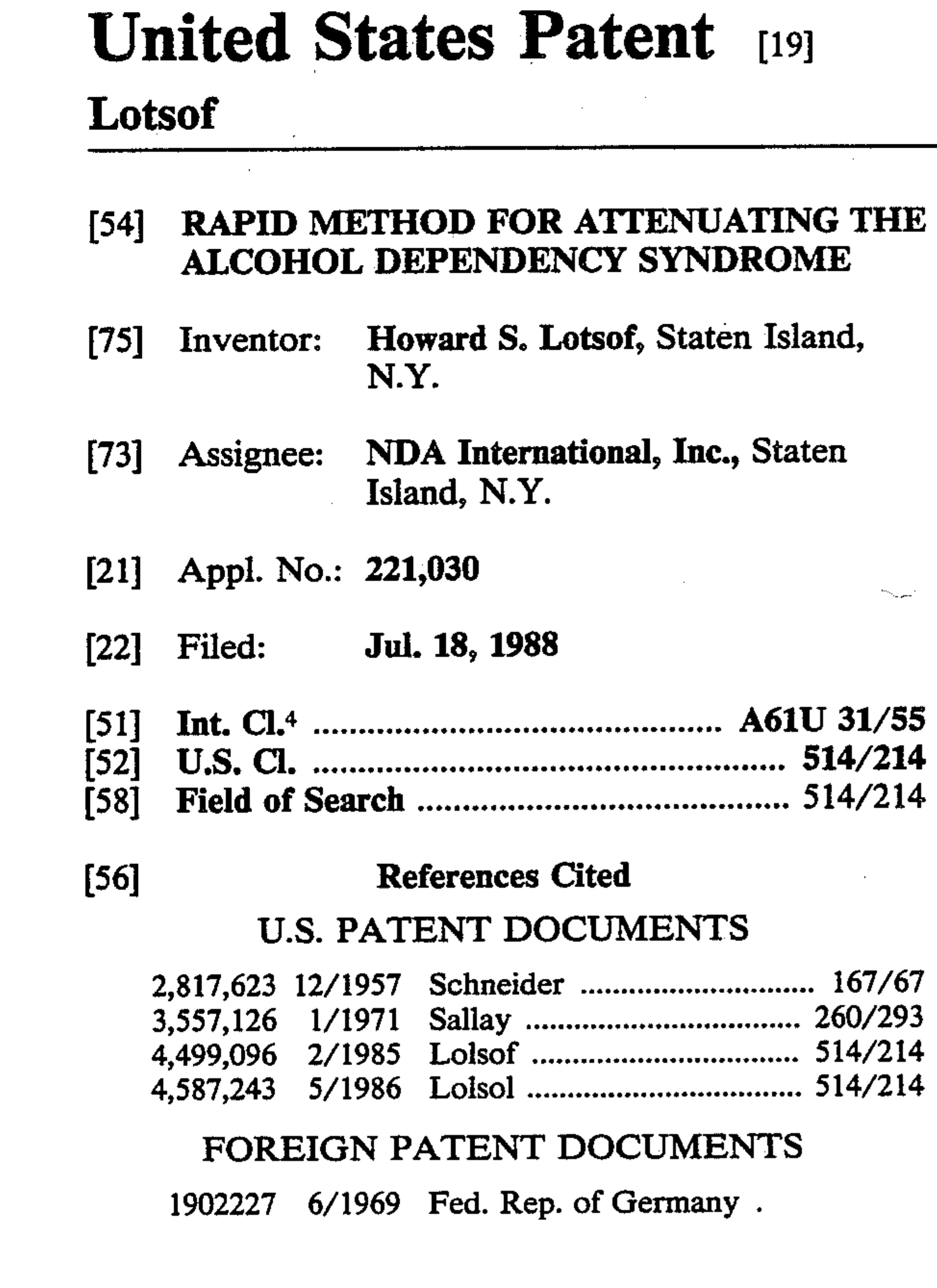
US 4,857,523, “Rapid method for attenuating the alcohol dependency syndrome”, was granted in 1989. Like its predecessors it asserts effectiveness without a trial behind it, and the first patent in the series lists a single reference: an entry in a chemical index.
What ibogaine is sets out how that sequence of patents came to stand in for evidence, and why there is no success rate covers what a real outcome figure would have to look like.
 Enlarge
 The comparison a reader is really making
Someone reading this page is usually weighing ibogaine against either doing nothing or against conventional treatment. Both comparisons go badly for ibogaine, and for different reasons.
Against conventional treatment, the asymmetry is stark. Alcohol dependence has medications with randomised trial evidence behind them, and psychosocial treatments with the same. Ibogaine has nine people, five of whom finished.
The ibogaine story is built on opioid withdrawal, where the syndrome is miserable but rarely lethal.
Alcohol withdrawal is different in kind. Severe withdrawal can kill, through seizures and delirium tremens, and it requires medical management. Nothing in the ibogaine literature addresses it.
Two features of ibogaine treatment point the wrong way here. It causes vomiting and fluid loss, and low potassium and magnesium both lengthen the QT interval and lower the seizure threshold. One case report describes generalised seizures after a very large ibogaine dose, with the author suggesting it acts as a proconvulsant at high doses. A person in alcohol withdrawal is already at raised seizure risk before any of that.
Heavy drinking also damages the liver, and ibogaine is cleared by a liver enzyme whose activity already varies several-fold between people. Noribogaine explains why that variation matters and why the drug is still present days after the experience ends.
The honest summary
There is no evidence that ibogaine treats alcohol dependence, and the absence is not a technicality. No randomised trial has been run. The one study that set out to treat alcohol dependence enrolled nine people, was not designed to measure efficacy, and lost four of them. The animal case rests on a single behavioural experiment. The percentages in circulation come from a patent application.
What the field does have is a good safety observation from a clean study: even under continuous hospital monitoring, in nine people, five had QT changes. Ibogaine and the heart is where that leads.
Common questions
Sources
5 sources · How we source
- Feasibility, safety and preliminary effects of ibogaine in patients with moderate and severe alcohol use disorder: a pilot, open-label study
- Ibogaine in the Treatment of Alcoholism: an Open-label Escalating-dose Trial (NCT03380728)
- Ibogaine and addiction in the animal model, a systematic review and meta-analysis
- Noribogaine, but not 18-MC, exhibits similar actions as ibogaine on GDNF expression and ethanol self-administration
- Rapid method for attenuating the alcohol dependency syndrome (US 4,857,523)