

On 9 February 1839, in his own house on the left bank of the Gabon estuary, Kowé Rapontchombo, known to the French as Roi Denis, ceded two leagues of land to France in perpetuity. The convention itemises what he received: cloth, powder, guns, tobacco, brandy, and ten white hats. He signed with a cross inside a circle. Nothing on this site connects him to iboga. Everything on this site came through the door he opened.

This page exists because a reader asked for it, and because the honest version turned out to be worth writing.
There is no iboga in this story. We looked for one and did not find it, and a page that manufactured a link would be the exact failure this site was built to avoid. What there is instead is the opening of a corridor, and once you have read the document, a good deal of the rest of this site reads differently.
The document
The convention is short enough to set out almost in full. It was made at the village and in the house of Roi Denis, on the left bank of the Gabon, between the king, in the presence of his son Petit Denis and of Dolingua, and Lieutenant Édouard Bouët of La Malouine with Captain Broquant, delegate of the Bordeaux chamber of commerce.
Article 1. The king undertakes to cede in perpetuity to France two leagues of land, from Pointe Sandy toward the king’s village, across the whole width of the left bank, in return for the goods named below:
Twenty pieces of assorted cloth · Ten barrels of powder of twenty-five pounds · Twenty single-shot guns · Two sacks of tobacco · One barrel of brandy · Ten white hats
Article 2. France will erect there whatever buildings, fortifications or houses it judges suitable.
Article 3. The king undertakes an offensive and defensive alliance with France, which in return guarantees him its protection.
Article 4. Once ratified, possession may be taken immediately.
Then the signatures. Bouët signs his name. Broquant signs his name.
Signature of the King: a cross inside a circle. Petit Denis: a cross. Dolingua: a cross.
The itemised list is not there to be shocking. It is there because a commercial transaction requires a schedule of goods, and the man from the Bordeaux chamber of commerce was present to make sure there was one.
What sits oddly is the word perpetuity, on the same page, in the same sentence, as ten white hats. One side of that clause has an end date and the other does not.

The man who signed
He was Antchuwè Kowè Rapontchombo, born around 1780 on the left bank, dead on 9 May 1876 in his nineties. He was Mpongwe, of the Asiga house, and succeeded his father with the title oga. The French called him Denis. The British called him Denny.
The Mpongwe held the estuary between the river and the ocean, and their position was brokerage: they stood between the peoples of the interior and the ships. The ships had been arriving since the Portuguese reached the mouth of the Komo in the fifteenth century, and Spanish, Dutch, English, American and French vessels followed. He spoke English, Spanish, Portuguese and French.
That is the office he held when Bouët arrived. He was not a man encountering Europeans for the first time. He was the most practised intermediary on the coast, negotiating with a state that wanted a coaling station.
Three powers decorated him within a year
France made him a Chevalier de la Légion d’honneur by royal ordinance signed at Saint-Cloud on 16 September 1839, seven months after the convention.
Queen Victoria sent him a gold chain and a gold medal. Its reverse is recorded as reading:
Victoria, Queen of Great Britain and Ireland. To King Denny. In Testimony of Her Majesty’s deep sense of his human and generous conduct in rescuing from captivity four wounded British seamen, in the river Gaboon, 1839.
The boat’s crew had been captured after a fight in which five men died; the four survivors were held, and it took his diplomacy to ransom them.
From Rome, Pope Gregory XVI sent a Bene merenti medal, in thanks for his good offices toward Catholic missionaries.
Three states, in and around a single year, each recognising a different service. It is a fair measure of how central he was, and of how many parties wanted something from the estuary.
The regalia came from London
One of those gifts was not a medal, and the difference matters.
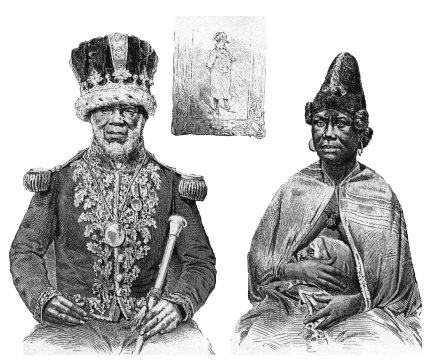
The heir to the throne, interviewed at her home in 2015, put it in her own words. C’est l’Anglaise, la reine Victoria qui lui offrira deux couronnes de souveraineté dont l’une pour son épouse — it was the Englishwoman, Queen Victoria, who gave him two crowns of sovereignty, one of them for his wife.
Two crowns. The engraving at the top of this page shows him beside her.
A medal recognises a service and can be put in a drawer. A crown of sovereignty is an emblem of the office itself, and it is worn. On the family’s own account, the regalia of this throne were given by a European monarch in the same decade the estuary was ceded, by the head of a state whose ships had been working that coast for generations.
It does not create the office. He had succeeded his father with the title oga around 1810, nearly thirty years before Victoria sent anything, and the Mpongwe held the estuary long before that. A crown arriving from London does not make a throne British.
What it does is put the material tokens of an African sovereignty into a European hand to bestow. The office was his. The objects that now stand for it were somebody else’s to give.
And the tokens outlasted the man. His descendant’s formal designation today is conservatrice du patrimoine cultuel et des attributs royaux — keeper of the ritual heritage and the royal attributes. The attributes she keeps include, on this account, the crowns from London.
He was a broker in an estuary whose principal export had been people. A Gabonese account of his life records that in his youth he served aboard a Spanish sailing ship in the period when Gabon was supplying enslaved people to Brazil and Cuba, and that he later had three hundred enslaved people in his service.
The same account continues, in its own words: contrairement à ce que l’on croit généralement, ces esclaves étaient, pour la plupart, satisfaits de leur sort — contrary to what is generally believed, these slaves were, for the most part, satisfied with their lot.
We reproduce that sentence because it is doing work, and because a reader researching this man will meet it. Nobody can report the contentment of enslaved people, and the claim is not evidence about them. It is evidence about how the memory of a founding figure gets tended.
Ten years after the convention, in the same estuary, the French founded Libreville to settle people freed from a slave ship.
What followed, on the document’s own account
The source that carries the convention calls it, without ceremony, the first of a long series.
Within three years a treaty with Roi Louis conceded French sovereignty over the right bank. In 1843 the fort d’Aumale went up. On 1 April 1844 a general treaty recognised French sovereignty with nine chiefs of neighbouring villages. In 1849 the village of Libreville was created, to settle people freed from a slave ship.
The Gabon trading post had already been attached to the government of Senegal in September 1840, eighteen months after the convention was signed.
Why this page is on a site about a plant
Because of what used the corridor afterwards.
The collector. Robert Bruce Napoleon Walker reached Gabon in 1851, twelve years after the convention, and stayed twenty-three. The Pitt Rivers Museum’s founding collection holds 141 items connected with him, ninety of them formerly in the collection of the Anthropological Society of London. Who wrote iboga down follows what he sent and what his son later wrote.
The administrators. The provenance lines on Gabonese objects at auction read the same way for a century afterwards: collected in situ by a colonial administrator between 1913 and 1934; acquired by a colonial governor in 1917. The Gabonese mask that sold for 4.2 million euros sets those out.
And the word. The estuary is Mpongwe country, and the Mpongwe are a branch of the Myene. Iboga is a Myene word, and it is by that word that the entire world now knows the plant.
Set beside that, one figure from a 2014 report on the community: Libreville has around seven hundred thousand inhabitants, and fewer than five thousand people still speak Myene.
A word from that language is on the packaging of an international market. The same report notes that surnames such as Raponda-Walker are among the traces left by the alliances of this period, which is where the other half of this story comes from. Iboga names and etymology traces it, and iboga and the peoples of Gabon explains why the plant’s name and the practice’s name come from two different parts of the country.
The convention did not send anything anywhere. It established the place from which sending became possible, and put a French station, a chamber of commerce and a garrison at the mouth of the river.
The chieftaincy did not end with the convention
This is the part that matters most for the rest of this site, and it is current.
The throne has an heir. Princesse Marie Anne Ankombié Rapontchombo is described as a granddaughter of King Denis and as keeper of the ritual heritage and royal attributes of Pointe Denis. Interviewed at her home in Owendo in 2015, she was presented by the BBC’s Libreville correspondent as protector of Mpongwe rites and traditions and heir to the throne, holding a crown two centuries old, and it is her account of its origin that the section above rests on. Spellings of her name vary between sources.
And the authority is not ceremonial in the sense of being inert.
In April 2026, a circular signed by her announced the ceremonies of the Throne of King Denis Rapontchombo at Pointe Denis, from the 8th to the 12th. For Sunday the 12th, the day of offerings at sea and in the rivers, it required that all maritime activity be suspended on the Komo estuary and the Atlantic, addressed to economic operators, boat owners and users of the sea. Fishing was to stop from the 12th to the 17th.
A second Gabonese report on the same circular adds the detail that matters most. These suspensions are not exceptional. The chieftaincy calls them regularly for major ceremonies, and the report states that they are broadly respected by riverside populations and economic operators alike.
And the head of state attends
On Saturday 28 June 2025, President Brice Clotaire Oligui Nguema took part in the sacred procession of the Mpongwe community, in the presence of the Nkomi, Orungu, Simba, Benga, Akele of the Estuaire and the Sekiani. The ceremonies were held at the traditional Eka chieftaincy.
Évandaganyé is described by the Gabonese agency reporting it as a ceremony of purification, pardon and reconciliation particular to the Mpongwe.
Several of the peoples named in that line are Myene-speaking, and iboga and the peoples of Gabon sets out which of them the ethnographic record connects to the plant.
Every argument this site has made about benefit sharing turns on the same question: who is a party?
The patent record names the plant and not the knowledge. The museum provenance lines name the European collector and stop. The French court that heard three claims on 4.2 million euros dismissed the one from Gabon in a sentence. In each case the missing party is treated as historical.
Here is a customary authority on the estuary, descended from the man who signed in 1839, issuing an instruction five months ago that suspends commercial activity on the water, published in the national daily and generally obeyed. And here is the head of state, the year before, standing in its ceremonies.
Whatever else is true, the counterpart is not a memory. It is an institution that the Gabonese state itself turns up to.
Iboga in Gabon and what Gabonese law actually says set out a 2026 decree that now requires authorisation across the whole iboga chain. Who gets consulted under it is a real question with living people on the other end of it.
What we are not saying
We are not saying Roi Denis was duped. He was a ruler making a calculation about a French alliance against neighbours and against the traffic in people, in a region where European ships had been arriving for centuries. The convention gave him a defensive alliance and French protection, and those were the terms he sought. Treating him as a naïve party is its own kind of condescension.
We are not saying the convention caused what followed. Colonial expansion in Central Africa did not depend on one signature, and the treaties of 1842, 1843 and 1844 involved other rulers with their own reasons.
And we are not saying he had any relationship with iboga, because we have found no source that says so. He is here because the plant’s name, the objects and the collectors all left through an estuary whose left bank was ceded in perpetuity one February morning, in a house, for ten white hats among other things.
Common questions
Sources
8 sources · How we source
- Convention passée entre le roi Denis, le lieutenant de vaisseau Édouard Bouët et le capitaine Broquant, 9 février 1839
- Gabon, le Chef de l'État prend part à la procession sacrée de la communauté Mpongwè
- Estuaire du Komo, la chefferie Mpongwè suspend les activités maritimes pour des rites traditionnels
- Une reine gardienne du temple
- Pointe Denis, le trône du roi Denis Rapontchombo appelle au respect des traditions maritimes
- Libreville, les enfants du roi Denis
- Denis Rapontchombo, récit biographique non signé
- Robert Bruce Napoleon Walker, Rethinking Pitt-Rivers research pages
More in Tradition

The Babongo and Iboga
Bwiti's own account places them at its origin. The anthropology describes something more uncomfortable and more interesting than the Western telling.
Biopiracy and the Nagoya Protocol
Gabon has been bound since 2014 and has legislated at home since 2019. What the protocol obliges, and what the international register actually shows.