

Gabon has dozens of peoples. Iboga belongs to some of them, not to the country as a whole, and the ethnographic literature documents its use most fully among around ten. The practice and the plant reached the best-known community from two different parts of the country, in two different languages.
Writing about iboga in Gabon means naming peoples, and naming peoples means being careful about two things: which ones the record actually connects to the plant, and how much weight the tidy lists can bear.
The peoples the record connects to iboga
These are the groups whose relationship with iboga is documented in the ethnographic and ethnomusicological literature, rather than asserted.
| People | What the record documents |
|---|---|
| Mitsogo | The branch with the fullest published account; the reference monograph is on their material |
| Fang | The best-known form, adopted at the beginning of the twentieth century |
| Apindji | Named alongside the Mitsogo in the southern material |
| Babongo | Hold the mythical origin point in the ritual’s own account |
| Punu | Named as officiants in fieldwork on one branch |
| Massango | Named in the southern branch material and in work on Babongo relations |
| Myene-speaking coastal groups | The word iboga is theirs; the Nkomi are the subject of a dedicated study |
| Bavove, Nzebi and others | Named in archive recordings and branch listings |
That is roughly ten peoples. It is not sixty, and the difference is not a gap in our research. It is what the literature contains.
The Bwiti peoples sets out the branches and their associations in detail.
Two words, two regions
The single most useful fact about iboga’s place in Gabon is that the practice and the plant do not come from the same direction.
Iboga is a Myene word, of the Galwa and Mpongwe cluster spoken on the coast and the lower Ogooué. Bwiti is a Tsogo word from the Chaillu mountains in the south, for an ancestor cult.
The Fang, whose practice is the one Western writing usually describes, borrowed the cult from southern peoples at the beginning of the twentieth century, and the plant name by another route entirely. Iboga names and etymology traces both.
So there is no single people from whom iboga radiated outward. There is a country in which a plant, a practice and a vocabulary travelled separately and combined differently in different places.
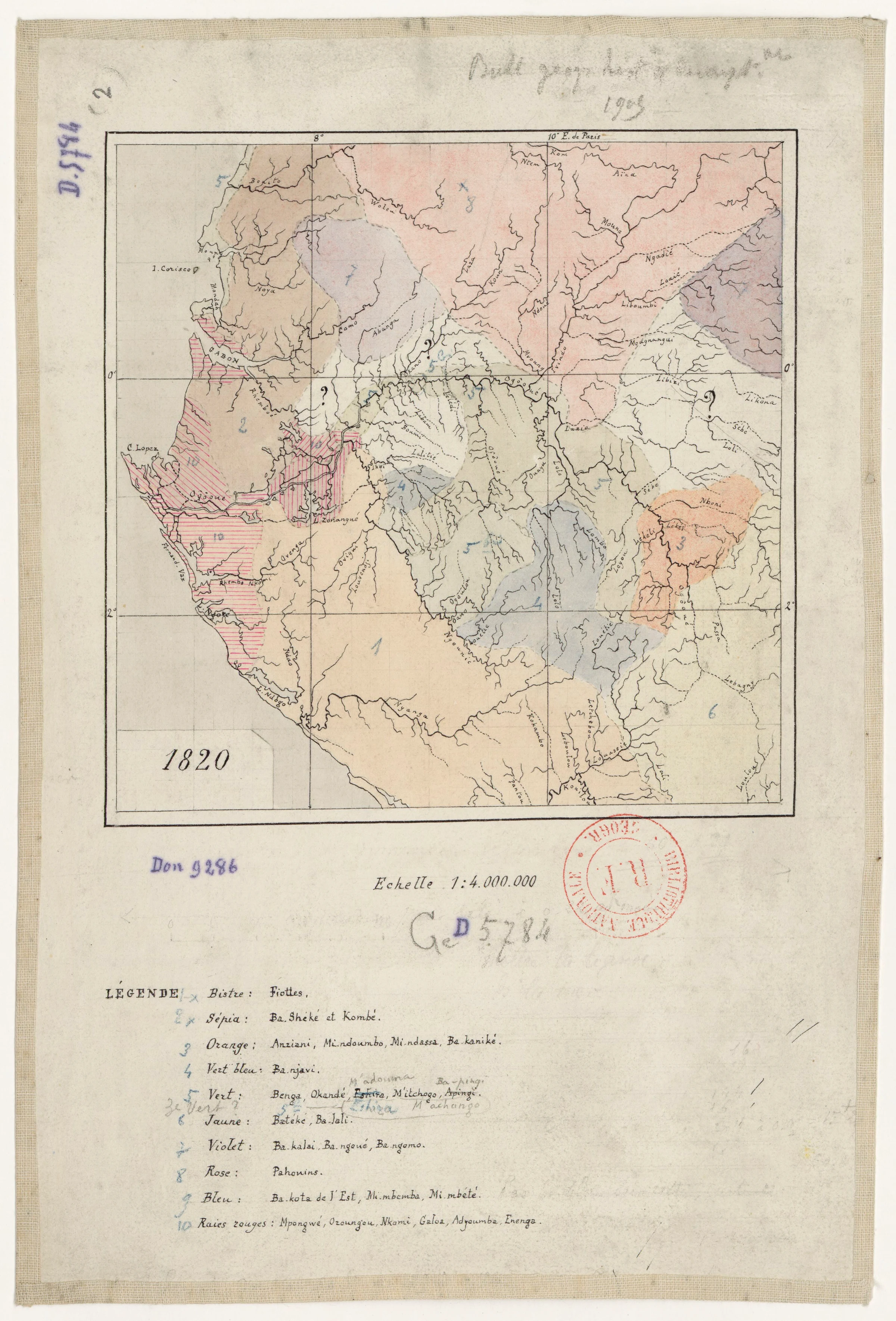
Classifications of Gabon’s peoples into a fixed number of groups circulate widely, in administrative documents, in journalism and in graphics shared online. They give a satisfying number and a clean hierarchy.
Ethnographers do not treat those groupings as settled. Branch and group boundaries are contested, spellings vary between sources, and the same name covers different things in different regions. Our own reading of the branch literature found that the short confident taxonomies in English circulate mainly through operators selling ceremonies, and flatten distinctions the scholarship keeps carefully apart.
A number is not a finding. We use the names the ethnographic sources use, and where sources disagree we say so.
 Enlarge
 .jpg)
What naming a people does not establish
This matters for how the rest of this site is written.
Appearing in a list of Gabon’s peoples establishes that a people exists and is recognised. It establishes nothing about iboga. Many Gabonese peoples have no documented relationship with the plant in any literature we could reach, and some belong to entirely different linguistic families and religious traditions.
Treating a national ethnic listing as a list of iboga-using peoples would be a category error, and it would misrepresent both the plant and the peoples.
So this site names a people when a source connects them to the subject, and does not otherwise. Where we have a name and no substance, we say we have a name and no substance.
The national frame
Alongside the peoples sits a claim made at country level.
Gabon has treated iboga as national patrimony, suspended its export since 2019, and issued a 2026 decree classifying it as strategic national heritage, requiring prior authorisation for any iboga activity and creating a sovereign fund. Iboga in Gabon covers those instruments.
That is a claim about a country, and it sits somewhat awkwardly beside the fact that the practice belongs to particular peoples rather than to all Gabonese. Heritage designation and benefit-sharing raise the question of who exactly benefits, which biopiracy and the Nagoya Protocol takes up.
Where the record is thinnest
Three honest gaps.
The southern and coastal material is largely in French and largely open access, while the English-language literature is dominated by one Fang monograph. That imbalance shapes almost everything written in English, including the assumption that Fang Bwiti is Bwiti.
Some peoples appear in the record and nowhere else. A study of Bwiti among the Nkomi exists and we could not obtain it. Work on Punu practice exists in a form too thin to summarise responsibly.
And the people best placed to correct all of this have said so in print. At a Gabonese university seminar in 2000, initiates publicly contested outside researchers’ standing to speak about this. We write from outside and are reviewed from inside, and that arrangement is the most we can offer.
What the West gets wrong about Bwiti collects the specific claims this page exists to keep apart.
Common questions
Sources
4 sources · How we source
More in Tradition

The Babongo and Iboga
Bwiti's own account places them at its origin. The anthropology describes something more uncomfortable and more interesting than the Western telling.
Biopiracy and the Nagoya Protocol
Gabon has been bound since 2014 and has legislated at home since 2019. What the protocol obliges, and what the international register actually shows.