Ibogaine for Parkinson's and MS
The neuroregeneration claim rests on a growth factor. That growth factor has been given to people with Parkinson's, twice, in randomised trials.

No person with Parkinson’s disease has ever received ibogaine in a study. The claim that it might help runs through a growth factor called GDNF, and GDNF has been delivered directly into the brains of people with Parkinson’s in two randomised trials. Both missed their primary clinical endpoint, and in both the brain imaging showed the protein had arrived.
This page exists because the argument for ibogaine in neurodegenerative disease is unusually easy to check, and checking it gives a clearer answer than most questions on this site.
Start with the absence
Three independent searches, all of which anyone can repeat.
The medical literature index returns 491 records for ibogaine and zero when Parkinson’s disease is added. Broadening to iboga, noribogaine, nigrostriatal and the standard animal models of Parkinson’s returns only papers on ibogaine as a folding chaperone for mutant dopamine transporters, which concern rare inherited transporter defects in cells and fruit flies, not Parkinson’s, and none of which involves a patient.
The trial registry returns nine ibogaine studies. Their indications are opioid use disorder, opiate withdrawal, PTSD and traumatic brain injury, alcoholism, and substance-use surveys. Not one lists Parkinson’s disease or multiple sclerosis.
The United States national funding database returns 21 project-years of ibogaine grants across ten distinct titles. None concerns Parkinson’s.
So there is nothing to review, and this page is about the argument offered in its place.
The argument, and where it comes from
It goes like this. Ibogaine raises GDNF, a glial cell line-derived neurotrophic factor. GDNF supports the survival of the dopamine neurons that die in Parkinson’s. Therefore ibogaine might slow or reverse Parkinson’s.
Each step of that has a real paper behind it, and the chain still fails.
GDNF was described in 1993 in embryonic rat midbrain cell culture, and the paper that named it proposed Parkinson’s as the indication. In 1996 it improved bradykinesia, rigidity and postural instability in lesioned rhesus monkeys and doubled midbrain dopamine. That is a genuine and impressive primate result, and it is why people tried it in patients.
Then they tried it in patients
This is the part of the story that never gets told alongside the ibogaine claim, and it is the whole point of the page.
| Trial | Design | N | Route | Result on the main clinical measure |
|---|---|---|---|---|
| 2003 | Randomised, double-blind | 50 | Into the ventricles | Negative. Not improved at any dose |
| 2003 | Open-label phase 1 | 5 | Into the putamen | Encouraging: 39% motor improvement |
| 2006 | Randomised, controlled | 34 | Into the putamen | Negative. p = 0.53 |
| 2019 | Randomised, double-blind, placebo-controlled | 41 | Into the putamen | Negative. p = 0.41 |
The first failure was explicable. Delivery into the ventricles never reached the target, because GDNF does not cross into brain tissue from blood or from spinal fluid in useful amounts. That limitation is why every subsequent trial used a catheter implanted through the skull.
The last two are the ones that matter.
In the 2006 trial, motor scores improved 10.0% on drug against 4.5% on placebo, a difference that did not come close to significance. But the PET marker of dopamine function was 32.5% better on drug, p = 0.019.
In the 2019 trial, motor scores fell 17.3% on drug against 11.8% on placebo, p = 0.41, and no secondary endpoint reached significance. PET uptake rose significantly across the whole putamen in the active group only, by 25% to 100% depending on the subregion.
The protein arrived. The imaging proved it. The patients did not get better.
That dissociation is the single most useful fact anyone can carry into a conversation about growth factors and neurodegeneration. Target engagement is not benefit.
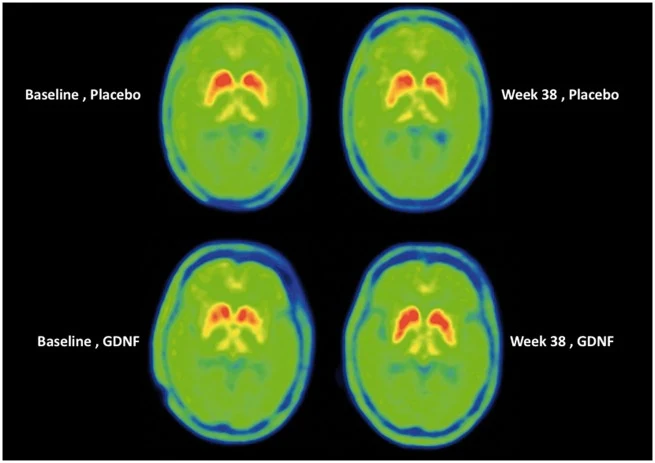
An open-label extension put everyone on GDNF to week 80. The two groups ended up 0.4% apart, p = 0.96.
That extension study’s declared interests are worth reading, and this site applies the same standard to industry that it applies to ibogaine clinics. Six authors were employees or shareholders of the company holding the GDNF licence, nine were employees of the company manufacturing the delivery system, and one was that manufacturer’s medical director, the inventor of the delivery system with a possible future royalty share, and a holder of share options in the licence holder.
Now the part that turns the argument around
The claim treats “more GDNF” as self-evidently protective. It is not.
In a six-month toxicity study, rhesus monkeys received GDNF infused directly into the putamen. At the highest dose, four animals showed multifocal loss of cerebellar Purkinje cells with thinning of the molecular layer, and in some cases loss of granule cells as well. The authors’ own conclusion was that the small numbers precluded statements about mechanism, but that the data supported an association with treatment.
A later review by researchers affiliated with the licence holder put figures on it: Purkinje cell loss affecting 1 to 21% of the cerebellar cortex in four of fifteen animals at the highest monthly dose, none at lower doses, and none by the ventricular route. Their proposed mechanism is that GDNF leaks into the spinal fluid, down-regulates its own receptors on Purkinje cells, and that abrupt withdrawal produces the lesion. A subsequent study using intermittent delivery found no such damage.
Ibogaine kills Purkinje cells in rats. It does so indirectly, by over-exciting the inferior olive, whose fibres then flood each Purkinje cell with glutamate at hundreds of synapses at once. Destroy the inferior olive first and the damage almost entirely disappears, which proves ibogaine is not directly toxic to the cell.
GDNF kills Purkinje cells in monkeys, by a different mechanism entirely.
So the growth factor invoked to explain ibogaine’s neuroprotection has, in its own right, destroyed the very cell type ibogaine is known to destroy. We have not seen this pointed out anywhere. It does not make either finding wrong. It does mean that “ibogaine raises GDNF” is not a statement about safety.
The rat study, read carefully
The paper most often cited for the GDNF claim gave rats ibogaine at 20 or 40 mg/kg and measured both the transcript and the protein in two dopamine regions.
The transcript rose in the ventral tegmental area and the substantia nigra at the higher dose. The protein rose in the ventral tegmental area only.
That distinction decides the page. The substantia nigra is the structure whose dopamine neurons degenerate in Parkinson’s disease. The ventral tegmental area is the one implicated in reward and addiction. The rat result points at the wrong structure for this indication, and it points there in the paper that the claim rests on.
There is a second problem with the same result. The dose that produced it, 40 mg/kg by injection, sits inside the range where ibogaine damages the cerebellum. A dose-response study found no difference from saline at 25 mg/kg, degeneration in two of six rats at 50, and in every animal at 75 and 100. Different strains and different laboratories, so this is a juxtaposition and not an equivalence, but the two numbers are close enough to state.
How ibogaine works sets out the wider mechanism question, and it is the same shape: several proposals, none confirmed in a person.
Multiple sclerosis
Everything on this page concerns the central nervous system. Ibogaine for peripheral neuropathy and CIDP takes the same growth-factor argument into peripheral nerve, where it fails for different reasons.
There is one publication and it describes two patients.
A man of 41 with recently diagnosed relapsing-remitting MS received a large dose then a daily microdose, and a woman of 44 with secondary progressive MS received a smaller dose. The paper reports a 71% reduction in lesion volume in the first patient, with imaging changes interpreted as remyelination.
Its declared conflicts are unusually complete and should be read in full. Five authors are affiliated with the company that offers the treatment, two are shareholders in it, one is a shareholder in a company that manufactures and distributes ibogaine products, and the paper states that the funder’s involvement included study design, data collection and analysis, the decision to publish, and preparation of the manuscript. The patients were treated at that company’s facility.
Three further things sit in the paper itself.
The timeline is ambiguous. The methods describe scans before arrival and several months afterwards, but the figure legend describes measurements at one month and three months. The paper never states unambiguously that the 71% figure compares against the pre-treatment scan.
The natural history is not addressed. The first patient’s lesion was imaged around the time of a new diagnosis, when an acute lesion is at its most swollen, and he had started a standard disease-modifying drug a month earlier. Acute MS lesions routinely shrink over subsequent months regardless of what else happens. The authors do not discuss this.
The presenting symptom did not resolve. A year after his second treatment he still had not experienced any remission of vertigo. The authors also concede that the effects cannot be confirmed as specific to MS.
An independent 2025 review with no declared conflicts, funded by the Italian health ministry, calls the report anecdotal in as many words, notes ibogaine’s cardiotoxic profile, and concludes that current evidence is insufficient to predict clinical efficacy in an autoimmune disease.
The rodent basis for the remyelination idea deserves one line of precision too. The rat study behind it found that ibogaine alone had no effect on the main myelination marker. The effect appeared only after repeated morphine. It is a morphine-exposed white-matter model, not a model of demyelinating disease.
Where this leaves a reader
If you have Parkinson’s disease or MS and you are reading this because someone suggested ibogaine, the honest position is short.
Nothing has been tested. The mechanism offered instead has been tested in a more direct and more favourable form, twice, and it did not help patients even when imaging confirmed it had reached them. The same growth factor has damaged the cerebellum in primates. And the rat finding points at a brain structure that is not the one your disease affects.
Against that sits a documented way to die, and a treatment that produces severe loss of coordination in essentially everyone who takes it, which is a poor combination with a movement disorder.
Common questions
Sources
7 sources · How we source
- Randomized trial of intermittent intraputamenal glial cell line-derived neurotrophic factor in Parkinson's disease
- Randomized controlled trial of intraputamenal glial cell line-derived neurotrophic factor infusion in Parkinson disease
- Six-month continuous intraputamenal infusion toxicity study of recombinant methionyl human glial cell line-derived neurotrophic factor (r-metHuGDNF) in rhesus monkeys
- Ibogaine Administration Modifies GDNF and BDNF Expression in Brain Regions Involved in Mesocorticolimbic and Nigral Dopaminergic Circuits
- A dose-response study of ibogaine-induced neuropathology in the rat cerebellum
- Case report: Significant lesion reduction and neural structural changes following ibogaine treatments for multiple sclerosis
- Psychedelics in Multiple Sclerosis: Mechanisms, Challenges, and Prospects for Neuroimmune Modulation and Repair