

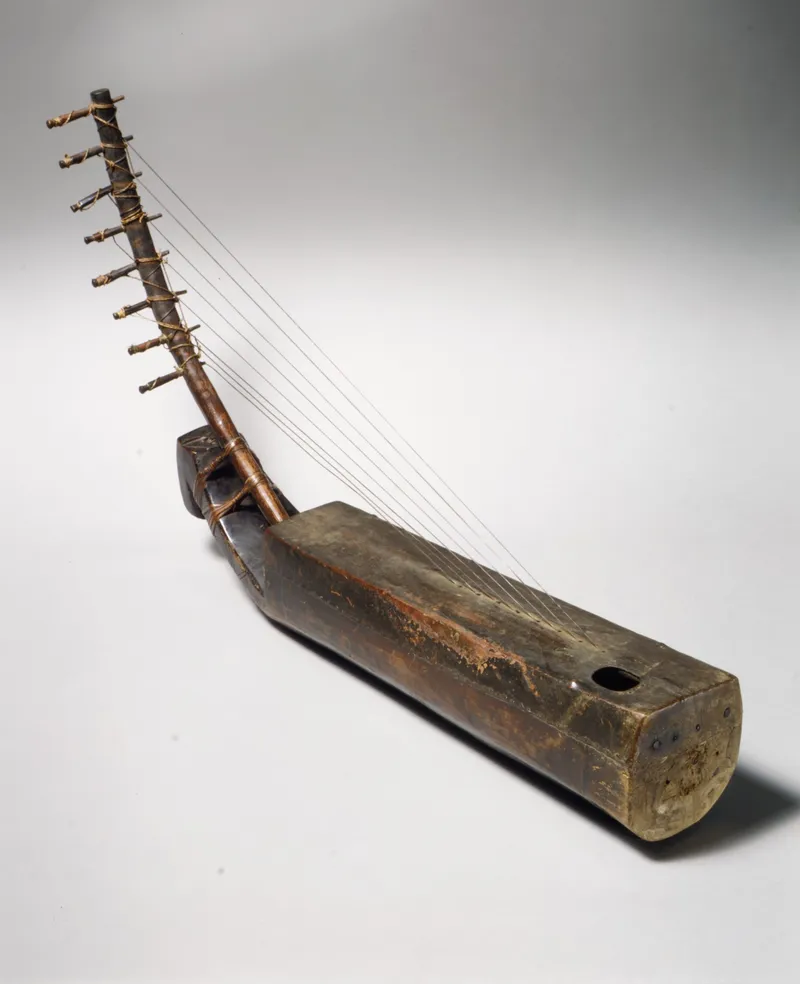
The ngombi is a harp: eight strings, an arched neck, a soundbox. The mongongo is a musical bow, a single string resonated in the player’s mouth, with no soundbox at all. English-language writing merges them constantly, and the phrase mongongo harp is the usual symptom. They are different instruments, though the reason the confusion persists turns out to be more interesting than a simple mistake.
The ngombi
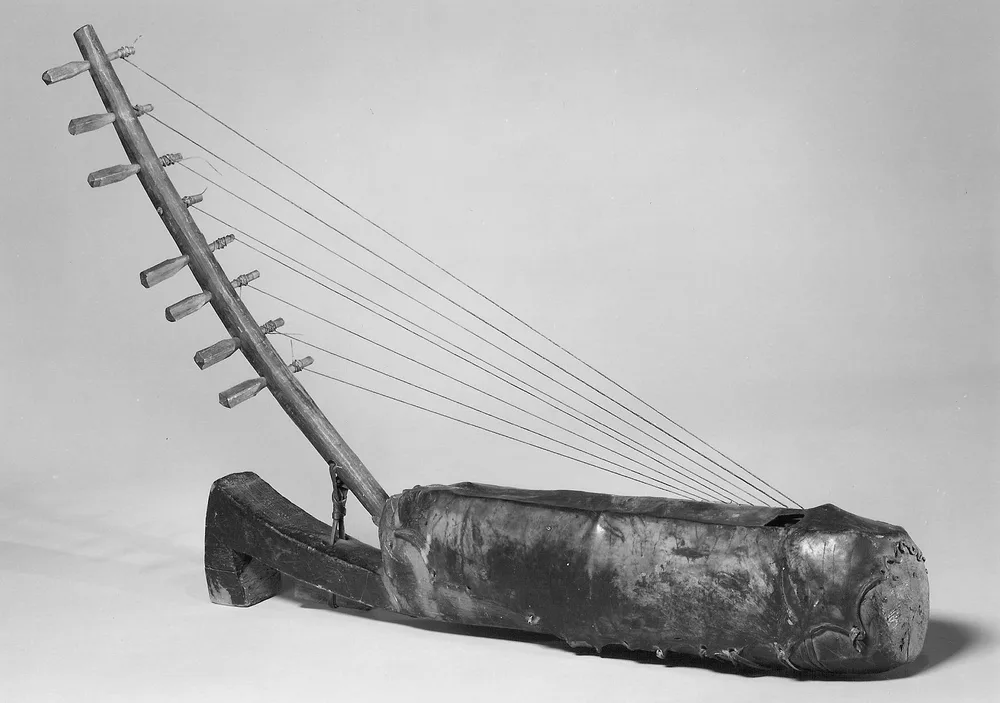

A doctoral study of Mitsogo harpists gives the technical description more precisely than anything in general circulation. The ngombi has eight strings, a hexatonic hemitonic tuning, and accompaniment figures played in strict ostinato.
The same study carries a fact that almost never reaches English-language accounts. The harp is a symbol of traditional religion in Gabon because it holds a fundamental role in the initiatory ceremonies of both the male societies of bwete and the female societies of ombudi. Writing that presents the ngombi as an exclusively male instrument has left out half of where it is played.
Bwiti music and ritual instruments covers what happened to the Fang harp before Bwiti reached them, which is a stranger story again.
The mongongo
A musical bow is a stave held under tension by a single string. The player holds one end at the mouth and uses the mouth cavity as the resonator, changing its shape to bring out one harmonic or another over a fundamental that barely changes. There is no soundbox and there is no fingerboard.
That technique is why the instrument is so often described as speaking. An ethnographer of Bwete Misoko titled his study of it the voice of the mongongo, or how to make a musical bow speak. The mouth that shapes the harmonics is the same mouth that would form the words.
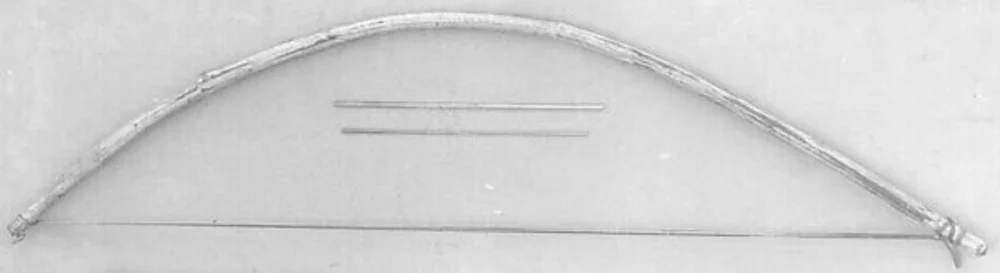
The plate above is the museum’s own, and it is the single image on iboga.co that does not carry an open licence. It is here because this section is about that exact object and that exact restriction, and its credit line says so plainly rather than dressing an exception up as the rule.
The Metropolitan Museum of Art holds a Gabonese musical bow. Its record gives the culture as Gabonese, the date as mid-nineteenth to early twentieth century, the material as wood and the length as 98.4 centimetres. It entered the museum from the Crosby Brown Collection of Musical Instruments, formed in 1889, and was accessioned in 1910.
The plate repays looking at slowly, because it carries a detail no text on this page had.
The bow lies flat against a pale ground. The stave is a single length of wood, bark still on it in places, tapering and bound at both ends where the string is made fast. The string runs the whole span, almost straight, so the tension is in the wood rather than in a deep curve.
And lying beside it, not attached to anything, are two thin rods of different lengths.
That is the part a written description usually loses. The instrument is not only a bow. It arrives as a set: the bow and the slender sticks that go with it, which is how a struck bow is played rather than a plucked one. Somebody catalogued the whole kit in 1910 and kept the pieces together.
Two lines on that record explain why the image is not reproduced here. The object is marked not on view, so it is in storage. And beneath the image the museum states plainly that it cannot be enlarged, viewed at full screen, or downloaded.
Compare that with the same museum’s Gabonese arched harp, its Tsogo ngombo and its quadruple bell. Those three are released as open access, at full resolution, for anyone to reproduce, which is exactly why they appear on this page and the bow does not.
So the answer to where is the picture of the mongongo is not that nobody took one. It is that the harp, the bell and the ngombo were judged worth opening, and the bow was photographed once, filed, and closed. The instruments that circulate freely are the ones that look like treasure. A bent stave with a string on it sits in a drawer behind a line of small print.
Mongongo and mougongo both circulate. The scholarly literature we can reach writes mongongo.
There is also a Central African tree and its oil-bearing nut called mongongo, entirely unrelated to any instrument. A search that returns nutrition articles has found the tree.
Why the conflation is not a simple error
This site has said elsewhere, flatly, that the mongongo and the ngombi are two things and that mongongo harp is wrong. That is still true of the phrase. It is too simple as an account of why the grouping happens.
An ethnomusicologist working on Central African instruments has set the problem out directly: cultures routinely group together instruments that organologists classify as different. Her argument draws on a set comprising the ground harp, the monochord harp and the resonator bow, with examples from eight cultures of different languages and ways of life.
Across all of them, three things stay constant: who plays, what it is for, and how it is played. On that basis she treats these organologically distinct types as a single class of equivalence, and concludes that the cultural coherence is stronger than the classificatory hesitation, which becomes secondary in the face of use.
So there are two different errors available, and English-language writing usually commits the first.
Fusing the names into mongongo harp destroys a distinction the players themselves make, and leaves a reader unable to tell which object is meant.
Insisting only on the split imports a European classification system and treats it as the last word, when the people who use the instruments have their own grouping and their own reasons for it.
The honest position keeps the names apart and does not pretend that the organologist’s categories are the only real ones.
What is struck
The ceremony is not one instrument with accompaniment. It is layered, and the struck layer is the one English-language writing skips.
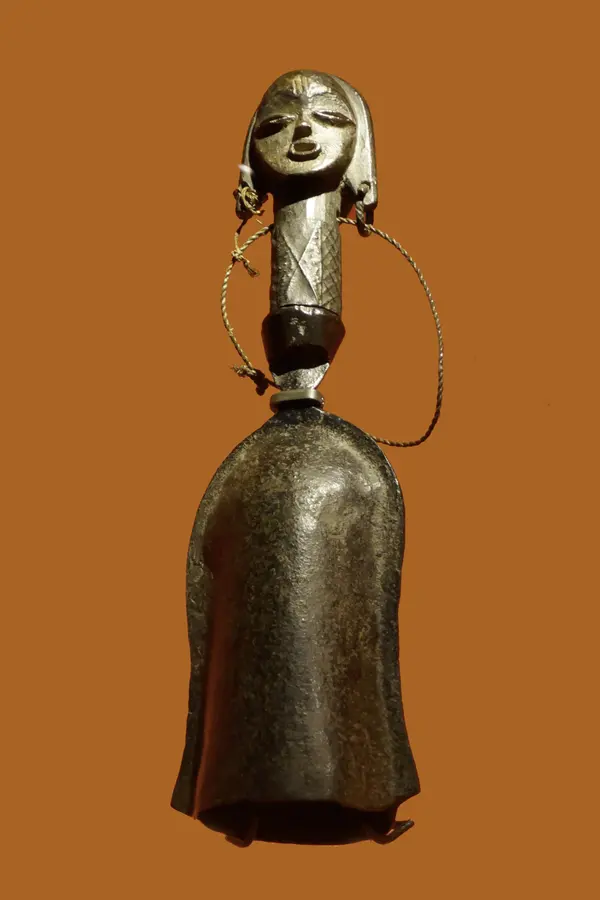
The mokengue, a double bell
.jpg)
This one is Tsogho, which places it with the people whose language gives Bwiti its name. It is forged rather than carved, and it belongs to the ironworking tradition rather than the woodworking one, which is a different set of makers and a different body of knowledge.
The standing drum
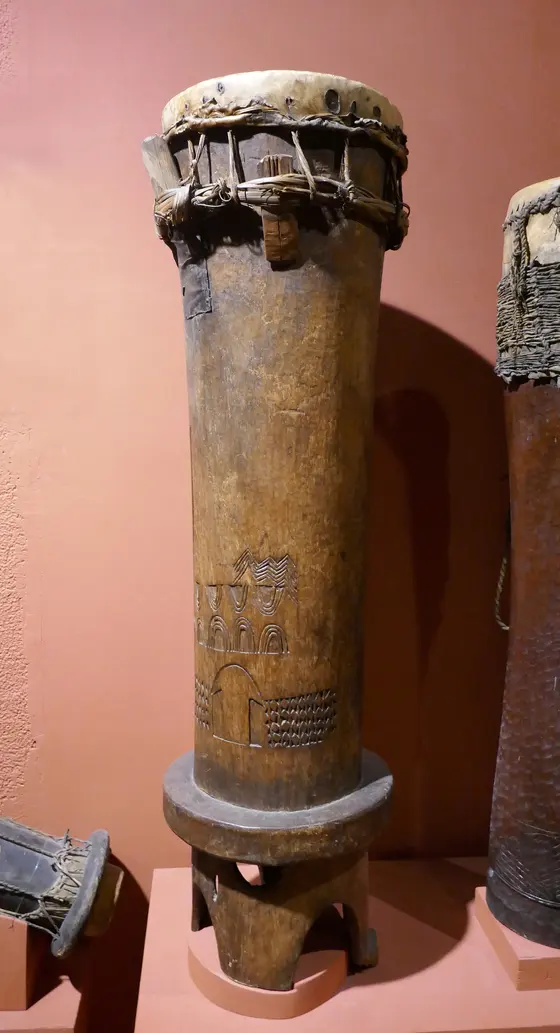

Note what the museum record says about the surface: the drum is not a plain sound-producing cylinder but a carved object, decorated with figures. Where an instrument carries figuration, the instrument is doing more than making noise.
The quadruple bell
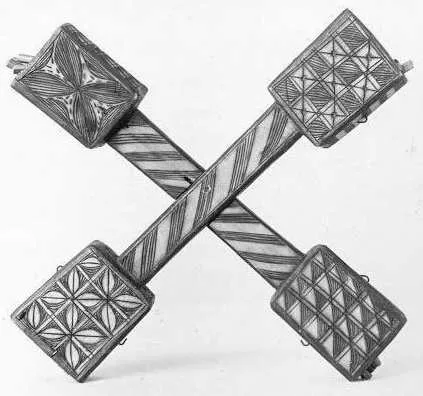
Set beside the forged Tsogho bell above, this one is instructive: same family of instrument, entirely different material and different maker. One came from a smithy and the other from a carver’s bench.
The obaka
Struck sticks or beams. This is the layer that holds the pulse under the harp, and it is also where the published material runs thinnest.
We can tell you it is named, that it appears in the branch listings and archive records, and that it is percussive. We are not going to invent a paragraph about its construction or its history to make this section look even with the two above. The imbalance is in the literature that reached us, not in the practice.
The ngombo
And a lamellophone
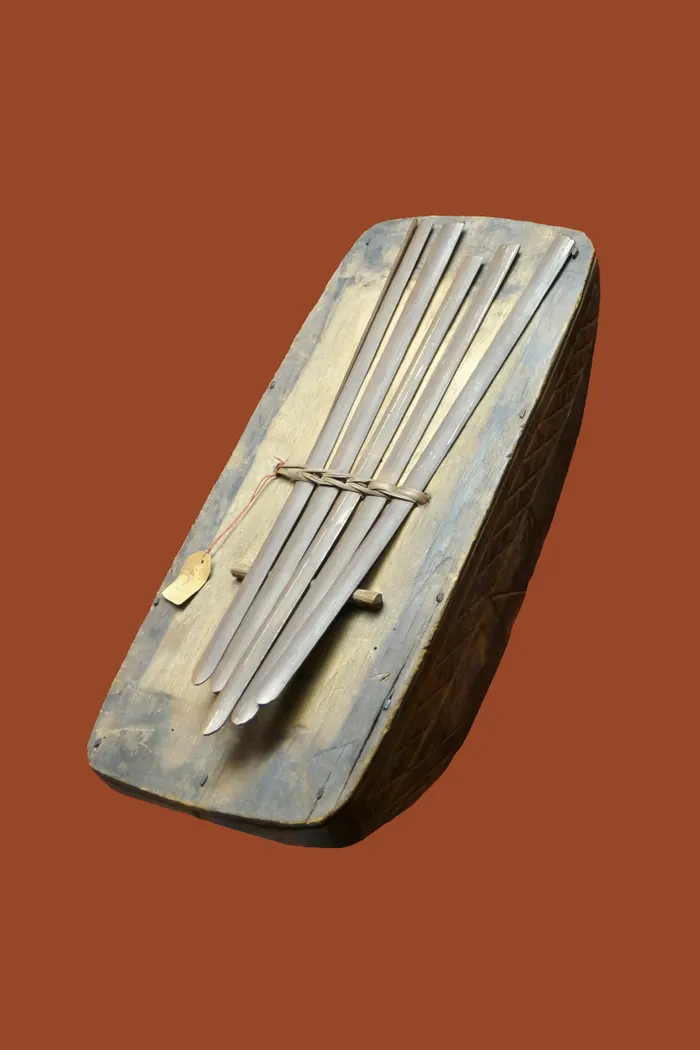

The sanza is not specific to Bwiti and is played across Central Africa. It is here because it is Gabonese, nineteenth century, and because its record carries a detail worth noticing: it sits in a Bordeaux museum on deposit from the quai Branly, so its custody has already moved twice within France.
The mvet, which is three things at once
The mvet appears in every list of Gabonese instruments and it needs its own treatment, for two reasons.
It is not a Bwiti instrument. It belongs to the epic tradition of the Bulu-Beti-Fang, across Cameroon, Gabon and Equatorial Guinea. Lists that put it beside the ngombi without saying so leave a reader thinking it is played in the same ceremonies.
And the word does not name only an instrument. A study of the epic sets out that the term mvet designates three interdependent elements.
The instrument, a harp-zither called mvǝ́t-óyǝ̀ŋ, Mvet-raphia. A raphia stem carries a bridge fixed at its upper middle, supporting four strings. Three calabashes are fixed to the lower part as resonators, one at each end of the stem and the third in the middle, symmetrical to the bridge.
The epic, narratives called ǹláŋ-mvǝ́t, declaimed before an audience. They run to an average of seven hours, and they are interdependent: a narrative told by one teller in one place carries information that helps make sense of another told elsewhere by someone else.
The performer, the m̀bòm-mvǝ́t, at once orator, storyteller, musician and poet, who declaims the epic while playing. The practice demands both a specific oratorical speed, named èlàt-mvǝ́t, and command of the whole epic from which each telling is composed.
English has separate words for the instrument, the repertoire and the musician, and assumes the separation is natural. Mvet does not make it.
That is the same point the ethnomusicologist quoted earlier makes about the grouping of bows and harps: the categories that matter to the people using them are not the categories organology arrives with. Here it is not even a disagreement about which instruments belong together. It is that instrument, repertoire and performer are one term.
What they are made of
| Instrument | Materials, as the records give them |
|---|---|
| ngombi | Wood, skin, gut and fibre |
| mongongo | A stave and a string. The resonator is the player’s mouth |
| mvet | A raphia stem, four strings, three calabashes |
| mokengue | Iron and wood, forged rather than carved |
| standing drum | Carved wood body, skin head, pegged and laced |
| sanza | Wooden body, metal tongues of graduated length |
| obaka | Wood, struck |
Read the column rather than the rows and something appears. This is not one craft. It is woodcarving, ironworking, skinwork and cordage, plant-fibre work and calabash, and the smith who forges a double bell is not the carver who hollows a drum.
An ensemble assembled from five trades is a piece of social organisation before it is a sound. Somebody had to be a blacksmith for that bell to exist.
And at the other end of the table sits the mongongo, which needs almost nothing: a bent stave, a string, and a human mouth. The instrument with the least material in it is the one described as speaking.
The calling horn, and what a catalogue cannot hold
One instrument on this page comes to us from practice rather than from literature, and we mark it as such rather than dressing it up.
A buffalo horn is sounded to open the vigil. It is a calling horn: it does not accompany, it announces. The night begins when it is blown.
We have not found that stated in a source we can cite, and we are not going to manufacture a citation for it. It is given here as what practitioners describe, and this page is reviewed from inside the tradition rather than only from outside.
Now set that beside what the museums hold. The Metropolitan catalogues two Gabonese side-blown horns, both nineteenth century, both about thirty-six centimetres, one attributed to the Fang. Both are ivory. Neither is released under an open licence.
Ivory and buffalo horn are not the same material, and a prestige object is not necessarily a working one, so we are not claiming those two horns are this instrument. They may be something else entirely.
A museum record gives material, dimensions, date, donor and accession year. The Met’s horns are described to a sixteenth of an inch.
None of that tells you when the horn is blown.
That the sounding of a buffalo horn opens the vigil is not a fact about an object. It is a fact about a night, and it survives in the people who hold the night rather than in any drawer. The catalogue has the thing. The practice has what the thing is for.
It is the exact inverse of the pattern this page has been tracing. Seven instruments photographed abroad and none in Gabon; and the one piece of knowledge that makes an instrument make sense is not in any of those records.
The full list, as far as the record supports it
| Instrument | What it is |
|---|---|
| ngombi | Arched harp, eight strings, the sacred instrument |
| mongongo | Musical bow, resonated in the player’s mouth |
| obaka | Struck sticks or beams, the percussive layer |
| mokengue | Double iron bell, forged, Tsogho |
| standing drum | Pegged and laced skin, carved and figured body |
| mvet | Raphia harp-zither of the Bulu-Beti-Fang epic, not a Bwiti instrument |
| tsambi | Listed as a separate instrument in archive records |
| buffalo horn | Sounded to open the vigil. A calling horn, not an accompaniment |
Where the photographs are
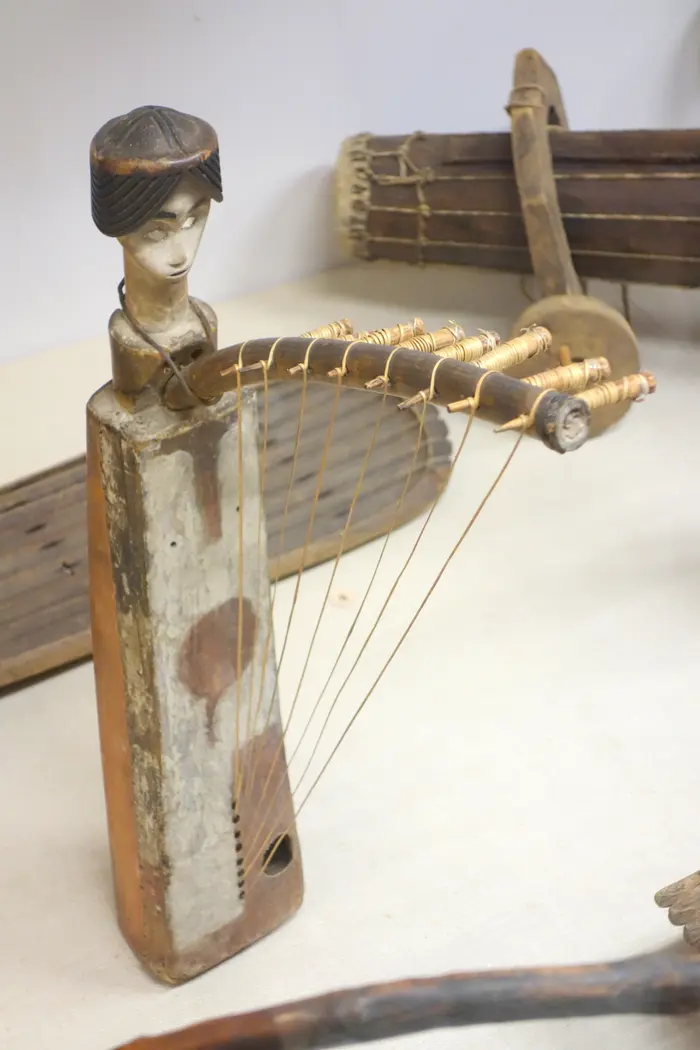

Count where the objects on this page are kept.
| Instrument | Where it is |
|---|---|
| Arched harp, 19th century | The Metropolitan Museum of Art, New York |
| Ngombo, Tsogo | The Metropolitan Museum of Art, New York |
| Quadruple bell | The Metropolitan Museum of Art, New York |
| Fang harp | Royal Museum for Central Africa, Tervuren, Belgium |
| Mokengue bell, Tsogho | Fowler Museum at UCLA, Los Angeles |
| Standing drum, Fang | Musée d’Aquitaine, Bordeaux |
| Sanza, 19th century | Musée d’Aquitaine, on deposit from the quai Branly |
Seven instruments, four cities, three countries, and not one of them in Gabon. An eighth, the musical bow, is in New York, in storage, photographed once and released to nobody.
That is not a claim that any of them was taken wrongly, and we have no provenance for most of them. It is a statement about which instruments a person can see a photograph of, which turns out to be the ones that left.
Gabonese reliquary art in Western museums follows the same observation about objects rather than instruments, and the Gabonese mask that sold for 4.2 million euros follows the money.
The Metropolitan’s caution is worth repeating: its own record gives the maker as Fang people? and the culture as possibly Fang people. A museum hedging its own attribution is being careful, and the hedge is more informative than a confident label would be.
Common questions
Sources
5 sources · How we source
- Morphologie et usages
- Du religieux au commercial : créativité musicale et circulation numérique dans les compositions des harpistes Mitsogo
- La voix du mongongo ou comment faire parler un arc musical
- La notion de système à l'aune du Mvet, épopée bulu beti fang
- Arched Harp, possibly Fang people, Gabon, 19th century
More in Tradition

The Babongo and Iboga
Bwiti's own account places them at its origin. The anthropology describes something more uncomfortable and more interesting than the Western telling.
Biopiracy and the Nagoya Protocol
Gabon has been bound since 2014 and has legislated at home since 2019. What the protocol obliges, and what the international register actually shows.