

The species is assessed Least Concern, its threats classification table is entirely empty, and its count of mature individuals is blank. Meanwhile its botanical monograph records that whole plants are uprooted to obtain the roots, causing large-scale destruction of natural stands. Both of those are true, and the reason is that nobody has ever counted anything.
Iboga is described as endangered in a great deal of Western writing and as Least Concern by the body that assessed it. This page is about why both statements can be made, and what is actually known.
The assessment, read closely
Tabernanthe iboga was assessed in 2019 by a tree specialist group and categorised Least Concern. Population trend stable. Extent of occurrence over two million square kilometres.
Its justification is that the species has a very wide distribution, a large population, no current major threats and no identified significant future threats.
Now read the rest of the record.
| Field | What it holds |
|---|---|
| Threats classification | Entirely empty |
| Number of mature individuals | Blank |
| Area of occupancy | 408 km² |
| Bibliography | Four biodiversity databases and one paper from 1969 |
| International trade | Not recorded |
An assessment can be correct on this evidence and it is a thin evidence base for a global category. The whole species-specific literature it cites is a single paper more than half a century old.

What nobody has done
This is the load-bearing negative and it is a searched one rather than an impression.
We ran systematic searches of the medical and life-science literature for this species crossed with conservation, sustainability, harvest, overharvesting, population and inventory terms. The hits are biosynthesis papers, synthetic chemistry and clinical work. Not one is a population study, an inventory or a measurement of harvesting pressure.
So: a species carries a global conservation category, is described worldwide as threatened, and has never been counted in a peer-reviewed study. That is the honest state of it, and it is the reason both camps can cite something.
What the botany says about harvesting
The botanical monograph is where the concern actually comes from, and it is specific.
Whole plants are uprooted to harvest the roots, and the monograph describes this as leading to large-scale destruction of natural stands. It adds that no germplasm collections of the species exist, and that while iboga is not yet threatened in its natural environment, it may become endangered in the near future if demand remains high.
Two facts make that arithmetic worse. The plant reaches about sixty centimetres in three years and needs five to six years before it reproduces. And the alkaloids concentrate in the root bark, so the part in demand is the part whose removal kills the plant.
Iboga root bark covers why that part specifically, and growing iboga covers the propagation that could change the equation.
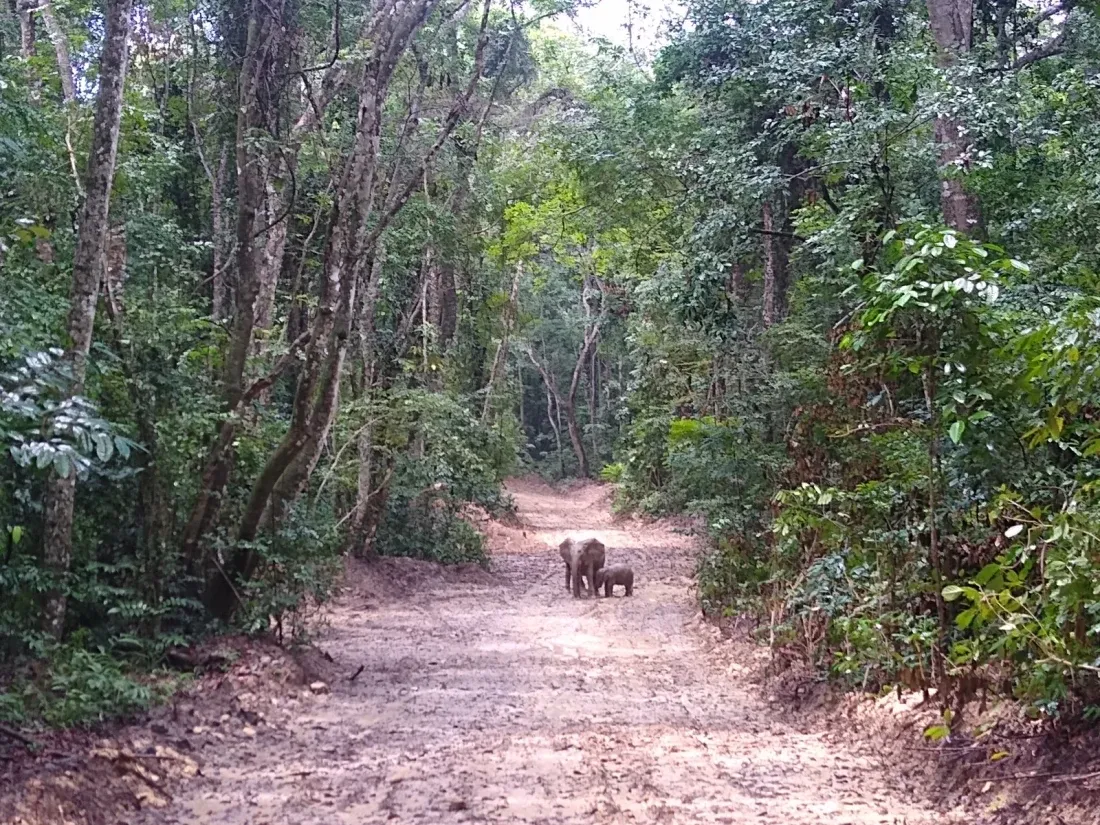
The monograph records that iboga seeds are dispersed by elephants.
The African forest elephant was assessed Critically Endangered in 2026.
So a plant with a stable conservation status has, as its only documented seed disperser, an animal at the highest category of extinction risk short of extinct in the wild. The 2019 assessment does not mention it.
Two honest caveats. The dispersal claim rests on a single botanical source and we found no peer-reviewed study documenting it for this species specifically. And this does not show the assessment is wrong, only that it did not weigh this.
No international trade control
Worth stating because it is widely assumed otherwise.
Iboga appears in no CITES appendix. We verified this against the European regulation that transposes the appendices, in which the entry for its plant family lists three other genera and not this one.
The family is in scope. The genus is not listed. There is no international permit requirement on iboga, and any provider claiming to hold one is describing something that does not exist.
What Gabon has done
The monograph, written in 2006, recorded a specific gap: the government considered iboga a national patrimony, but there was no law protecting it against overexploitation.
That has changed. Export has been suspended by ministerial order since February 2019, and a 2026 decree regulates the whole sector, classifying iboga as strategic national heritage, requiring prior authorisation from the culture ministry for any iboga activity, framing patent applications on the resource and its derivatives, and creating a sovereign fund.
Iboga in Gabon covers those instruments, and biopiracy and the Nagoya Protocol covers the benefit-sharing question they sit inside.
What we could not verify
A 2012 report commissioned by the Gabonese government, widely cited as establishing that iboga is disappearing from the forest, we could not retrieve. Secondary accounts note that its conclusions are considered speculative by some in the absence of a national park survey. We do not cite it as data.
Reported price rises in Libreville, described as roughly tenfold over a decade, come from a researcher-authored non-governmental publication rather than a measurement. We report it as that.
And there is no Gabonese protected-species listing for iboga, no national red list entry and no official seizure series that we could find.
The position to hold
Not endangered, and not fine either.
The category says Least Concern on an evidence base of four databases and a 1969 paper. The botany says the harvest kills whole plants and destroys stands at scale. The demand is rising and the plant takes six years to reproduce. And the one measurement that would settle it has never been made.
A site that told you it was endangered would be overstating. One that told you it was safe would be worse. What is true is that nobody knows, and that the people best placed to be harmed by getting it wrong live where it grows.
Common questions
Sources
3 sources · How we source
More in Tradition

The Babongo and Iboga
Bwiti's own account places them at its origin. The anthropology describes something more uncomfortable and more interesting than the Western telling.
Biopiracy and the Nagoya Protocol
Gabon has been bound since 2014 and has legislated at home since 2019. What the protocol obliges, and what the international register actually shows.