·
Tabernanthalog: Sold by the Kilogram, Never Given to a Human
Tabernanthalog has no registered trial and no human data. Manufacturers are offering it in kilogram quantities to ibogaine clinics, for research use.

Tabernanthalog has never been given to a human being in any registered study. The trial registry returns zero results for it. PubMed returns fourteen papers, all of them in rodents, cells or receptor preparations. It is nonetheless available for purchase in quantities up to the kilogram, sold for laboratory research, and manufacturers are offering it directly to the clinics that treat people with ibogaine.
This site has written about the analogues as a scientific question. This page is about something else, which is that the supply chain has arrived first.
What the record contains
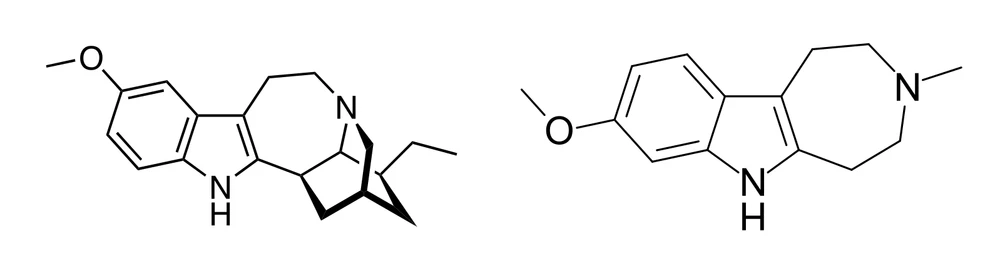

Tabernanthalog was described in a 2021 Nature paper as a non-hallucinogenic analogue built by simplifying the iboga scaffold, reported to promote neuroplasticity, to reduce alcohol- and heroin-seeking in animals, and to show less apparent cardiotoxicity than ibogaine in preclinical assays.
Five years later, this is the whole file.
| Question put to the record | Answer |
|---|---|
| Papers mentioning tabernanthalog on PubMed | 14 |
| Of those, clinical trials | 0 |
| Registered studies, ClinicalTrials.gov | 0 |
| Registered studies for the wider ibogalog class | 0 |
The fourteen are worth characterising, because a count alone can mislead. They run from the founding paper through circuit-level work on stress, a polydrug addiction model, nicotinic receptor pharmacology, neuropathic and visceral pain in mice, cancer-related cognitive deficits in a mouse tumour model, spatial memory in rodents, antiseizure activity in rodents, antioxidant activity in lipid membranes, and receptor modelling.
Every one is an animal, a cell or a molecule. Not one is a person.
The supply arrived anyway
Chemical manufacturers are selling tabernanthalog now, in quantities from grams to the kilogram, with stock held and short lead times.
They are not selling it into a vacuum. At least one approach has gone directly to an ibogaine treatment provider, the sender explaining that they had found the recipient while researching the market of ibogaine therapy providers. The material is offered for laboratory research use only, because it is not approved for human use, and international orders require a signed statement confirming that intended use.
This site does not name suppliers, publish prices or describe how to obtain anything. What matters here is the shape.
A statement of intended use is a document. It records what a buyer says they will do. It is not an inspection, not a licence, and not a control on what happens after delivery.
The compound is sold that way because it has not been approved for people. The buyers being approached are organisations whose work is giving substances to people.
Those two facts do not sit together, and the paperwork does not reconcile them. It only records that the seller asked.
The claim that should stop a reader
The pitch for this compound, in the approach we have seen, includes the assertion that the cardiac risk has been removed.
Understand what that sentence is doing. Ibogaine’s cardiac risk is not a reputational problem. It is the mechanism by which people have died, and it is the reason this site carries a page on ibogaine and the heart and another on the interactions that catch people out.
The founding paper reports less apparent cardiotoxicity in preclinical work. That is a real finding and it is worth having. It is also a statement about rodents and cell preparations.
Nobody has measured what this compound does to a human heart, because nobody has given it to a human in a study. “Cardiac risk removed” is not a description of evidence. It is a description of an absence of evidence, phrased as a reassurance.
Even the literature is arguing with the simple version
The more recent work makes the picture less tidy rather than more.
A 2024 pharmacology paper reports that tabernanthalog inhibits nicotinic acetylcholine receptors, with greater potency at those targets than at some others tested, which means it is not the clean single-target compound the shorthand implies. A 2025 study on receptor signalling argues that what distinguishes non-hallucinogenic from hallucinogenic compounds may be low signalling efficacy rather than the tidy biased-agonism story often told. And a 2025 mechanistic paper finds the compound produces sustained effects without the immediate gene-activation response classical psychedelics produce, which is interesting and also means the mechanism is not settled.
A 2026 review gathers all of it, and its translational language is more confident than the complete absence of human evidence supports. That gap between the tone of a review and the state of the file is itself part of what a buyer is reading.
People are already taking it
Self-reports from people who say they have consumed tabernanthalog have been published, including a structured phenomenological account.
There is no trial. There is no dose-ranging study. There is no safety database. There are people writing up what happened to them, and a compound available in kilogram quantities to anyone willing to sign a form.
That sequence is the whole point of this page. The ordinary order is trial, then approval, then supply. Here supply came first, marketing came second, and the trial has not been registered.
It is not saying tabernanthalog is dangerous. Nobody knows, and that is the problem rather than the accusation.
It is not saying the research is bad. The founding paper is in Nature, the follow-up work is in serious journals, and the design logic behind removing the hallucinogenic effect is a legitimate scientific programme.
And it is not saying the manufacturers are breaking rules. On what we have seen, they are describing their position accurately: not certified, not approved, sold for research, no trials they are aware of, and perhaps five to twenty years before any appear.
The problem is not that anyone lied. It is that a compound with no human data can be bought by the kilogram by the operators of clinics, and that everything in that sentence is currently permitted.
Ibogaine analogues sets out the three families and the pattern where the spinout puts a different molecule into trials. What the ibogaine companies have delivered covers what has come out of the regulated end of the same field, which is very little.
Common questions
Sources
3 sources · How we source