Tabernanthe iboga is a shrub of up to four metres in the Apocynaceae family, native to the forest understorey of Central Africa from Cameroon to Angola. Its root bark holds about thirty alkaloids, ibogaine among them. The leaves contain a different structural class and no ibogaine at all.

The botanical literature on iboga is small, mostly old, mostly French, and routinely misquoted by the much larger literature about the drug. This page stays with the floras.
Name and publication
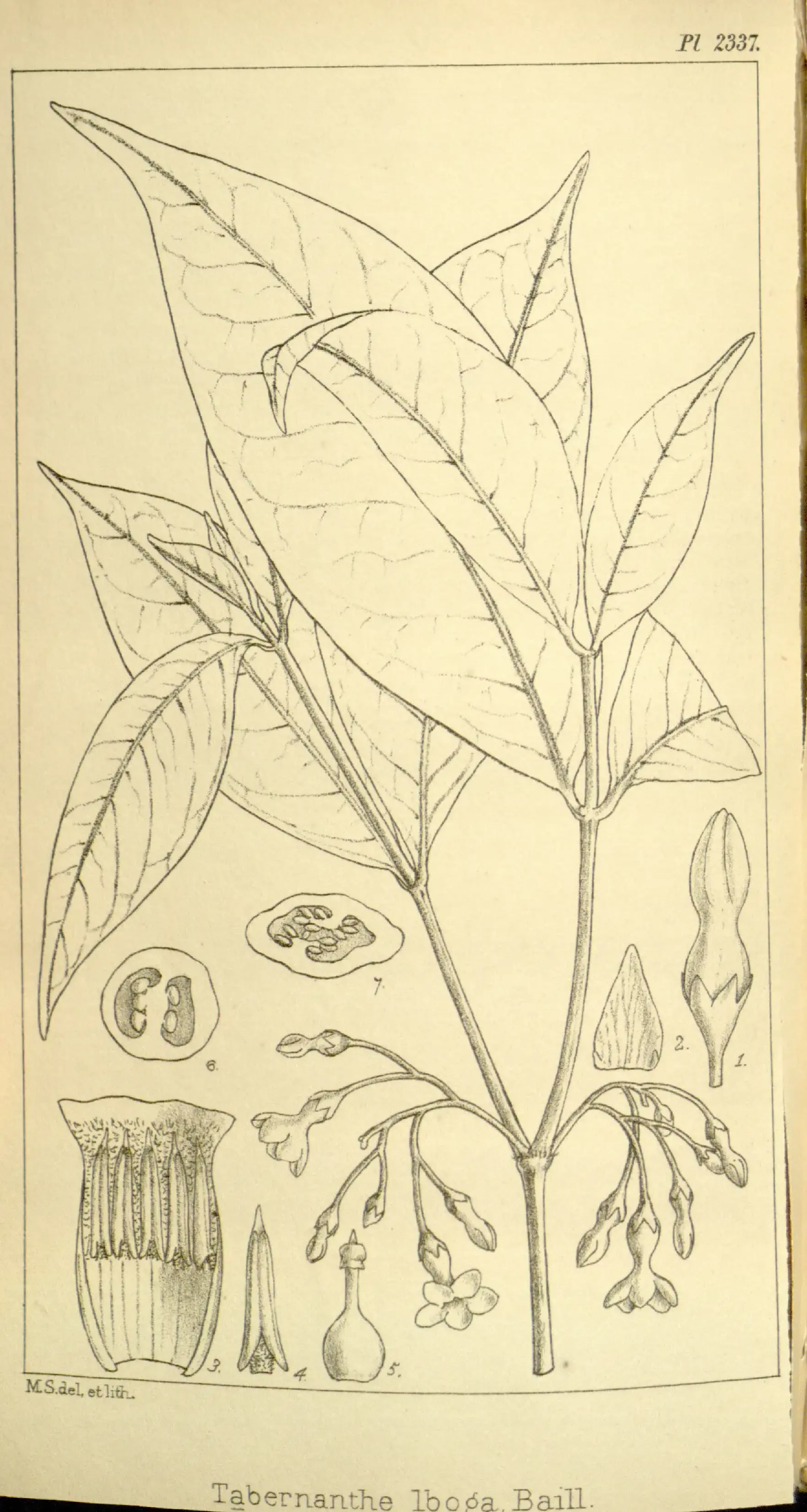
Tabernanthe iboga Baill., family Apocynaceae, order Gentianales. Chromosome number 2n = 22.
The protologue appeared in the Bulletin Mensuel de la Société Linnéenne de Paris, volume 1, page 783. The year is given as 1888 by two Kew databases and as 1889 by two others, including the International Plant Names Index. We have not resolved it, and we mention it because a discrepancy between Kew’s own products is a fair warning about how thin the underlying record is.
Several synonyms are folded into the accepted name, among them Tabernanthe mannii Stapf, which matters because the pharmaceutical literature of the 1930s describes its product as an extract of Tabernanthe manii. The count itself is one more place the databases disagree: the global backbone folds in six, Kew’s own list gives a different figure, and we have not reconciled them.
 Enlarge
 The other species
The genus contains two accepted species. Tabernanthe elliptica grows in the Congos and north-eastern Angola, differs in leaf venation and fruit structure, and hybridises with T. iboga.
PROTA’s frequently quoted numbers of 5.6 per cent alkaloids in root bark, 2.4 per cent in stem bark and about eighty per cent of that being ibogaine sit inside the paragraph describing T. elliptica, in a sentence with no explicit subject. They are widely reproduced as facts about T. iboga. We do not repeat them as such, and neither should anyone else without asking PROTA.
Structure and habitat
A shrub or small tree to four metres, repeatedly dichotomously branched, with white latex throughout and a trunk to ten centimetres in diameter. Bark pale to dark grey and smooth. The fruit is a berry of three to six and a half centimetres, yellow to red, with many seeds in white pulp. Seeds are seven to ten millimetres and deeply indented.
It grows in forest understorey, sometimes riverine or swamp forest, and in relatively wet savanna. Its seeds are dispersed by elephants feeding on the fruit, which is worth holding in mind when reading about the plant’s future.
Native range, from Kew: Gabon, Cameroon, the Central African Republic, Congo, the Democratic Republic of the Congo, and Angola with Cabinda.
Shrub or tree?
Both words are used, and the disagreement is real rather than careless.
The floras describe Tabernanthe iboga as a shrub or small tree reaching about four metres, with a trunk to ten centimetres across, repeatedly branching in twos. That is at the shrub end of the range by most definitions: no single dominant trunk, branching low, and a height a person can reach the top of.
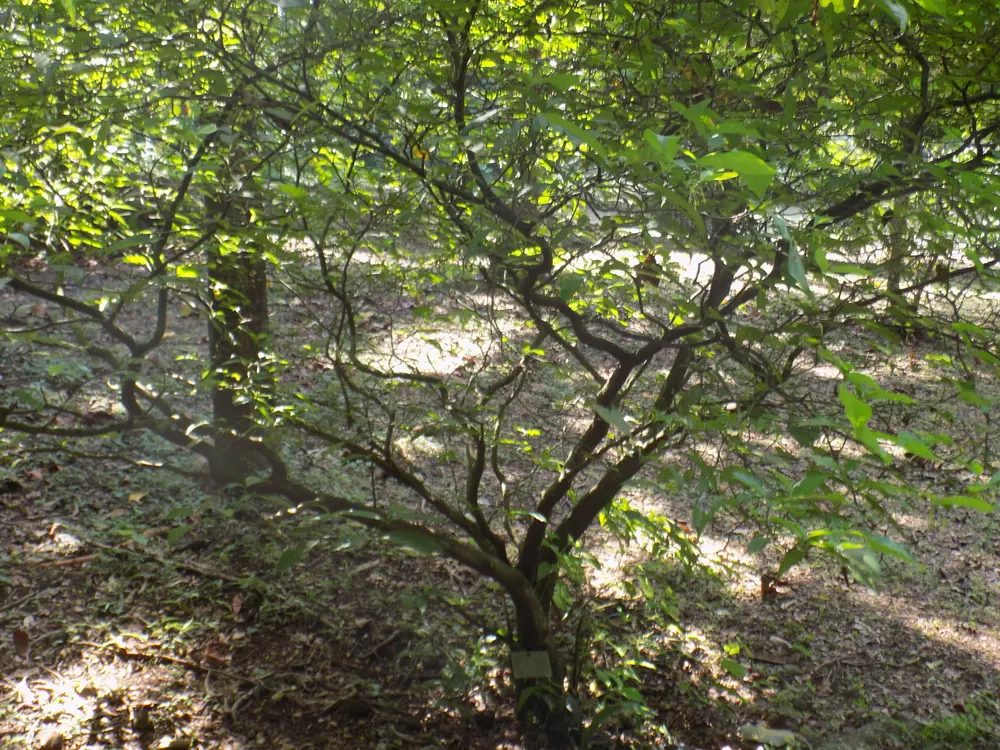
In cultivation and in open ground it grows taller and reads more like a small tree, which is where much of the photography comes from. Most images labelled as the iboga tree are of cultivated plants, and most people who search for the tree are picturing something considerably larger than what grows on the forest floor in Gabon.
The practical consequence is a slow one. It reaches roughly sixty centimetres in three years and takes five to six years to reproduce, and harvesting the root bark generally means taking the whole plant out of the ground. A plant that looks like a shrub and grows like one cannot be cropped like a tree, which is the arithmetic underneath the conservation question.
Searches for the iboga tree often land on a different species altogether. Voacanga africana is a genuine tree, to six metres and sometimes far more, in the same family, and it is the source of much of the world’s ibogaine by way of its bark. Where ibogaine actually comes from separates the two, and the confusion between them is not accidental.
Chemistry
Modern work using high-resolution mass spectrometry assigned thirty indole alkaloids to the root bark, and the verb matters. Seven had been reported for this plant before: ibogaine, iboxygaine, ibogaline, catharanthine, ibogamine, voacangine and coronaridine. The other twenty-three are tentative assignments, matched against databases of compounds reported in other species. The same analysis left a further forty-eight peaks as unidentified alkaloids, accounting for about a fifth of the total.
So the root bark carries something like seventy-eight alkaloid features, seven of which are securely identified. “Thirty alkaloids have been identified” is the sentence that circulates, and it is not what the paper says. The other alkaloids of iboga takes those seven individually, with what is known about each and how thin that is.
Distribution by plant part, from PROTA: root bark five to six per cent total alkaloids, roots one to two and a half, stem bark two, seed one, leaves under one.
The leaves are a genuine exception rather than simply a poorer source. Work published in 2018 found they produce isoplumeran-type alkaloids rather than the ibogan types of the roots and stems.
An earlier version of this page said that finding was consistent with a flat statement in PROTA that the leaves contain no ibogaine. That was wrong twice over, and we have corrected it.
PROTA’s main text says the opposite: ibogaine is present in all plant parts except the seeds. The “no ibogaine in the leaves” sentence sits in the paragraph describing Tabernanthe elliptica, the neighbouring species, which is the very paragraph this page warns elsewhere is easy to misattribute. We fell into the trap we had flagged.
And the 2018 paper does not say none either. Its words are that the ibogan alkaloids were markedly lower or not detected in leaf tissue, and that the leaf compounds were only tentatively identified.
| Question | What the published answers say |
|---|---|
| How much of the root bark is alkaloid? | Five to six per cent by the classical figure; one 2018 sample gave 7.8 per cent |
| How much of that alkaloid is ibogaine? | About 24.6 per cent by peak area in 2018; about 80 per cent by a 2002 visual estimate |
| How much ibogaine by weight? | 1.93 per cent of powdered root bark in the one modern sample we could find |
| Does the stem bark contain ibogaine? | PROTA says yes at two per cent; a 2002 study reports negligible amounts. Unresolved |
What has never been measured
No study has quantified how alkaloid content varies between individual plants, or between geographic origins, using botanically verified material.
Everything published as variation is variation between products, with provenance asserted by whoever sold them. That distinction is not pedantic: it is the difference between a plant that is inherently unpredictable and a supply chain that is. Nobody has established which.
Common questions
Sources
3 sources · How we source
More in The plant
Ibogamine and the Other Alkaloids of Iboga
What is ibogamine, how does it differ from ibogaine, and what have analyses found in iboga bark and extracts? A sourced look at the evidence and its limits.
Growing Iboga from Seed
Germination is slow, irregular, and fails once the seed coat dries. What the botanical record says, and where iboga is already farmed.