Iboga Patents: What the Register Actually Contains
Counts of iboga patents circulate without the query that produced them. Here are the queries, the counts, and what the register does not contain.

There is no such thing as the number of iboga patents. Ask the public register how many documents name Tabernanthe iboga on the front page and it answers two. Ask how many mention ibogaine anywhere in an English text and it answers 2,802. Every figure quoted in this debate sits somewhere in that range, and almost none arrives with the query that produced it. Below are the queries.
Counts of iboga patents circulate constantly. They appear in press releases, in advocacy documents and in news coverage, they differ from each other by an order of magnitude, and they share one feature: none of them is accompanied by the search that produced it, so none can be checked.
That is fixable in an afternoon, and this page is the fix.
The queries and what they return
These were run against
PATENTSCOPE, the free public
search system operated by the World Intellectual Property Organization, on
28 August 2026. FP searches the front page, meaning title, abstract and the
claims that appear there. EN_ALLTXT searches the full English text.
| Query | Documents |
|---|---|
FP:("tabernanthe iboga") | 2 |
FP:(iboga) | 55 |
FP:(ibogaine) | 148 |
FP:(noribogaine) | 202 |
FP:(ibogaine OR iboga OR noribogaine OR ibogamine OR voacangine) | 393 |
EN_ALLTXT:("tabernanthe iboga") | 412 |
EN_ALLTXT:(iboga) | 690 |
EN_ALLTXT:(ibogaine) | 2,802 |
Anyone can re-run these. The counts will drift upward as documents publish, which is a reason to date a figure rather than a reason to avoid producing one.
Three things inflate a patent count, and all three are usually silent.
A single invention filed in ten offices produces up to ten documents. Unless a count is deduplicated to one family member, it measures filing activity across borders rather than distinct inventions.
A full-text hit is a mention, not a claim. A formulation patent for an unrelated
drug that lists ibogaine among forty comparator compounds is counted by
EN_ALLTXT and has claimed nothing about iboga at all. That is most of the
distance between 148 and 2,802.
And full-text search here is English-only, so the same query undercounts documents published in other languages while overcounting mentions. The errors do not cancel.
The honest figure for what has actually been claimed is the front-page count, and it is in the hundreds rather than the thousands.
Three things in the table worth stopping on
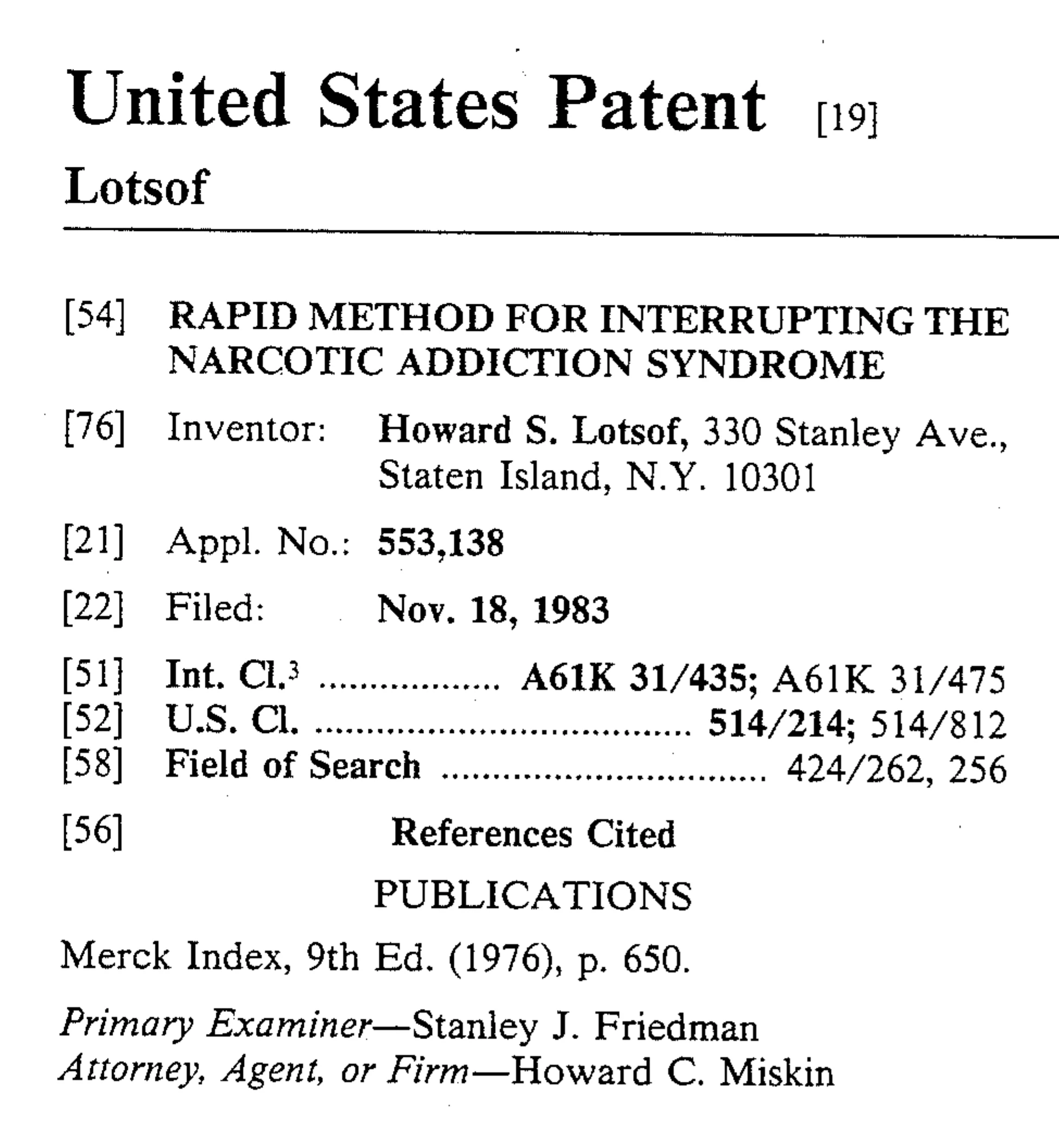
Noribogaine outnumbers ibogaine. A metabolite of the parent compound carries 202 front-page documents against ibogaine’s 148. This is not an accident of chemistry. Ibogaine has been described in the literature since the nineteenth century and its basic use was patented in 1985 and 1989, so the compound itself is poor patent material. Derivatives, metabolites, salts, formulations and methods are not. The register records where the claimable ground was, and it was downstream of the plant.
The plant is named, but never claimed. Two documents name Tabernanthe iboga on the front page, while 79 of the 148 name it somewhere in the text. It appears in the background section as the place the compound came from, and then does not appear in the claims. Seventy-five mention Africa. Six mention Bwiti.
So the register is not silent about origin, and a page saying otherwise would be wrong. Applicants say where the molecule came from, and say it often.
What is missing is the vocabulary of entitlement.
Phrase, within FP:(ibogaine) | Documents |
|---|---|
"tabernanthe iboga" | 79 |
africa | 75 |
gabon | 18 |
indigenous | 11 |
bwiti | 6 |
"traditional knowledge" | 0 |
"traditional medicine" | 0 |
"traditional use" | 0 |
ethnobotanical | 0 |
Naming a plant obliges an applicant to nothing. Naming traditional knowledge, in a world that has had the Nagoya Protocol since 2010, is a different kind of sentence to write, and across 148 documents nobody has written it.
 Enlarge
 The shape over time
| Period | Front-page documents |
|---|---|
| 1980 to 1999 | 26 |
| 2000 to 2009 | 27 |
| 2010 to 2019 | 181 |
| 2020 to 2026 | 119 |
Query: FP:(ibogaine OR noribogaine OR iboga) AND DP:[period].
Two decades of near-flat activity, then a sevenfold jump in the 2010s. The current decade is running at a similar rate with three years still to go, so the step change of the 2010s has held rather than reversed.
Who actually holds this
The same register answers a question the counts alone do not: whose filings these
are. PA searches the applicant field.
Applicant, within FP:(ibogaine OR noribogaine OR iboga) | Documents |
|---|---|
| All applicants | 365 |
| DemeRx | 196 |
| atai | 16 |
| Leland Stanford Junior University | 15 |
| Ambio Life Sciences | 8 |
One company holds more than half of the entire front-page corpus. Narrow it to the metabolite and the concentration is starker still: of the 202 documents carrying noribogaine on the front page, 157 are DemeRx, which is 78 per cent.
That single fact reframes the whole subject. A field described as a global scramble is, in the register, largely one portfolio. The company was founded by a researcher whose academic work on ibogaine this site cites elsewhere, and the overlap between the people who publish the science and the people who hold the claims is a recurring feature rather than an accident.
Stanford’s fifteen documents are worth noting beside the veteran PTSD cohort, whose paper discloses that authors are inventors on patent applications. Ambio’s eight sit beside a clinic operator publishing case reports on an indication it has also filed on.
One patent, followed from provisional to lapse
Counts are abstractions. It is worth walking a single document from beginning to end, because the shape of one patent’s life explains why the totals above overstate what anyone actually controls.
Take US 8,993,559, Use of ibogamine congeners for treating obesity, assigned to Albany Medical College and naming Stanley Glick, Isabelle Maisonneuve and Olga Taraschenko as inventors.
| Event | Date |
|---|---|
| Provisional application 61/023,977 filed | 28 January 2008 |
| Published as application US 2009/0281134 A1 | 12 November 2009 |
| Granted as US 8,993,559 B2 | 31 March 2015 |
| Confirmatory licence recorded to the National Institutes of Health | 23 April 2015 |
| Anticipated expiry | 23 May 2031 |
| Actual status | Expired, fee related |
Four things follow from that table.
Seven years separate the filing from the right. Between January 2008 and March 2015 this was an application, not a patent, and it restrained nobody. Every count on this page mixes documents at that stage with granted patents, because the front-page register does not distinguish them. Counting filings counts intentions.
It died early, and not because anyone challenged it. The term ran to 2031. The status reads expired, fee related, which means the maintenance fees stopped being paid. No court, no opposition, no revocation. Somebody decided it was not worth the renewal, and the claims fell into the public domain sixteen years before they had to.
The public paid for it. A confirmatory licence to the National Institutes of Health, recorded three weeks after grant, is the marker of federal research funding. Public money produced the work, a college held the exclusive right, and the right lapsed unused.
The indication is obesity. Not addiction, not depression, not trauma. The claims cover administering ibogamine congeners at 1.0 to 80 mg/kg to treat obesity, and they rest on the same laboratory’s rat work that we read closely on ibogaine for other addictions, where 18-MC reduced operant responding for sucrose. A reader scanning the totals above would count this document as part of an iboga patent thicket. It is a weight-loss method claim from a pharmacology department, granted, unused and now dead.
What an independent study adds
The queries above are cheap, reproducible and limited. They count documents, not inventions, they read front pages rather than claims, and they cannot tell a live patent from a dead one. A study published in 2026 does all three things properly, and this page would be weaker without it.
It was prepared by Porta Sophia, a non-profit that maintains a prior-art library for psychedelic compounds, with a patent search cut-off of 21 May 2026. That library is searchable and is worth a reader’s time independently of the study: it holds prior art on iboga as websites, books, articles and patents, and searching it is the quickest way to see what a patent examiner would be shown. The organisation also states that its prior-art services are provided free of charge where a patent attempts to monopolise a known Indigenous practice. Its central method choice is the one that matters: every term was searched in the claims of each patent, not in the description, on the ground that the claims are what define the legal right. A document mentioning iboga only in its background was deliberately excluded.
Its findings, which our own queries cannot produce:
Filings are not inventions. 1,382 filings across 24 jurisdictions reduce to 273 distinct inventions once families are merged. The most threatening to traditional knowledge number 57.
Most of the threatening ones are dead. Behind those 57 inventions sit 256 filings. Twenty-one are in force, 43 are under examination, and 192 have expired or been abandoned. An expired patent stops nobody from doing anything.
A handful of holders. DemeRx accounts for 18 of the 57 inventions. atai, and the former NDA International and Addiction Research Institute portfolios, hold seven each. Together, 32 of 57.
Most claim the traditional use itself. 155 of the 256 concern the treatment of addiction, withdrawal or dependence, which is the oldest documented use of iboga rather than a modern discovery.
The filings do name the origin. 224 of the 256 refer to indigenous knowledge, traditional medicine, or name the iboga plant in their own text. That is consistent with what our own front-page queries found, and it is the applicants’ own wording rather than an inference.
Almost nothing is filed in Africa. The United States accounts for 380 filings, international applications 187 and Europe 150. Africa has 20, of which only two went through OAPI, the regional system Gabon belongs to, and both of those were filed in 2000.
Two things persuaded us. Where the chemistry made it unclear whether a claim actually covered a naturally occurring iboga compound, the study referred the claim to a chemist: 132 such cases were reviewed and 84 were removed from the report as genuinely novel laboratory chemistry. A study that discards two-thirds of its own ambiguous cases is not counting to reach a number.
And it publishes the figure advocacy usually omits, that 192 of the 256 most threatening filings are already dead.
It also states its own limits plainly: it is not legal advice, it is thorough but not exhaustive, it did not assess the validity or enforceability of any patent, and it recommends no course of action.
Disclosure. The study was written by Porta Sophia and commissioned by two conservation organisations, Blessings of the Forest and the Indigenous Medicine Conservation Fund, both of which campaign on this issue. We apply the same rule here that we apply to studies whose authors hold shares in the clinics they report on: who paid is part of what a reader needs. It does not make the arithmetic wrong, and we have reproduced the parts we can.
What this proves and what it does not
It does not prove theft. A patent on a synthetic derivative is not a claim over a plant, and nobody is prevented from using iboga in Gabon by anything in this register. Reading a patent count as a count of thefts is the error that makes this subject hard to discuss.
It does not prove value either. Most patents are never worked. A filing is a bet, not a revenue stream, and the companies file across the whole field precisely because they do not know which bet will land. What the ibogaine companies have actually delivered covers how little has emerged at the other end.
What it measures is which acknowledgement gets made, and there the finding is clean. An intellectual property system recorded several hundred claims arising from a plant. The plant is named freely, the continent almost as often, and the one category that carries legal consequence is named by nobody at all.
That is not a moral accusation against any individual applicant. Patent drafting has had no field for provenance, and no drafter is penalised for omitting what the form does not ask. It is a description of what the system was built to record, and what it was built to leave out.
That is precisely what a treaty adopted in 2024 sets out to change by putting the missing term on the form for the first time. The GRATK Treaty covers what it requires, and the four reasons it cannot reach any document counted on this page.
That gap is the entire subject of biopiracy and the Nagoya Protocol, which sets out the instrument written to close it, what it requires, and why a protocol about access and benefit sharing does not reach a patent office.
Method
Register: PATENTSCOPE, WIPO. Dates run: 28 and 29 August 2026. Counts are documents, not deduplicated to one member per family, and full-text queries are English-only. Both limitations inflate rather than deflate, and are stated here so that a reader comparing this page against a larger published figure can see exactly where the difference comes from.
Common questions
Sources
6 sources · How we source
- PATENTSCOPE, the WIPO international patent search system
- Rapid method for attenuating the alcohol dependency syndrome, US 4,857,523
- Use of ibogamine congeners for treating obesity, US 8,993,559 B2
- Prior art library search tool
- The patent record on iboga medicine, a global analysis of patent claims on iboga medicine and traditional knowledge
- Nagoya Protocol on Access to Genetic Resources and the Fair and Equitable Sharing of Benefits Arising from their Utilization