Why Is Ibogaine Illegal? The 1970 Schedule I Decision
Congress wrote ibogaine into the Controlled Substances Act in 1970, before its claims were tested and decades before its risks were understood.

Congress wrote ibogaine into Schedule I of the Controlled Substances Act on 27 October 1970, as item 8 in a list of seventeen hallucinogens, before its claimed effect on addiction had been tested. The cardiac risk now given as the reason to keep it there was not established until decades later.
When was ibogaine made illegal?
The date is exact, and it matters more than the usual “around 1970”.
Ibogaine is named in the text of the statute Congress passed. Schedule I(c) of the Comprehensive Drug Abuse Prevention and Control Act of 1970 lists seventeen hallucinogenic substances, and item 8 is a single word: Ibogaine. It sits between 4-methyl-2,5-dimethoxyamphetamine and lysergic acid diethylamide. The Act was signed on 27 October 1970. Ibogaine was not added later by agency rulemaking. It was in the bill.
It remains there today, at 21 CFR 1308.11(d)(21), DEA drug code 7260.
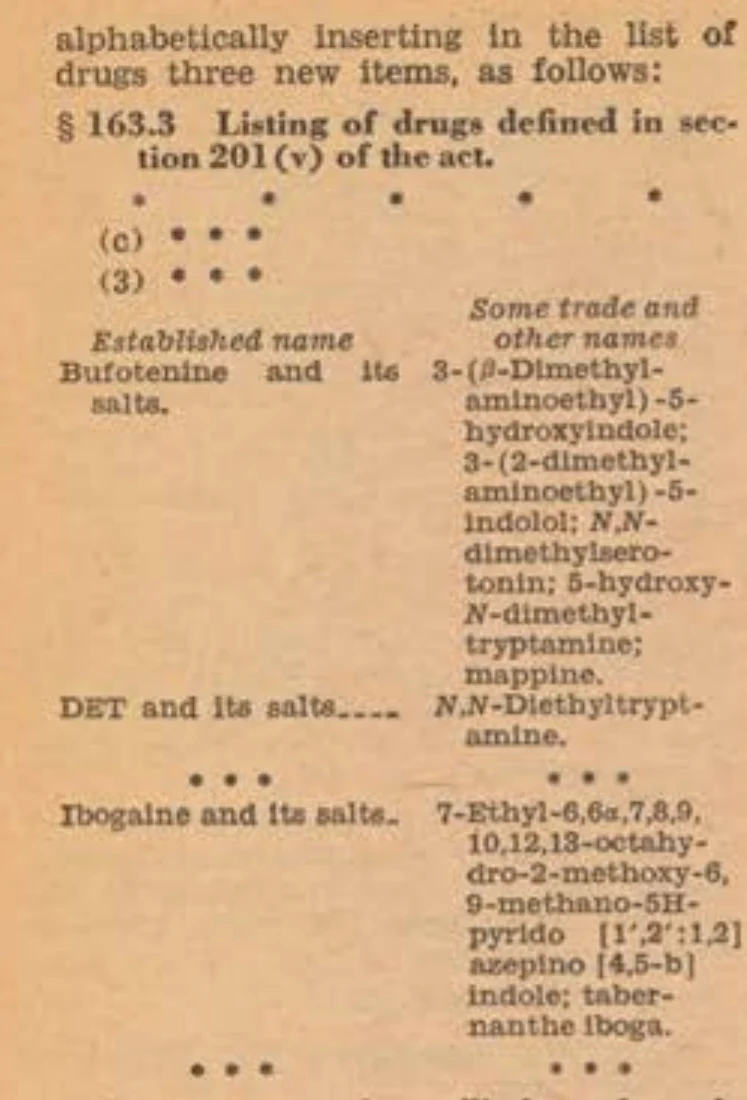
Three years earlier, in 1967, the Food and Drug Administration had already restricted it, using powers granted by the Drug Abuse Control Amendments of 1965, which allowed it to list substances with a potential for abuse. The context in both cases was a general federal retreat from psychedelics, not a finding about this molecule.
The order of events
| Year | Event | What it established |
|---|---|---|
| 1962 | Howard Lotsof, a 19-year-old with opioid dependence in New York, takes ibogaine and reports no withdrawal and no craving | An uncontrolled self-report, later extended to six friends |
| 1967 | FDA restricts ibogaine under the Drug Abuse Control Amendments of 1965 | A substance with potential for abuse |
| 1970 | Congress names ibogaine in Schedule I of the Controlled Substances Act, 27 October | No accepted medical use, high potential for abuse, no accepted safety |
| 1990-1995 | The National Institute on Drug Abuse funds preclinical animal work, then declines in 1995 to fund the human study | An effect in rats, never tested for efficacy in people |
| 2009 | A case report in the New England Journal of Medicine records a QTc of 548 ms after a single dose | The cardiac signal, in a top-tier journal |
| 2012 | A forensic review of the 19 ibogaine-associated deaths reported between 1990 and 2008 outside West Central Africa | Comorbidities or other drugs explained or contributed to death in 12 of the 14 cases with adequate records |
| 2015 | A review in Molecules sets out hERG channel blockade, QT prolongation and torsades risk | The mechanism, and a conclusion that ibogaine is unsafe at therapeutic doses |
The prohibition is therefore older than the evidence now offered to justify it, by thirty-nine years to the first published cardiac signal and forty-two to the mechanism. That does not make the prohibition wrong. It makes the usual explanation of it false.
“Is ibogaine dangerous?” and “why is ibogaine illegal?” have different answers, and conflating them is the single most common error on this subject. It is dangerous, for reasons the cardiac risk page sets out. It is illegal for reasons that predate that knowledge.
One nuance the mortality literature adds, and that both camps tend to drop: the deaths cluster where the heart was already compromised, other substances were present, or nobody was watching. That is an argument for screening and monitoring rather than for prohibition, and it is equally an argument against the claim that ibogaine is safe in competent hands without either.
 Enlarge
 The three findings, examined
Schedule I placement rests on three statutory findings. Two are contestable and one is self-fulfilling.
High potential for abuse. Ibogaine produces a day of nausea, vomiting and near-total collapse. Recreational demand is negligible, there is no significant illicit market of the kind the abuse criterion was written for, and the LAPPA brief prepared for the federal Model Acts Program says plainly that ibogaine is not used recreationally or as a club drug.
No currently accepted medical use in the United States. True, and true in part because of the schedule. A Schedule I listing makes research harder, slower and more expensive; the absence of accepted medical use that results is then cited as grounds for the listing. This circular logic is a known feature of the Act, not something unique to this drug.
Lack of accepted safety under medical supervision. This is the finding that has aged into accuracy. In 1970 it was an assumption. Today the cardiac literature supports it, at least for administration without screening and monitoring.
Cocaine and fentanyl are Schedule II, because they have accepted medical uses. The schedule records a regulatory judgement about medical use, not a ranking of harm. Reading Schedule I as “the most dangerous” is a mistake the categories invite and do not support.
Why other countries diverged
Ibogaine is not listed under the 1971 Convention on Psychotropic Substances. There is no treaty obligation to control it, and it is not on the World Health Organization’s list of substances under surveillance either, so it is not even in the pipeline for international review.
That single absence explains the map. Without an international requirement, each country decided for itself, at its own moment, usually by extending an existing rule rather than by considering ibogaine on its merits. Six regimes resulted, and the status by country table marks which entries we have read against the primary text and which we have not.
| Regime | Where | What it means |
|---|---|---|
| Prohibited | United States, France, Sweden, Switzerland, Belgium, Italy, Denmark, Hungary, Israel, Singapore | Criminal offences attach to supply and usually to possession |
| Supply prohibited | United Kingdom, Ireland, Germany, Finland, Brazil | Supply and import are offences; simple possession is not |
| Unscheduled | Netherlands, Mexico, Costa Rica, Portugal, Uruguay, Norway | No drug offence, and no approval either |
| Prescription medicine | Canada, New Zealand, Australia, South Africa | Lawful from an authorised prescriber, for a product no regulator has approved |
| Authorisation | Gabon | The origin country, governing its own plant through a permit regime rather than a drugs schedule |
| Decriminalised | Colorado under state law | Still unlawful, but personal possession is handled administratively |
Portugal sits in the unscheduled row rather than the decriminalised one, and the reason is worth stating because it is the mistake we most often have to correct. Portuguese decriminalisation is real and famous, and it does not touch ibogaine: the substance appears in none of the Portuguese schedules, so there is nothing scheduled to decriminalise.
The prescription route is the most coherent of these and the least travelled. Canada reached it in 2017, after fatal adverse reaction reports, by adding ibogaine to its Prescription Drug List rather than to its drug schedules. That is the clearest example of a state treating ibogaine as a medicine whose problem is unsupervised use, rather than as a drug whose problem is existence.
The status by country table gives each jurisdiction and the instrument behind it.
What is moving now
More than at any point since 1970, and less than the headlines suggest.
At least nine US states have enacted ibogaine research legislation since early 2025, and they do not all do what the coverage implies. Texas appropriated a reported $50 million, Arizona $5 million. Mississippi built a framework and attached nothing to it, the $5 million widely reported there being an error we made ourselves in the first version of that page. California, Oklahoma and Kentucky appropriate nothing: Kentucky’s $42 million was removed by committee substitute before the bill passed over the governor’s veto. Colorado went furthest of all, having decriminalised personal possession by ballot measure in 2022. None of them legalises anything, because no state can reschedule a federally controlled substance. The federal position sets out each instrument.
On 18 April 2026 the President signed Executive Order 14401, Accelerating Medical Treatments for Serious Mental Illness. Two of its provisions bear on this question.
It directs the Attorney General to open a rescheduling review once a product completes Phase 3 clinical trials for a serious mental health disorder, with rescheduling itself reserved for products ultimately approved. And it names ibogaine directly, ordering the FDA and DEA to build a Right to Try access pathway for eligible patients, including the Schedule I handling authorisations a treating physician would need.
The sequence is: a completed Phase 3 trial, then a rescheduling review, then approval, then rescheduling if appropriate. No ibogaine product has completed Phase 3, so the first link has not been forged. The order writes the sequence down; it does not shorten it, and legal commentators have questioned whether an executive order can compel rescheduling at all.
The honest summary
Ibogaine is in Schedule I because of when it was noticed, not because of what was known about it. It stays there because the machinery for getting out requires clinical evidence that fifty years of prohibition made difficult to produce, and because the evidence that has since emerged about its cardiac effects gives regulators a reason not to hurry.
Both halves of that sentence are true at once. A reader who holds only the first concludes ibogaine is a victim of politics. A reader who holds only the second concludes the ban was always sound. The record supports neither on its own.
Common questions
Sources
9 sources · How we source
- 21 U.S.C. 812, Schedules of controlled substances
- Comprehensive Drug Abuse Prevention and Control Act of 1970, Pub. L. 91-513, 84 Stat. 1236
- 21 CFR 1308.11, Schedule I
- Executive Order 14401, Accelerating Medical Treatments for Serious Mental Illness
- Green List: substances under international control, 1971 Convention
- Koenig X, Hilber K. The anti-addiction drug ibogaine and the heart. Molecules 2015;20(2):2208-2228
- Alper KR, Stajic M, Gill JR. Fatalities temporally associated with the ingestion of ibogaine. J Forensic Sci 2012;57(2):398-412
- Hoelen DWM, Spiering W, Valk GD. Long-QT syndrome induced by the antiaddiction drug ibogaine. N Engl J Med 2009;360(3):308-309
- Ibogaine, Legislative Analysis and Public Policy Association, April 2025