Ibogaine in South Africa
South Africa places ibogaine in Schedule 6, with morphine and fentanyl. A practitioner may administer it, but no product is registered.

Ibogaine is a Schedule 6 medicine in South Africa rather than an illegal drug, which puts it with morphine and fentanyl rather than with ordinary prescription drugs. A registered practitioner may prescribe and administer it, but no product is registered, so any administration requires a section 21 authorisation from SAHPRA for a named patient.
Medicine, not contraband
South Africa controls ibogaine under the Medicines and Related Substances Act 101 of 1965, and specifically in Schedule 6 of the schedules made under section 22A(2). That is the highest schedule a medicine can occupy while remaining prescribable, and the company it keeps is morphine, fentanyl, methadone and single-component codeine, not ordinary prescription drugs.
Ibogaine does not appear in the Drugs and Drug Trafficking Act 140 of 1992, including in the Schedules substituted in full by the amendment act of 2022, so it is not a drug in the trafficking sense. It is a scheduled medicine in the company of the controlled opioids, and a registered practitioner may lawfully prescribe and administer it within their scope of practice.
Possession is narrower than that summary suggests. Section 22A(16) permits possession of a Schedule 6 substance to someone holding a prescription from an authorised prescriber, to a practitioner administering it within their scope of practice, and to a pharmacist or licence holder holding it for sale. Possession outside those routes contravenes the Medicines Act. It is not a free space.
South Africa is, on paper, the country where that route is most travelled, and the one where the treatment sector is most visible. We have not been able to establish from any primary source how many practitioners administer it, or under how many section 21 authorisations, so treat the size of that sector as reported rather than documented.
Canada, New Zealand, Australia and South Africa share a regime and differ sharply in what it produces. The variable is not the law. It is how many practitioners are willing to take responsibility for an unapproved drug, and what professional infrastructure exists around them.
 Enlarge
 Approval is still missing
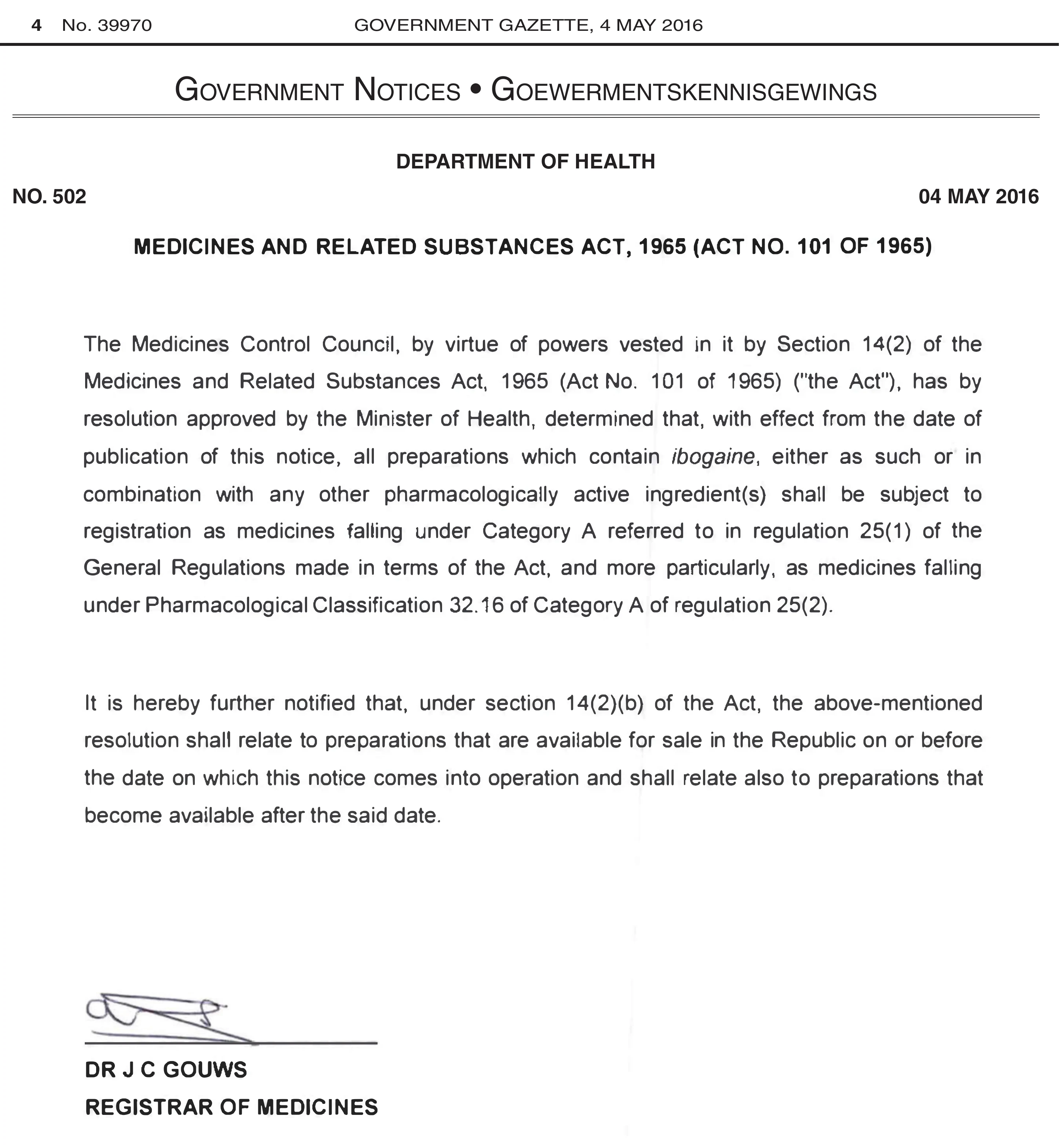
Scheduling is not registration. In Government Notice 502 of 4 May 2016 the Medicines Control Council, with the Minister’s approval, called up all preparations containing ibogaine under section 14(2) of the Act: they became medicines subject to registration, in Category A, pharmacological classification 32.16. The effect is that an ibogaine preparation may not lawfully be sold in South Africa unless it is registered, and no registered product is known.
The route around that is section 21, under which SAHPRA may authorise the sale of an unregistered medicine for a specified purpose and period. It is South Africa’s equivalent of Canada’s Special Access Program and Australia’s Special Access Scheme, and it is granted for a named patient or a specified institution, for a stated quantity and period. A practitioner administering ibogaine is administering an unregistered medicine, which requires a section 21 authorisation, and carries the clinical responsibility personally.
SAHPRA regulates the import, manufacture and distribution of health products, which is why material moving through licensed channels is pharmaceutical-grade ibogaine hydrochloride rather than root bark. It does not follow that any particular facility is using it. That is a question to ask a provider, and to ask for documentation of.
What to check with a South African provider
A lawful regime is not the same as a competent provider, and the questions worth asking are the same as anywhere.
Is the person administering it a registered medical practitioner, and registered in what discipline? Is the ibogaine pharmaceutical-grade hydrochloride, and can they say where it came from? Is an ECG performed before, and is cardiac rhythm monitored throughout? What happens in the event of an arrhythmia, and how far is the nearest hospital?
A regulated country makes those answers checkable. It does not make them good.
SAHPRA regulates health products. The practice of medicine is governed separately, by the professional council that registers practitioners. A facility may be handling a properly scheduled medicine and still be doing so in a setting that would not satisfy anyone about cardiac risk. The questions worth putting to a provider are in the treatment section.
South Africa in context
Four countries treat ibogaine as a prescription medicine, and South Africa has the fewest published regulatory decisions explaining why.
| Instrument | Since | Class | Approved product | Published accountability | |
|---|---|---|---|---|---|
| Canada | Prescription Drug List | 19 May 2017 | Prescription drug | None | Criminal charge, 2026 |
| New Zealand | Medsafe classification, gazetted | 11 Feb 2010 | Prescription medicine | None | HDC decision on a death, 2015 |
| Australia | Schedule 4, Poisons Standard | date not established | Prescription Only Medicine | None | None found |
| South Africa | Schedule 6, Act 101 of 1965 | GN 502, 4 May 2016 | Narcotic-class medicine | None | None found |
Of the four, South Africa’s position has to be read out of the schedules and a single 2016 gazette notice rather than out of a published rationale. What is offered in South Africa covers the practice that has grown up under it. See the status by country table for the comparison, and New Zealand for the same regime with a clearer paper trail.
Common questions
Sources
5 sources · How we source