Is Ibogaine Legal in the United States?
Ibogaine is a Schedule I controlled substance under federal law. What that means, and how recent state-level activity does and does not change it.

No. Ibogaine is a Schedule I controlled substance under federal law, which makes it illegal to manufacture, distribute or possess in all fifty states. Nine states have enacted ibogaine legislation since 2025, though most of it funds nothing, and a 2026 executive order directs agencies to speed the research up. Neither changes the schedule.
What Schedule I means
Schedule I is the most restrictive category of the Controlled Substances Act. Placement there rests on three findings: a high potential for abuse, no currently accepted medical use in treatment in the United States, and a lack of accepted safety for use under medical supervision.
The second finding is the one that matters most in practice. Because a Schedule I substance has no accepted medical use by definition, no physician can prescribe it. Not a specialist, not with informed consent, not for a patient who has exhausted everything else. The route to lawful administration runs through a research registration and an approved protocol, not through a prescription pad.
Manufacture, distribution and possession are federal offences. Simple possession falls under 21 U.S.C. 844: a first offence carries up to a year and a minimum fine of $1,000, with the penalties escalating on a prior record. Larger quantities and evidence of intent move the charge to 21 U.S.C. 841, where the exposure is far greater.
State drug laws apply on top, which is why a single act can be charged twice over. Most states mirror the federal listing, though not all: according to the LAPPA brief prepared for the federal Model Acts Program, Alaska classifies ibogaine in its Schedule II, Maine in Schedule X and Massachusetts as Class C.
Schedule I is often read as a statement that a substance is more dangerous than those in lower schedules. It is not. Cocaine and fentanyl are Schedule II, because they have accepted medical uses. The schedule records a regulatory judgement about medical use, not a ranking of harm.
How it got there
Ibogaine’s prohibition predates any finding about its safety.
The Food and Drug Administration acted against it in the late 1960s, at a moment when the federal government was moving against psychedelics generally. The Controlled Substances Act of 1970 then placed it in Schedule I alongside the rest of that class. The anti-addictive observation that now drives interest in it had been made in 1962, but it had not been examined, and the cardiac mechanism that constitutes the real risk would not be understood for decades.
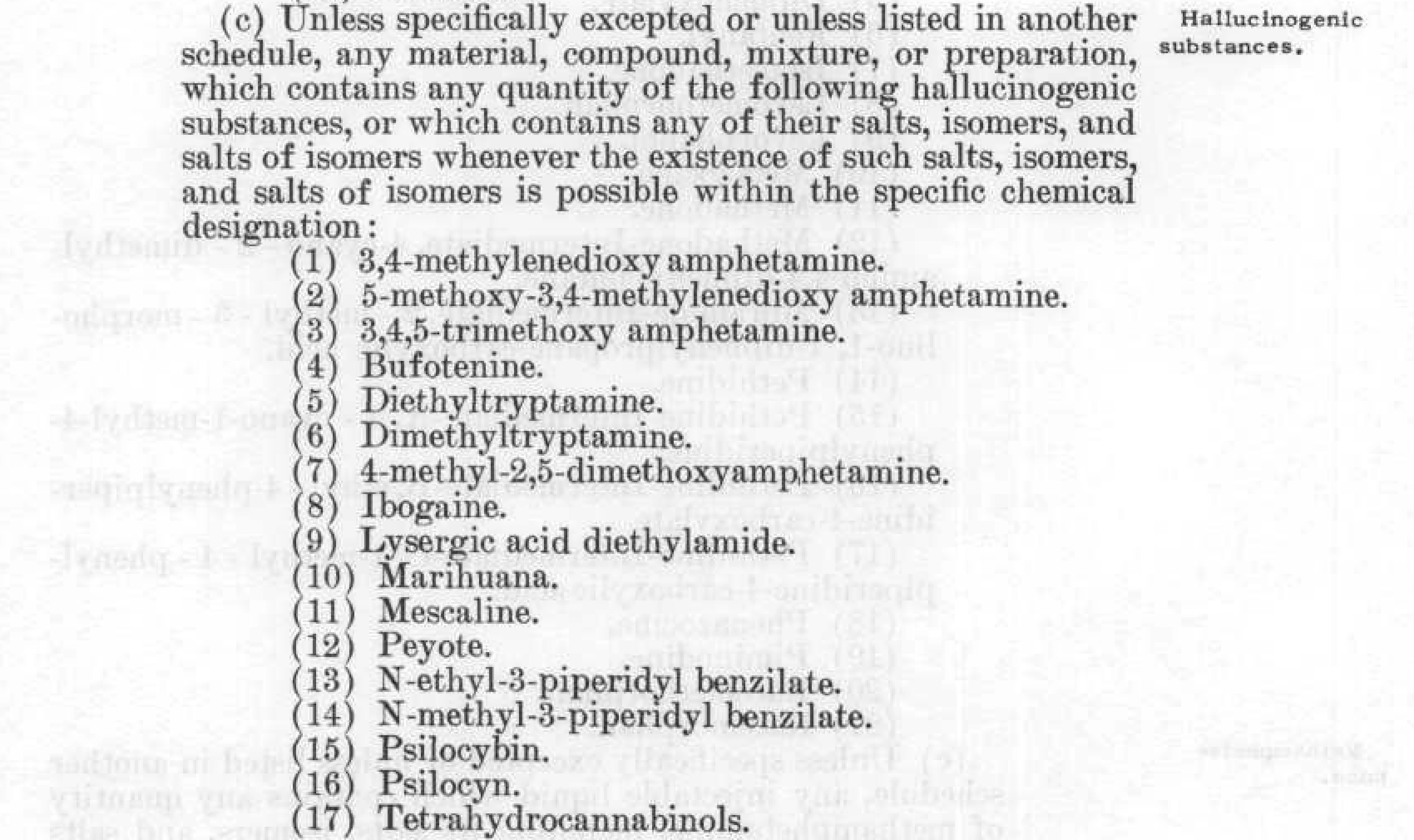 Enlarge
 The order matters. Ibogaine was not scheduled because it was found dangerous. It was found dangerous later, and that later finding is now routinely offered as the reason for the original decision.
The full account, including why the classification has proved so durable, is on why ibogaine is illegal.
What the states have actually done
Nine states have enacted ibogaine legislation since 2025. Most of them appropriate nothing, which the coverage rarely says.
The Tennessee HOPE Act passed both chambers in April 2026 and was signed by the speakers in May. We have not been able to confirm its enactment against a public chapter number, so it is absent from the table below rather than listed on the strength of reporting.
| State | Instrument | What it does | Money |
|---|---|---|---|
| Texas | SB 2308, June 2025 | State funds for an FDA-supervised trial, awarded to a university consortium | $50m via SB 1, matched from non-state sources |
| Arizona | SB 1735, FY2026 budget, June 2025 | Grant for a clinical study in neurological disease, awarded to Barrow Neurological Institute in August 2026 | $5m, no matching requirement in law |
| Indiana | HB 1001, enacted spring 2025 | Extends a psilocybin research fund to ibogaine | Shared fund |
| California | AB 1103, October 2025 | Streamlines approval for federally authorised Schedule I research | None |
| Mississippi | HB 314, March 2026 | Consortium framework, disbursement contingent on a non-state match | None in the Act; $5m expected from settlement funds |
| Kentucky | SB 77, April 2026 | Research framework with post-approval access conditions, enacted over a veto | None, $42m stripped in committee |
| Oklahoma | HB 3834, May 2026 | Contracts for multistate trials, with post-approval access conditions | None |
| Colorado | HB 26-1325, 2026 | Research pilot of up to five sites, conditional on donations | No state money |
| Louisiana | SB 43, 2026, law without signature | Psychedelic therapy programme covering psilocybin, ibogaine and MDMA | No state money; permits parishes to spend settlement funds |
Every law above builds a research or trial framework. None reschedules ibogaine, none authorises treatment, and none could: a state has no power over a federal schedule. A reader who takes “my state passed an ibogaine law” to mean access has misread all of them.
Nor do they all pay for anything. Kentucky’s $42 million, being $21 million in each year of the 2026-2028 biennium drawn from the opioid abatement trust fund, was removed by Senate committee substitute on 11 March 2026, three weeks before final passage. The emergency clause went with it. Most coverage still quotes the figure.
The programmes are starting to merge
Three of the 2026 laws require it. Mississippi’s consortium must collaborate with another state that has taken the same step, and Kentucky and Oklahoma both define an eligible drug developer as one holding an agreement with at least one additional state.
The reasoning is sound: no single state can fund a drug from Phase 1 to approval, and several separate underpowered studies would produce several inconclusive answers. It also concentrates the risk that Kentucky’s governor named. Pooled public money from several states, moving toward whichever developer wins the contract, makes the question of who that developer is considerably larger.
Kentucky and Oklahoma have both attached conditions to the far end of that bargain. Under each, a contracting developer must plan for accessible treatment after FDA approval: priority for state residents, an effort to secure third-party payor coverage, access routes for the uninsured, and provider training. Kentucky enacted its version on 14 April 2026, a month before Oklahoma.
Colorado is the exception, and not in the way people think
One state has gone further than funding research. Colorado’s Proposition 122, approved by voters in 2022, decriminalised the personal use and possession of several natural medicines, ibogaine among them. That is the state legislature’s own description of it, in the fiscal note to a 2026 bill.
Three things follow, and all three are routinely lost.
It is decriminalisation, not legalisation. The state penalty for personal possession is removed. There is no lawful supply, no lawful sale, and no provider who may administer it.
The federal offence is untouched. Possession remains a federal crime in Colorado exactly as in Texas. A state declining to prosecute is not a state granting permission.
Ibogaine is not yet in the regulated programme. Colorado’s healing centres currently work with psilocybin. In 2025 the Natural Medicine Advisory Board recommended adding ibogaine, conditional on the medicine being sourced through the Nagoya Protocol, and HB 26-1325 in 2026 built a research pilot around that condition. The full account is on ibogaine in Colorado.
The Kentucky veto, and the question it left on the record
Governor Andy Beshear vetoed SB 77 on 13 April 2026, and both chambers overrode him the next day, 31 to 6 in the Senate and 77 to 18 in the House, according to the legislative record.
His objection was not to ibogaine. It was that the bill names a single drug rather than a class of candidate treatments, which he read as a route to paying a particular company. When a state writes a cheque only one or two entities in the world can cash, the distinction between funding research and funding a firm gets thin.
No other governor has put that question on the record, and it applies to every appropriation in the table above. The full account is on ibogaine in Kentucky.
The 2026 executive order
On 18 April 2026 the President signed Executive Order 14401, Accelerating Medical Treatments for Serious Mental Illness. It is the largest federal movement on this subject in fifty years, and it is consistently overstated.
What it does: directs the FDA to prioritise review of psychedelic compounds; directs the FDA and DEA to establish an access pathway for eligible patients under the Right to Try Act, naming ibogaine compounds explicitly; and directs HHS to allocate at least $50 million of existing funds through ARPA-H to support and partner with state programmes.
What it does not do: reschedule anything. Section 5 directs the Attorney General to initiate and complete a review of any Schedule I product that has successfully completed Phase 3 trials for a serious mental health disorder, so that rescheduling, if appropriate under 21 U.S.C. 811, may proceed as quickly as practicable. The trigger is completion of Phase 3, not approval. No ibogaine product has completed Phase 3, so nothing has been triggered for ibogaine, and a review commits the Attorney General to nothing beyond considering whether rescheduling is appropriate.
It also creates no enforceable right for any patient or provider, and it does not approve any drug for medical use.
Where this leaves a reader
Ibogaine is illegal to possess, and no physician can prescribe it. That is the answer today, and none of the activity above has changed it.
What has changed is the direction. Money is being appropriated, a federal order is instructing agencies to clear the path, and trials that did not exist two years ago are being organised. If a product ever completes Phase 3 and is approved, the rescheduling machinery now has a written route to follow. That is a real change, and it is years from producing a lawful treatment.
In the meantime, the practical consequence for most people asking this question is that treatment means going abroad, and that carrying ibogaine back is a separate offence. What exists in the United States covers what that leaves domestically, and the status by country table sets out where treatment is lawful, and under what regime.
Common questions
Sources
9 sources · How we source
- Controlled Substances Act, Schedule I
- Governor Abbott signs ibogaine treatment research law at the Texas Capitol
- Senate Bill 77, an act relating to ibogaine research in the Commonwealth
- Psychedelics and the executive order: from Schedule I to treatment priority
- Executive Order 14401, Accelerating Medical Treatments for Serious Mental Illness
- 21 U.S.C. 844, Penalties for simple possession
- SB 1735, FY2026 general appropriations act, summary
- HB 26-1325 Natural Medicine, fiscal note
- Ibogaine, Legislative Analysis and Public Policy Association, April 2025