Iboga is a plant: Tabernanthe iboga, a forest-understorey shrub of Central Africa growing to about four metres, whose root bark contains around thirty alkaloids. Ibogaine is one of those alkaloids, the most abundant. The plant has been central to initiation rites in Gabon far longer than any European record of it exists.
Most pages answering this question answer a different one, and describe what iboga is for. This one is about the plant.
The short version
Name. Tabernanthe iboga Baill., in the family Apocynaceae, the same family as periwinkle and oleander.
Form. A shrub of the forest understorey, growing to about four metres with a trunk up to ten centimetres across. Small white or cream flowers marked with red-purple, and an orange to yellow berry three to six centimetres long containing many seeds in a spongy white pulp. The seeds are described in the botanical literature as brain-like and deeply indented.
Where. Gabon, Cameroon, the Republic of the Congo, the Democratic Republic of the Congo, the Central African Republic and Angola including Cabinda, with some sources adding Bioko Island. Forest understorey, riverine and swamp forest and wet savanna, from sea level to about 1,500 metres.
What is in it. Around thirty alkaloids have been assigned to the root bark, concentrated there far more than anywhere else in the plant. Ibogaine is the most abundant of them.
How long it takes. Roughly 60 centimetres in three years, and five to six years before it reproduces.
Iboga is not ibogaine
This distinction decides almost everything else, including the law.
Iboga is the plant. Ibogaine is one molecule isolated from it, in Paris in 1901. When somebody says they took iboga they usually mean root bark, a plant material of variable composition. When somebody says ibogaine they usually mean a purified compound.
The difference is not academic. Published analyses of root bark give ibogaine contents ranging from under two per cent to over seven, and those figures come from different tissues, different methods and different suppliers, with no controlled comparison ever published. Iboga versus ibogaine sets out what follows.
Is iboga a drug?
People arrive at this plant through the word drug, and the word does more work than it looks. Four different things get called the iboga drug, and they are not interchangeable.
The plant. Root bark, chewed or swallowed as a powder. Variable in alkaloid content, and what the Bwiti tradition actually uses.
The isolated alkaloid. Ibogaine, one molecule of the roughly thirty, first separated in Paris in 1901. This is what clinics administer and what drug laws name.
A total alkaloid extract. Everything the bark contains, concentrated together, sold as TA or PTA. Neither the plant nor the pure compound.
A semi-synthetic product. Ibogaine made in a laboratory from a precursor taken from a different tree entirely, which is where a large share of the world’s supply comes from.
Forms of iboga works through what separates them and why the distinction bites. A dose of one is not a dose of another, and why there is no standard dose turns partly on exactly this.
What kind of drug, pharmacologically
There is no clean answer, and the honest position is that the categories do not fit.
Ibogaine is usually filed under psychedelics, and it does produce visual imagery. But it does not act principally on the serotonin 2A receptor, which is what defines the classical psychedelics. It binds a wide and untidy set of targets instead, which is covered in the pharmacology.
The term that recurs in the literature is oneirogen, meaning dream-inducing, and it fits the reported experience better than psychedelic does: people describe a waking dream state with an oddly passive, cinematic quality rather than the perceptual distortion associated with LSD or psilocybin. What it actually feels like covers what has been reported.
What kind of drug, legally
Also not clean. Almost every drug law that touches this subject schedules the molecule, not the plant, which produces the odd result that a bag of root bark and a vial of ibogaine are treated differently in several jurisdictions even though one contains the other.
In the United States ibogaine is Schedule I, and the federal entry lists Tabernanthe iboga among the substance’s other names, which closes that gap. Elsewhere it does not close. Where ibogaine is legal sets out twenty-six jurisdictions and the instrument behind each, and why it is illegal at all covers how a 1967 American scheduling decision became the global default.
Calling something a drug settles a question that this subject has not settled. Iboga is a sacrament in Gabon, an unapproved medicine in New Zealand, a Schedule I controlled substance in the United States, and a research compound in a laboratory, and all four descriptions are of the same alkaloid.
This site uses drug where the context is pharmacological or legal, plant where the subject is Tabernanthe iboga, and names the specific preparation wherever the difference could matter to somebody.
The alkaloids, stated carefully
A 2018 analysis using high-resolution mass spectrometry assigned thirty indole alkaloids to the root bark. The verb is doing work.
Seven had previously been reported for this species: ibogaine, iboxygaine, ibogaline, catharanthine, ibogamine, voacangine and coronaridine. The other twenty-three are tentative assignments matched against compounds reported in other plants. A further forty-eight peaks were left as unidentified alkaloids.
By peak area, ibogaine accounted for about a quarter of the alkaloid signal in that sample. The remainder is mostly other things, and most of those other things have never been studied in a person.
Alkaloid concentration falls sharply away from the root bark: roots at one to two and a half per cent against the bark’s five to six by the classical figure, stem bark two, seed one, leaves under one. Iboga root bark covers why that part specifically.
The conservation picture, and a gap in it
The species was assessed as Least Concern in 2019 by a tree specialist group. Population trend stable, extent of occurrence over two million square kilometres.
Read the assessment itself and two things stand out. The threats classification table is entirely empty. And the number of mature individuals is blank, because nobody has counted a population. Its complete bibliography is four biodiversity databases and one paper from 1969.
The botanical monograph records that iboga seeds are dispersed by elephants.
The African forest elephant was assessed Critically Endangered in 2026.
So a plant carrying a stable conservation status has, as its only documented seed disperser, an animal at the highest level of extinction risk short of extinct in the wild. The 2019 assessment does not mention it.
Two honest caveats. The dispersal claim rests on a single botanical source and we found no peer-reviewed study documenting it for this species specifically. And this does not mean the assessment is wrong, only that it did not weigh this.
Against the stable trend sits what the monograph says about harvest: whole plants are uprooted to obtain the roots, and this leads to large-scale destruction of natural stands. It adds that no germplasm collections of the species exist, and that Gabon considers iboga a national patrimony while having no law protecting it against overexploitation as of its writing.
Growing iboga covers propagation, which is the part of this that could change.
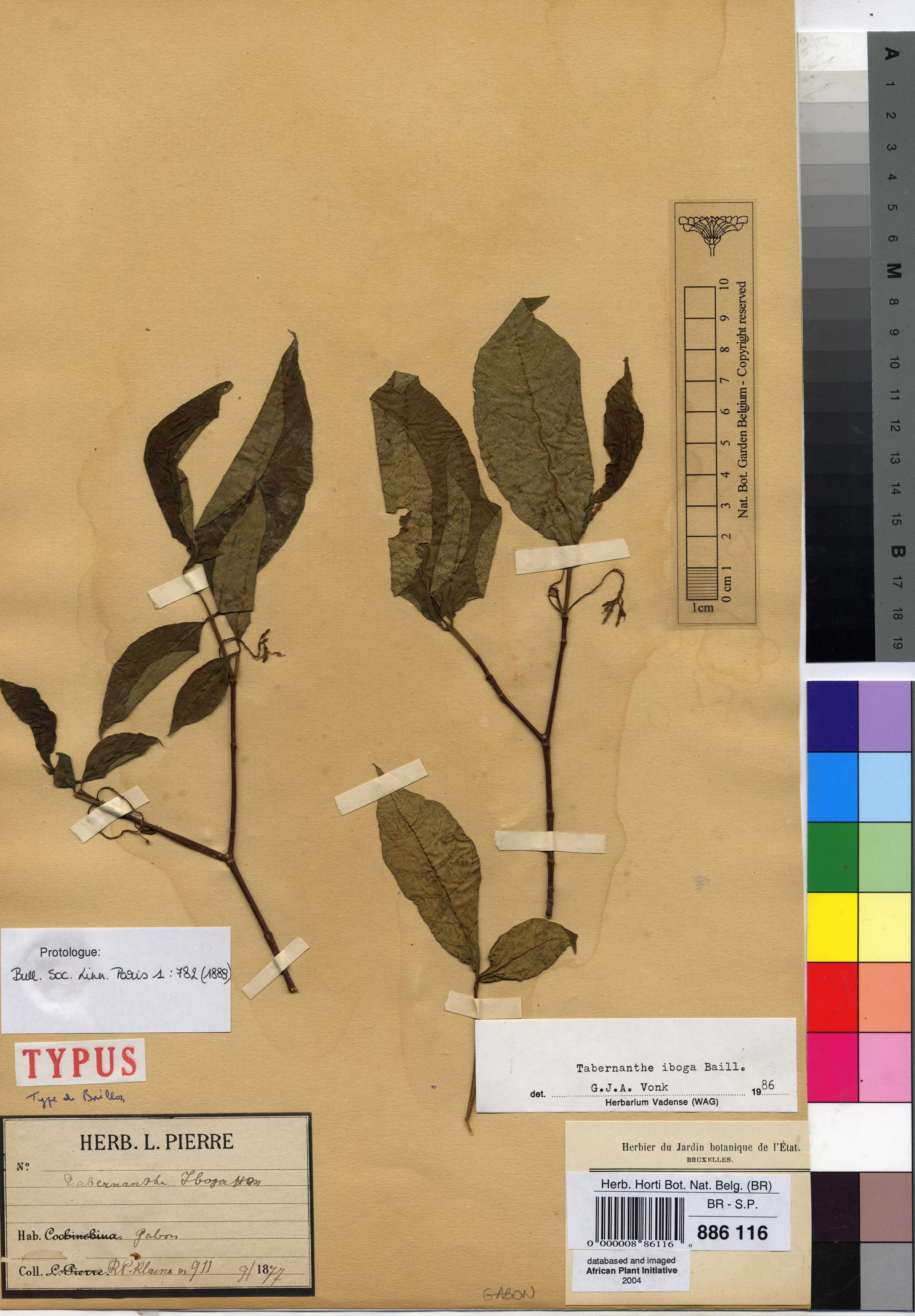 Enlarge
What “recorded” means, precisely
Biodiversity records are not plant counts, and the distinction matters here.
The global backbone holds 1,351 occurrence records for the species. By country: Gabon 489, the Democratic Republic of the Congo 417, Cameroon 46, Angola 43, Equatorial Guinea 34, Côte d’Ivoire 29 as a cultivated plant outside the native range, Congo 26, the Central African Republic 24, and Tanzania 4.
Those are herbarium sheets, observations and database entries accumulated over a century and a half. They tell you where botanists have been. They do not tell you how many plants exist, and nobody knows that number.
What the plant means where it grows
This page is deliberately botanical, and it would be a poor answer to the question if it stopped there.
Iboga is used in initiation in Bwiti practice in Gabon and neighbouring countries, and that use long predates any European description of the plant. The conservation assessment itself notes it, citing a paper from 1969.
We write about that tradition without speaking for it, and the pages that do so are reviewed by an initiating father in Gabon. Bwiti and the iboga tradition is where that belongs.
Where to go next
Tabernanthe iboga, the botanical profile has the taxonomy, the naming disputes and the database disagreements in full.
What ibogaine is covers the molecule, its isolation in 1901, and how it came to be in American federal statute.
Ibogaine and the heart is the page anyone considering taking any of this should read before the others.
Common questions
Sources
4 sources · How we source
More in The plant

Ibogamine and the Other Alkaloids of Iboga
What is ibogamine, how does it differ from ibogaine, and what have analyses found in iboga bark and extracts? A sourced look at the evidence and its limits.
Growing Iboga from Seed
Germination is slow, irregular, and fails once the seed coat dries. What the botanical record says, and where iboga is already farmed.